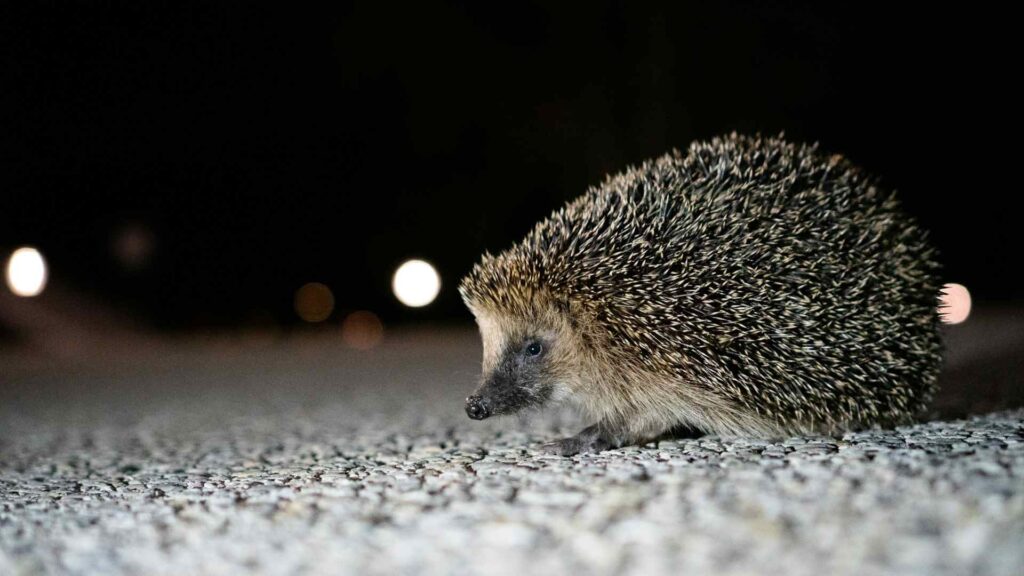
Small, nocturnal and familiar in European gardens, the hedgehog is also one of the wild animals that suffers most from the presence of cars. The European hedgehog(Erinaceus europaeus) was classified as“near threatened” by theInternational Union for Conservation of Nature in 2024. The decline of the species is linked to several factors: habitat loss, intensive agriculture, and land fragmentation. But among the most immediate causes of mortality remains road traffic.
According to some estimates, up to one in three hedgehogs die from being run over in certain areas. A figure that tells how modern infrastructure can become traps for slow-moving wildlife, especially at night.
New research could change the perspective, however, by harnessing a sensory capacity that had been almost ignored until now.
The hearing we didn’t expect
A study conducted by the Wildlife Conservation Research Unit of the University of Oxford and published in the journal Biology Letters has shown for the first time that hedgehogs can sense high-frequency ultrasound.
To test this hypothesis, the researchers analyzed the auditory brainstem response of 20 hedgehogs from wildlife rescue centers in Denmark. Through small electrodes affixed to the animals’ heads, the team recorded electrical signals emanating from the brain as different sounds were played.
The results indicate that hedgehogs respond at frequencies between 4 and 85 kilohertz, with particularly high sensitivity around 40 kHz. These are much higher frequencies than the limit of human hearing, which stops around 20 kHz.
An ear designed for high-pitched sounds
To understand how this is possible, the researchers also analyzed the structure of the hedgehog’s ear using high-resolution micro-tomography scans. The scans allowed them to build a detailed three-dimensional model of the auditory system.
It turns out that the bones of the middle ear are particularly small and dense, with a structure that makes the chain of ossicles more rigid and therefore more efficient in transmitting very high-pitched sounds. The stirrup-the smallest bone in the middle ear-also appears small and light, a feature that favors faster vibrations and transmission of high frequencies.
Together, these anatomical features explain why hedgehogs can perceive sounds that remain completely inaudible to us.
Warn hedgehogs before cars
The discovery now opens up a novel possibility for conservation of the species. If hedgehogs hear ultrasound, repellent acoustic devices could be designed that could alert them to the presence of an oncoming vehicle.
The idea the researchers are thinking about is to develop small ultrasonic devices to be installed on cars that can emit high-frequency signals when the vehicle approaches. Sounds inaudible to the human ear, but audible to hedgehogs, which could then move away from the road before the cars arrive.
According to biologist Sophie Lund Rasmussen, lead author of the study, the next step will be to work with the automotive industry to design and test prototypes of these systems. If they work, they could be integrated into vehicles or used in particularly sensitive areas for wildlife.
If they prove effective, they could significantly reduce one of the leading causes of mortality in the species. And perhaps teach that, to protect wildlife, sometimes all it takes is to learn to use languages that animals understand better than we do-the ones we cannot hear.