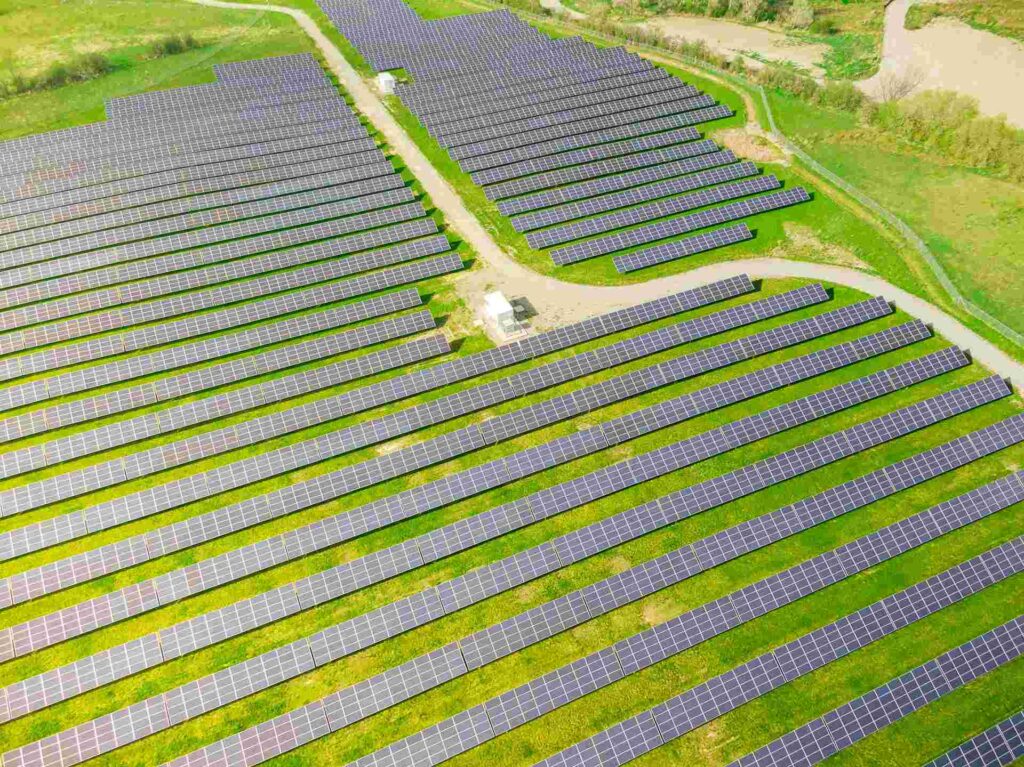
What connects the price of a shiny coin to the roof of a neighbor’s house? An invisible thread of precious metal:silver. As photovoltaics grinds out installation records, the metal that imprints its wafer-thin conductive tracks on cells has ignited a race that seems a paradox: more panels, more demand for silver, rising prices. But those very exaggerated prices are pushing the industry to use less and less of it. It is the spiral that holds speculation, technology and the energy transition together.
In the space of a year, silver has risen sharply: since late January it has touched $121.65/ounce and, while falling back in the weeks that followed, has remained at record high levels ($83-87 in futures), jumping 154 percent over the previous year and performing twice as well as gold. It is not just the work of speculators: about 60 percent of global consumption is industrial, and for the past decade solar has been the driving force. In 2025, solar manufacturers used about 6.1 million kilograms, 6 thousand tons: the equivalent of all the silver used in jewelry, accounting for nearly 17% of the market.
It is the best natural electrical conductor
Why it’s needed. Silver is the best natural electrical conductor: a screen-printed paste, printed in microtraces on the cells, collects and channels electrons. The new TOPCon technology, dominant today, requires more. But here the nonsense kicks in: precisely because silver costs money, modules have become “thrifty” at a truly remarkable rate. From 2011 to 2025, consumption per watt plummeted by 15 percent annually, from 73 to about 8 micrograms. And hybrid materials such as SCCP (silver-coated copper powder) cut between 30% and 50% silver with minimal losses in efficiency.
The price spike has opened up two very serious problems. The first is industrial: according to BloombergNEF , silver has come to weigh as much as 17-26% of the cost of a module, more than glass, aluminum and even polysilicon. With energy prices already volatile, many manufacturers-especially Chinese, which are more “silver-intensive”-have seen increasing economic problems: margins in the red by 2025 and a rush to “silver-free” solutions. Longi has announced substitution with base metals; Trina Solar is developing copper contact cells; Aiko is already producing silver-free cells (8.57 GW of capacity by mid-2025). Economic pressure, as is often the case, is stimulating research and innovation.
But technology drives savings
The second problem is a market one, and actually in the long run it may become an asset. If savings in use continue at this rate, demand for silver for solar would drop just as installations continue to grow: in 2035, with a third more panels, only a quarter of the silver used in 2025 would be needed. In parallel, other industrial uses would hardly make up the hole. The result: a future abundance that crushes prices.
Inside this expansion, silver remains a protagonist but loses centrality: the industry can do without it, and price spikes hasten its farewell. Paradox within a paradox: silver’s run is a signal that the PV boom is not over, indeed it is strengthening; and it is also the trigger that will make silver, before long, a less critical input. At least 80 percent of mines would remain profitable below $30 an ounce, and many also produce gold and copper, “hot” metals themselves.
A dynamic balance
Today about three-quarters of the world’s silver arrives as a by-product of zinc, lead, copper or gold deposits. These supplies are also in trouble. Lead and zinc mining peaked a decade ago, when lead-acid batteries were more common than lithium-ion cells for electric bicycles, and galvanized steel for construction in China was booming. Moral? The silver tracks printed on the cells tell of a dynamic balance: industrial demands rushing in, innovations subtracting grams, prices forcing choices. Each market shakeup-Shanghai futures above the spot, records and retracements-is an echo of factories rethinking recipes, of engineers mixing copper and expertise, of installers putting up miles of roofs.