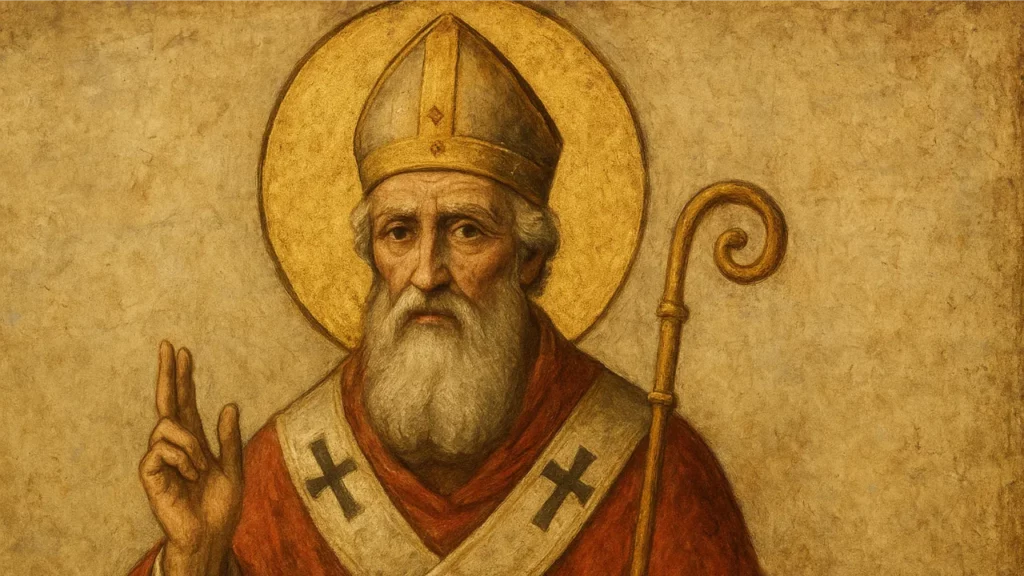
Before he became a global icon with reindeer, sleigh, and red coat, Santa Claus was a bishop. A flesh-and-blood man, he was born around 270 in Patara, a port in Lycia, in present-day Turkey, and died between 345 and 352. His name was Nicholas, he was bishop of Myra, and his name appears in the lists of participants at the Council of Nicaea in 325.
A slow, layered, centuries-long construction was grafted onto everything else. Historical records on Nicholas are few, but sufficient to place him accurately in time and space. The gap left by the sources has been filled by tales, legends and folk practices that have gradually transformed a bishop from Asia Minor into a familiar figure to children halfway around the world.
Gifts, children and a mediaeval pedagogy
Nicholas’ fame stems from specific episodes passed down through the centuries. The best known concerns three young women without dowries, whom their father was planning to start in prostitution. For three consecutive nights Nicholas threw sacks of gold into their home, allowing them to marry. Hence the idea of the nightly, anonymous gift, a central element in the modern figure of Santa Claus as well.
Another, harsher tale ties Nicolas to the children. Three boys are killed by an innkeeper and salted; Nicholas restores them to life. This story circulated mostly in medieval church schools, where the Feast of the Innocents was celebrated on December 28. On those days students elected a “bishop” who presided over the festivities and distributed gifts. From the 13th century, Dec. 6 became the day when children received gifts in the name of St. Nicholas.
From St. Nicholas to Santa Claus
In Protestant countries, with the Reformation, the figure of the saint lost the features of the Catholic bishop but retained the function of a benefactor. The name changed: Sinterklaas in the Netherlands, Samiklaus in the Germanic area. When European emigrants brought this tradition to America, the figure underwent a new transformation.
In 1822 a poem first described a Santa Claus travelling on a sleigh pulled by reindeer. The image was consolidated in the nineteenth and twentieth centuries: first with European Christmas cards, then with the iconography set in the 1930s by illustrator Haddon Sundblom for Coca-Cola, who codified the red and white suit. From then on, Santa Claus became a global character, disconnected from the December 6 date and permanently linked to Christmas.
Bones, relics and new questions
In the 11th century a good portion of Nicholas’ relics were brought to Bari; others ended up in Venice. In 1992, DNA analysis established that they belonged to the same person. In 2023, however, Turkish archaeologists identified an intact burial under the church of St. Nicholas in Demre that may be that of the bishop of Myra.
Thus, whilst Santa Claus continues to travel between publicity and collective imagination, St. Nicholas remains the subject of study, excavation and contention. A man, turned myth, who continues to move between documented history and popular narrative without ever ceasing to cause discussion.