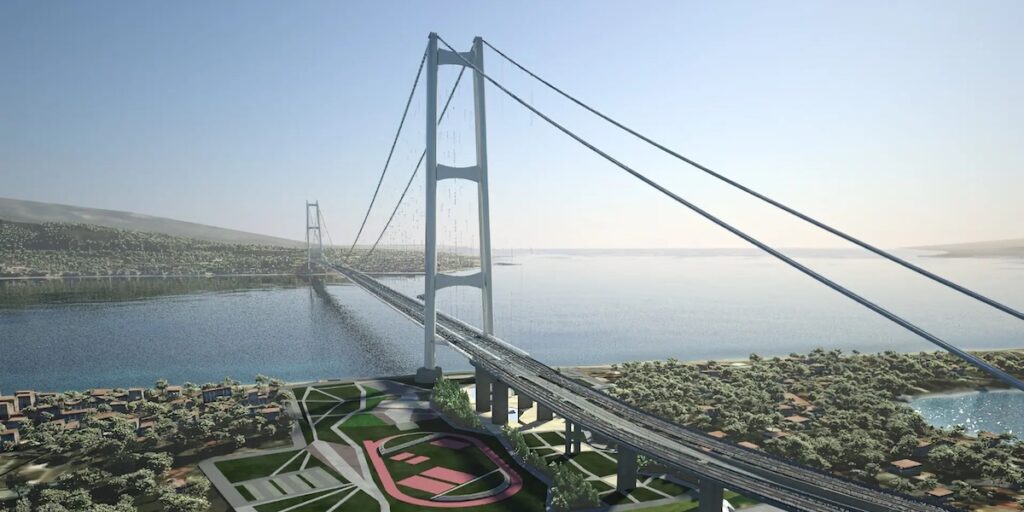
The road to the Strait Bridge is increasingly uphill. Science adds new elements of criticality that add to those already known. The latest geological studies, released in recent days, describe an even more articulated subsurface scenario than previously thought: not a single dominant fault, but a complex system of active tectonic structures crossing the Strait of Messina area.
The most recent research, based on advanced imaging and seismic techniques, indicates that the geodynamic framework of the sea arm between Sicily and Calabria is characterized by multiple interconnected faults, some capable of generating significant movements. It is an update that changes the weight of the variables at play. In other words: the ground on which one of Europe’s most ambitious infrastructures would rest is confirmed to be dynamic, irregular, and critical.
Not just earthquakes: a fragile balance
When one talks about the Straits, the thought immediately runs to seismic risk. And with good reason. The area is one of the most active in the Mediterranean, marked by devastating historical events such as the 1908 earthquake. But the issue does not end with tremors. Studies also point to possible seafloor instabilities, slow deformations of the crust, and complex behaviors of marine sediments, factors that directly affect design choices.
For a kilometer-long suspended structure, geology is not a technical detail but the very basis of safety. Each update of subsurface maps can result in structural reviews, additional verifications, more sophisticated simulations. Times that lengthen, costs that rise.
The critical issues that accumulate
The Bridge arises within a perimeter of complexities already known: high seismicity, intense winds, strong sea currents, ecosystems to be protected. Now an even more detailed geological snapshot is added to this list, reinforcing the idea of an extremely sensitive natural context.
It is not just a matter of engineering. The Straits areas are home to valuable marine and coastal habitats, ecological corridors, and unique environmental dynamics. Every major construction site involves profound transformations: materials handling, shoreline modifications, pressure on ecosystems. In an era marked by climate adaptation and biodiversity protection, the overall sustainability of the intervention inevitably returns to the center of the discussion.
Experts remind that the presence of active faults does not automatically imply that construction is impossible, but it requires the highest safety standards and a thorough understanding of the processes at work. So more data, more monitoring, more transparency. And above all, a willingness to accept that the nature of the site may impose more stringent technical and economic limits than expected.
Between vision and reality
The Strait Bridge continues to represent, for a part of the country, a symbol of modernization and territorial connection. But any revival of the project confronts a physical reality that does not bend to political deadlines. Geology, like climate, follows its own times.
Building in one of the most geologically complex contexts in Europe means accepting that scientific uncertainty is a structural element of the project. And at a time in history when infrastructure resilience and ecosystem protection have become non-negotiable priorities, the question remains suspended: will the Bridge be able to prove that it can withstand not only traffic, but also the weight of an area that continues to reveal all its extraordinary complexity?