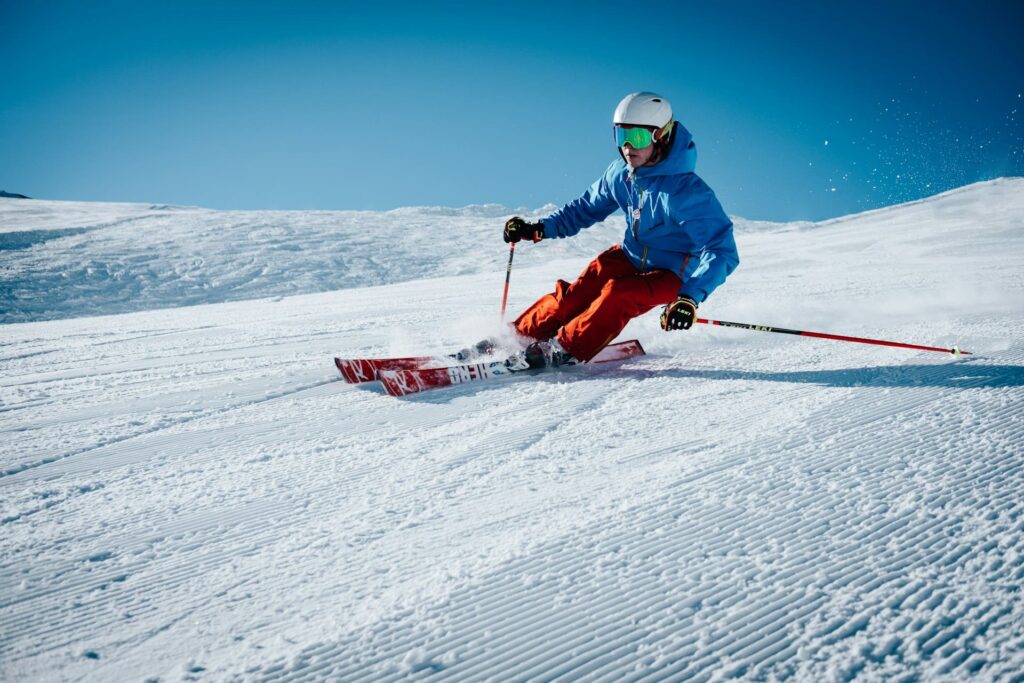
Skiing is not always as innocent as it appears. Beneath the patina of snow and silence, the sport leaves material traces that end up in the environment. Chemical waxes, plastic fragments, frequent maintenance. Invisible elements, but far from negligible, especially today when natural snow is increasingly rare and artificial slopes dominate the alpine landscape.
The first node concerns waxes. To improve glide, waxy substances have been used for years that, in some cases, contain fluorinated compounds such as Pfas, molecules that are persistent and almost impossible to eliminate. The International Ski Federation has banned their use in competitions, but outside of competition the picture remains fragmented.
The second problem is less well known but just as real: wear and tear on polyethylene slabs. With each descent, especially on artificial snow, the material wears away and fragments. Those particles end up in the soil and then in the water. Microplastics produced directly on the slope.
For the past 10 years, a research team led by physicist Paolo Ossi at the Politecnico di Milano has been working on a game-changing solution. The idea is to replace polyethylene with a stainless steel slab. Not a coating, but a unique, laser-machined plate with micro-incisions that adjust the thin film of water on which the ski slides. “Polyethylene performs excellently on natural snow, but it suffers greatly from the hard surfaces of modern slopes,” Ossi explained. “Wear and tear wears it down and fragments it: and those fragments end up in the environment.”
The most recent tests, conducted at Piani di Bobbio, show that performance is comparable to that of traditional skis, and in some cases better on artificial snow. The difference is in durability: steel holds up, does not release particles, and is not afraid of the overheating that can render a plastic base unusable. Entry into the competitive world will be slow, but the technology is ready.
While research is working on sliding, another innovation involves climbing. In Switzerland, startup e-outdoor has developed the E-Skimo, electric skis inspired by pedal-assisted bicycles. A motor drives a movable seal skin that helps the skier step by step. Sensors and a control unit adjust assistance based on slope and movement.
It is not traditional ski mountaineering, nor is it an effortless shortcut. “The effort remains,” explained founder Nicola Colombo, “but it becomes more accessible.” The idea is to open the mountain to those who remain excluded from it today, while reducing dependence on lifts and infrastructure.