For decades, the Aral Sea-the great salt lake of Central Asia-was considered one of the most obvious examples of human-induced environmental collapse. Today, something is changing in its northern basin: a series of infrastructure interventions, policy agreements and new rules on water use are enabling a gradual and measurable recovery.
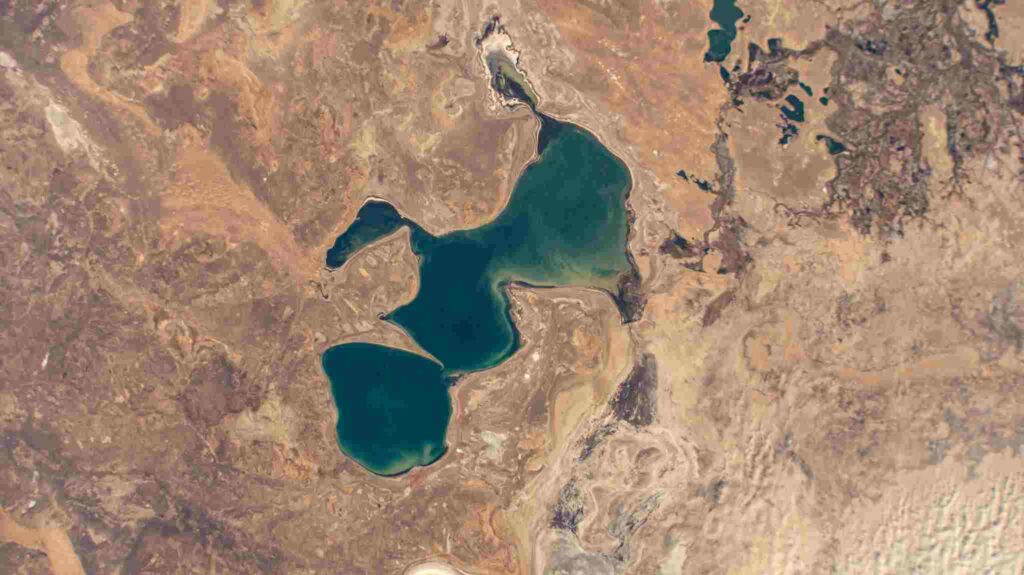
Since reaching its lowest point in the early 2000s, the northern Aral Sea in Kazakhstan’s territory has recovered about one-third of its lost water. Surface area has increased by 36 percent, water volume has nearly doubled, and salinity has halved. Numbers that tell of a turnaround after half a century of intensive exploitation.
The great detour
In the 1960s, the Soviet government decided to turn Central Asia into a giant cotton plantation. To irrigate ever larger fields, the waters of the Amu Darya and Syr Darya rivers were systematically diverted. The Aral Sea, which depended almost entirely on these inflows, thus began to recede.
Within a few decades it lost about 90 percent of its water mass, breaking up into four separate basins. Central Asia’s largest lake became a global case study of how the unwise use of resources can irreversibly alter environmental and social balances.
The dam that changed the course
The turning point came in 2005 with the construction of the Kokaral Dam, which separates the northern and southern basins. The work makes it possible to hold back the waters of the Syr Darya, encouraging the water level to rise in the northern part.
Added to this are new regional agreements between Kazakhstan, Uzbekistan, Kyrgyzstan, and Tajikistan for a more equitable distribution of water resources, and a comprehensive reform of Kazakhstan’s water policy. A dedicated ministry was established in 2023 with planning and control powers over irrigation.
According to official data, more than five billion cubic meters of water have been poured into the basin since 2023, bringing the total volume to more than 24 billion. The World Bank estimates that the current level is 50 percent higher than the all-time low.
Fishes, work, community
Rising waters have real effects on ecosystems and the local economy. Some 20 fish species that had disappeared for decades have reappeared in the Syr Darya delta. Today ten fish processing plants operate in the region, four of which are certified for export to the European Union.
Every year, between 4,000 and 5,000 tons of fish are shipped to thirteen countries. For communities hard hit by the environmental crisis, fishing has once again become a source of income and stability.
A fragile recovery
Despite progress, the situation remains delicate. Only the northern basin shows concrete signs of recovery. The southern Aral, in Uzbekistan, is now reduced to a salt desert, while the western and eastern sections have all but disappeared.
To curb the advance of Aralkum, the salt desert born on the drained lake bottom, Kazakhstan and Uzbekistan have initiated extensive reforestation programs: millions of seedlings have been planted on the drained lake bottom to limit the spread of toxic dust and salts.
The main threat, however, remains climate change. Most of the water that feeds the great Central Asian rivers comes from melting glaciers in the Tien Shan and Pamir Mountains, now rapidly receding. Should this natural reserve shrink dramatically, even the most ambitious policies are likely to fall short.
The slow revival of the northern Aral Sea shows that environmental destruction is not always irreversible. But it also teaches that recovery requires political vision, international cooperation and strict resource management. In an increasingly thirsty world, water once again becomes a strategic issue.