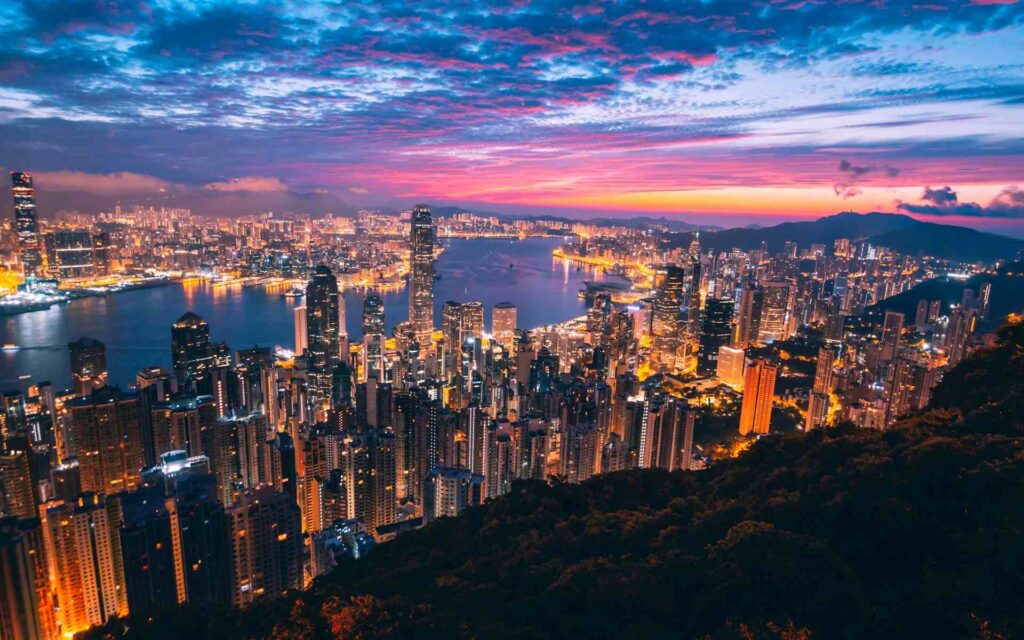
Behind the glass windows of the skyscrapers of Central, the financial district in Hong Kong, business is not just done with balance sheets and prospectuses. They have also always been looking for the right vibes, the ones that promise to channel luck and order into the inexplicable chaos of the markets. It is a city where the compass of the masters complements the algorithm of the traders, and where Feng Shui is as much a part of economic discourse as interest rates and profits.
Feng Shui, literally“wind and water,” is the Chinese practice that aims to harmonize people and places through the flow of qi, the life energy. In the tradition, orientation, shapes, colors and the relationship between mountains and water determine the balance of a site. Applied to spaces, it suggests entrances that “collect” energy, paths free of obstacles, proportions that promote stability. For moderns, it is an operational language: a codified way to transform perception, well-being and decision-making into a coherent environment. And that is why, in economics, many consider it a design system as well as a belief system.
The Four Pillars of Destiny
In an evening class atAdmiralty, suit-and-tie professionals thus study bagua (the “map” of feng shui, an eight-sector diagram used to read and organize space, time and qi flows) and bazi (also known as the Four Pillars of Destiny, it is a system of Chinese astrology that describes the “energy signature” of a person, event or entity, for example, a company, based on four temporal criteria: year, month, day and time of birth).
HKU SPACE‘s five-week Cantonese course at a continuing education school affiliated with the University of Hong Kong promises to analyze trends and investments with metaphysical tools. Which fate suits trading? Does the time of listing or the time of a company’s founding count? In the “period nine” of the Feng Shui cycle, the lecturers explain, earth loses vigor and fire – energy, technology – gains. Hence the recommendations: solid Chinese banks in the long view, ETFs on new energy.
The Lunar New Year
This mixture of esoterica and data is not new locally. Since 1992, the broker CLSA has been publishing the Feng Shui Index: a lunar New Year’s tradition that, with ironic tone but internal discipline, draws the year of the horse as being made up of “bond moves, quick spurts and sharp turns.” With Hang Seng in initial stumble, spring recovery, reversal in July, and backward step later. Talismans aside, the 2026 environment has already seen Asia on a strong run-a reminder that narrative and market often intersect.
In Hong Kong, feng shui is a subject taken very seriously. In the rest of China, the official line is different: the Beijing regulator has reiterated that analyses must be based on rigorous methods and data. Here, however, usage remains pragmatic. A finance professor who teaches feng shui does not talk about magic: he talks about internal morale, investor confidence, reputation. And in an asset class like cryptocurrencies, where fundamentals are unclear, there are those who claim to prefer astral maps to cash flow models. More symbolic compass than theory, but the need for anchorage is real.
One only has to look up in the HK skyline to understand its weight. The sharp, angled lines of architect I.M. Pei’s Bank of China Tower building, built in 1990 – considered aggressive – triggered decades of countermeasures by HSBC to protect its skyscraper designed by Norman Foster in 1985. In classical Feng Shui, dry, angled lines pointed at another building are considered harbingers of destructive energy. HSBC spent hundreds of millions of Hong Kong dollars on countermeasures: it placed two useless loading cranes on the roof, which are actually magic “cannons” pointed at its neighbor. BoC responded with water: tanks and waterfalls to put out the “fire” of the cannons. Between the two litigants, Standard Chartered bank chose a different mystical strategy for its building: soft profile, reflective facade, facing the harbor to accumulate the positive energy of water (which means cash flow).