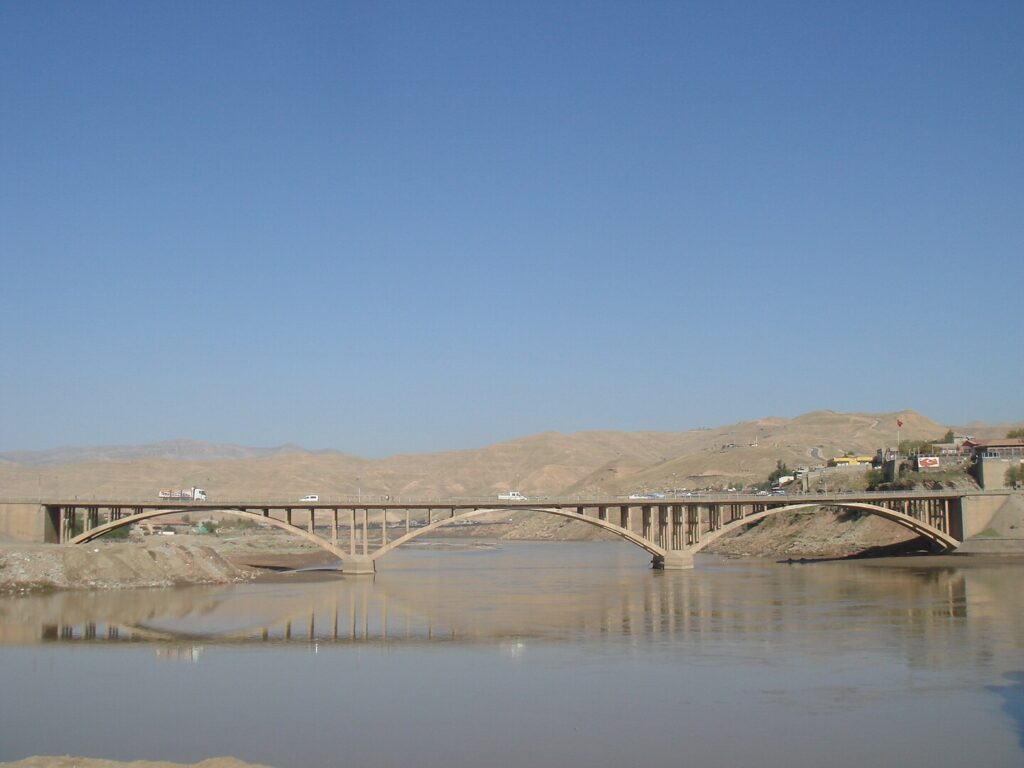
Along the banks of the Tigris there is a point where water is a condition of existence. For Sheikh Nidham Kreidi al-Sabahi, religious leader of the Mandeans (one of the oldest Gnostic religions in the world, reduced in Iraq to 10,000 people), drinking from a flowing river is not a choice: it is a spiritual obligation.“No water, no life,” he tells the Guardian, reminding the Guardian that water is as important to his community as air. The problem is that the Tigris, today, is flowing with an increasingly reduced flow.
The great Mesopotamian river, which rises in Turkey and flows through Iraq until it joins the Euphrates, is both an ecological backbone and a living archive of human history. Organised agriculture, writing, and the wheel were born on its shores. Today some 18 million Iraqis depend directly on its waters for drinking, irrigation, power generation. Yet the Tigris is sick: polluted, depleted, fragmented by dams and management that can no longer withstand the combined pressures of conflict, poor governance and climate crisis.
According to The Guardian reconstruction, the deterioration is not sudden. Iraq’s water infrastructure, once amongst the most advanced in the region, was hit during the 1991 U.S. military Operation Desert Storm , which also targeted strategic civilian facilities. Since then, destroyed and never fully rebuilt sewage treatment plants have allowed sewage, industrial waste, agricultural and sanitary residues to end up in rivers. Today only 30 per cent of urban households are connected to a wastewater treatment system; in rural areas it drops to 1.7 per cent. As a result, more than 118,000 people ended up in the hospital in Basra in 2018 after drinking contaminated water.
The loss of quality is compounded by the loss of quantity. In 30 years, the flow of the Tigris into Baghdad has been reduced by about one-third, largely due to large dams built upstream in Turkey and detour by Iran on shared waterways. Within Iraq, agriculture absorbs at least 85 per cent of surface water, often with inefficient irrigation systems. The result is an increasingly shallow river: last summer, in some stretches, it could be crossed on foot.
The climate crisis amplifies everything. Rainfall is down by about 30 per cent, and the country is experiencing its worst drought in almost a century. Less water also means more concentration of pollutants, as Salman Khairalla, founder of the NGO Humat Dijlah, notes: water quality depends on its quantity.
In an effort to stem the collapse, Baghdad and Ankara in November signed a cooperation mechanism on irrigation, pollution control and water governance, financed with Iraqi oil funds. The government called it “historic.” Critics and experts, however, speak of a non-transparent, non-binding and politically expedient agreement, signed on the heels of elections.
Meanwhile, along the Tigris, time is running out. For the Mandeans, running water is necessary for every passage of life, from birth to death.