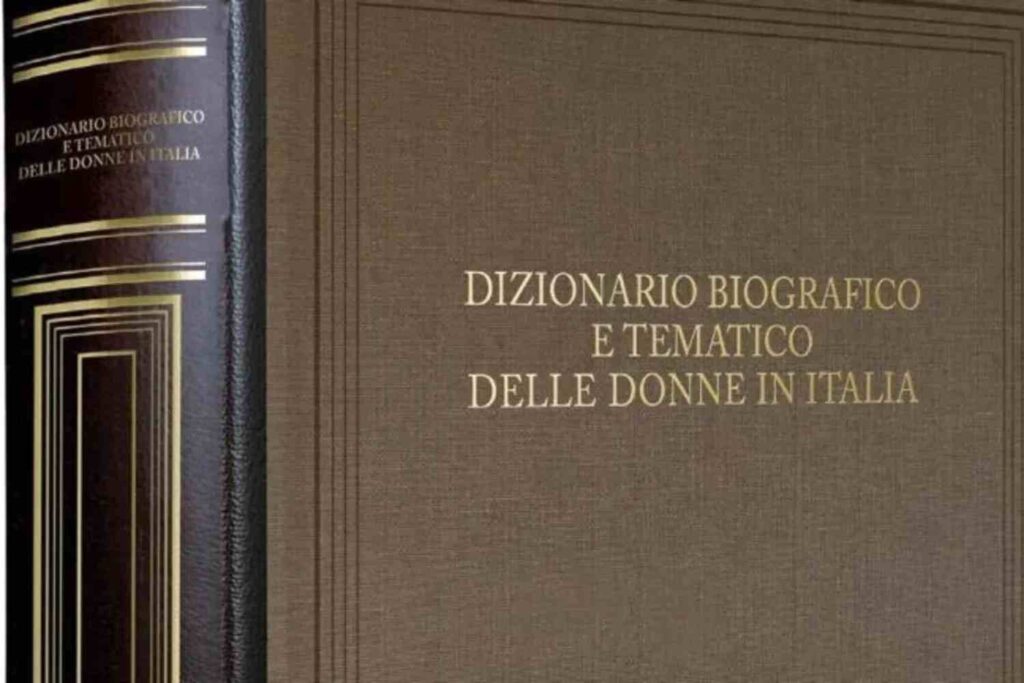
National history, as we have studied it, has often had an implicit subject: male. Now the Treccani Institute of the Italian Encyclopedia tries to change the perspective with the Biographical and Thematic Dictionary of Women in Italy, a work in three volumes, more than 2,500 pages and 650 profiles spanning more than three centuries.
Directed by Emma Giammattei, the project covers a chronological span from the 18th century to the first decades of the 21st century in a self-contained work that rereads the Italian story through women’s trajectories: culture, politics, science, art, sports, business.
A historical map
The layout is twofold: alongside biographical profiles, thematic essays delve into crucial nodes of women’s history and gender history. From eighteenth-century emancipation movements to their presence in the Risorgimento and Fascism, from journalism to entrepreneurship between the nineteenth and twentieth centuries, to environmental battles and labor transformations in the twenty-first century.
The stated goal is to reconstruct a historical and geographical network: women born in Italy or otherwise significantly connected to the country, placed in their social, economic and political context. The first volume (1700-1918) follows the formation of women’s consciousness throughout the modern and liberal ages; the second (1919-1989) traverses dictatorships, wars and reconstruction; the third (1990-2025) enters the contemporary, amidst plurality of paths and new inequalities.
From science to activism
Among the best-known figures is Rita Levi-Montalcini, to whom the work is dedicated: scientist and Nobel laureate, a symbol of a career built despite racial laws and prejudice. Alongside her appear protagonists of culture and entertainment such as Maria Callas, Fernanda Pivano and Anna Marchesini, historical figures such as Anita Garibaldi and Paolina Bonaparte, to recent voices such as Michela Murgia.
The perimeter includes conflict, marginalization, gender-based violence, and structural obstacles. In the background remains the issue of women’s work, persistent discrimination, and new forms of public exposure.
The image as a document
A distinctive element is the iconographic system: photographs, portraits and documents dialogue with the texts and become an integral part of the historical argument. A source that restores presence and materiality to biographies.
“Matilda Effect,” the audio version.
The release of the dictionary is accompanied by the podcast “Effetto Matilda,” produced by Edulia for Treccani and available from March 8 on major platforms. Ten episodes, hosted by Sofia Assante, delve into some of the protagonists, with a final episode in dialogue with the science director.
The title recalls the “Matilda effect,” an expression used to denote the systematic underestimation of women’s contributions in science and culture. In this case it becomes an invitation to reconsider the entire national memory. A different angle from which to look at Italian history.