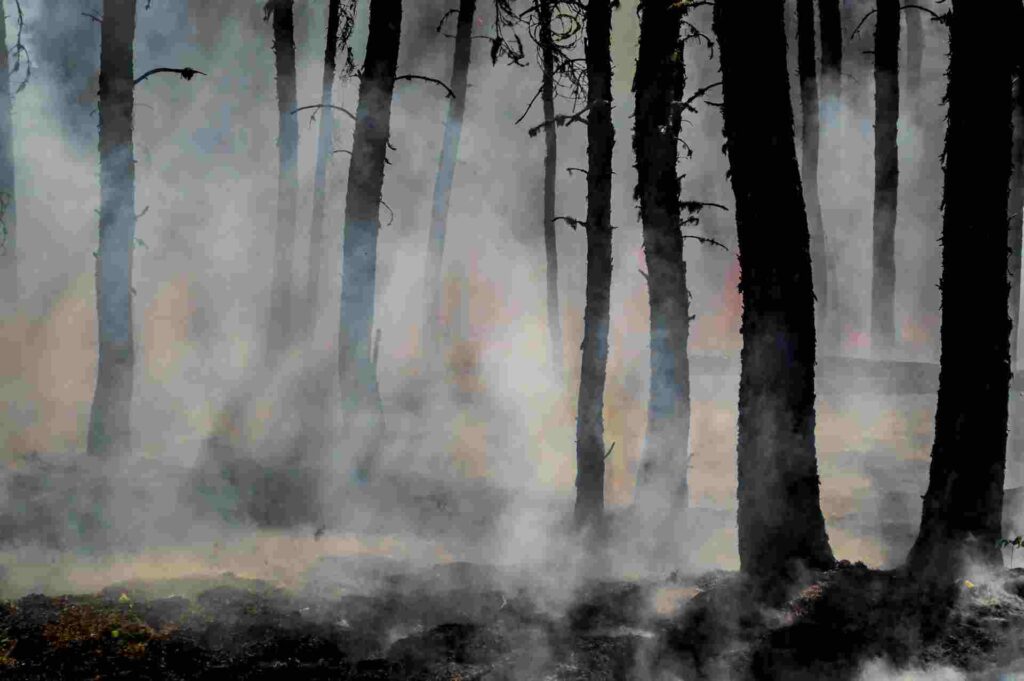
In recent decades, our Planet has put together a weather cocktail perfect for wildfires: higher temperatures, drier air and soil, and stronger winds. The consequence is that the number of days when the weather is potentially conducive to the ignition and rapid spread of forest fires has nearly tripled on a global scale over the past 45 years. This is revealed in a new study published in Science Advances that analyzed climate data from 1979 to 2024 and compared it to a hypothetical scenario in which human-induced climate warming had not occurred.
The key concept is “fire-prone weather“-conditions in which intense heat, very low humidity, and winds strong enough to turn dry vegetation-covered land into a veritable tinderbox. When these ingredients occur simultaneously in multiple areas of the planet over the course of a few days, scientists speak of“synchronous fire weather days“-a situation that makes fire management even more difficult because all affected regions require response resources at the same time.
From the last century to the present: a worrying leap
In the first half of the period analyzed-between 1979 and 1984-the average annual number of these days was about 22. By 2023 and 2024 it has risen above 60, practically almost three times as many. In some regions, the increase is even more pronounced: in the continental United States, for example, it has gone from an average of about 8 days per year in the 1980s to nearly 40 in the last decade. In the American South, the trend is even more dramatic, with more than 70 days of “potential fire” per year and a peak of 118 in 2023.
This does not mean that there are more fires per se on any single day than these conditions-because a fire also needs fuel (vegetation) and a spark (which can come from lightning, human error, or other causes) to start. However, it indicates that the probability of severe events has increased substantially, precisely because the weather “canvas” has become increasingly favorable to fire.
The role of the climate crisis
A central focus of the research is quantifying the role of the climate crisis. Using computer simulations comparing the actual climate of recent decades with a theoretical climate devoid of the increase in greenhouse gases caused by human activities, the authors estimate that more than 60 percent of the increase in days of favorable fire conditions is attributable to the influence of global warming, mainly due to the use of fossil fuels such as coal, oil and natural gas.
The increase in days with favorable fire conditions puts pressure on fire prevention and firefighting systems, which, especially when many areas are affected at the same time, risk not having sufficient resources-personnel, aircraft, equipment-to intervene everywhere. This phenomenon, referred to by experts as synchronous fireweather, can turn local fire seasons into global crises.
Second, longer climatic periods with these conditions can lengthen the risk seasons. Parallel studies indicate that, in many areas, the fire season has extended by several weeks longer than in the past, contributing to an increase in the average area burned.
For countries like Italy, embedded in the Mediterranean region, this trend is doubly worrisome. The Mediterranean is considered one of the hot spots of climate change, with faster-than-global-average warming and prolonged periods of drought drying out soil and vegetation, making forests and woodlands more vulnerable to wildfires.
These findings connect to concrete phenomena observed in recent years, such as record wildfires in different parts of the world, from the western United States to Australia and southern Europe. And as the scientific community continues to analyze and predict future scenarios, the most pressing question remains open: how do we adapt our land management and fire response systems to minimize the impacts of the new climate normality?