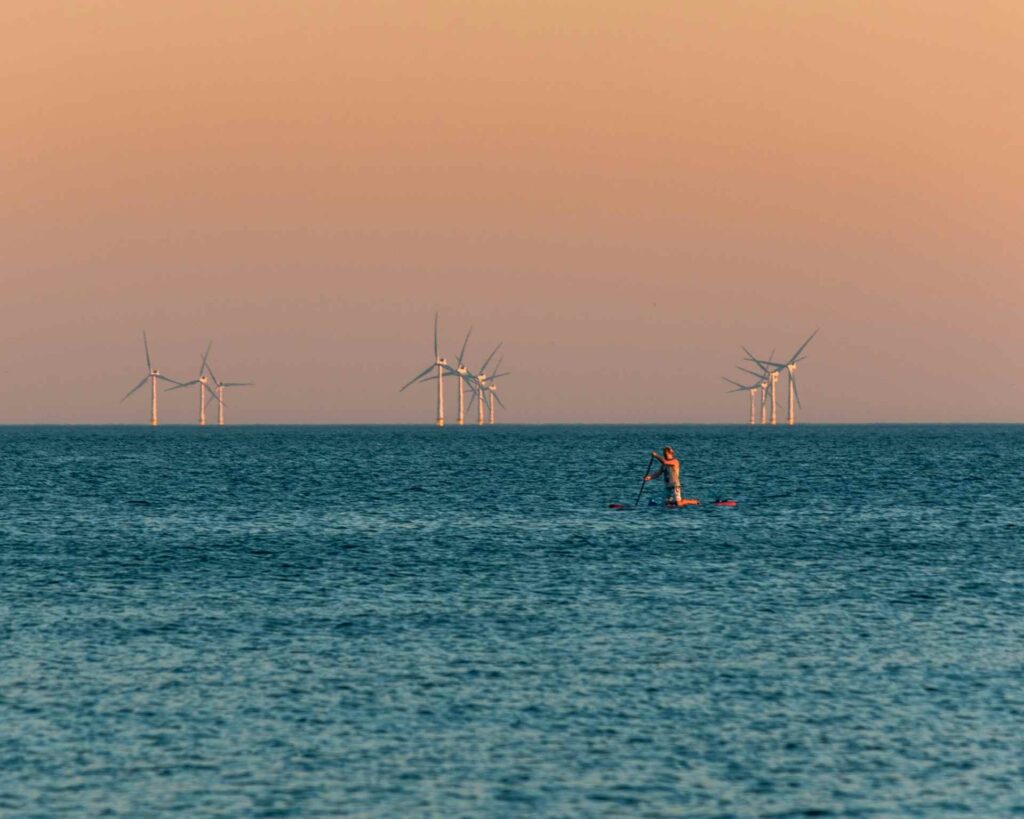
In order to stop wind power and support fossil fuels Trump is willing to throw away a billion dollars in one fell swoop. The federal government has decided to reimburse about $928 million to the French company TotalEnergies to cancel two large offshore wind projects along the East Coast between New York and North Carolina.
The projects covered two areas awarded by the Biden administration in 2022, and had a combined capacity of more than 4 gigawatts. The government decided to cancel the concessions and return to the company almost in full what it paid to acquire them. In return, TotalEnergies committed to stop developing offshore wind in the United States and to reinvest the same amount in oil and a large liquefied natural gas terminal in Texas.
It is another step in the White House’s path aimed at stopping clean energy and paving the way for the worsening climate crisis.
An explicit policy line
The Trump administration has always had a hostile attitude toward wind power, judging it-contradicting the economic assessments of experts from international organizations-expensive and inefficient. Now comes the news: the jump in the scale of the attack. The White House no longer merely slows down projects, but goes so far as to pay for their cancellation.
The result is a reversal of U.S. energy policy: public resources that, instead of accelerating the transition, are being used to dismantle investments that have already begun.
However, this does not mean that renewables in the United States have come to a standstill. The picture is mixed. Some offshore wind projects already under construction have not been stopped, in part because attempts to block them have been rejected in court.
And on the broader renewables front-especially onshore solar and wind-growth remains driven by economic factors: falling costs, rising electricity demand, and the need for new generating capacity.
The point is that federal policy is creating a climate of high uncertainty. Many investors have slowed or frozen new projects, especially offshore, where timelines are long and regulatory risk weighs heaviest. During the Biden administration, offshore wind was one of the pillars of America’s climate strategy, with billion-dollar auctions and very ambitious targets along the Atlantic coast. Today that supply chain is being scaled back: not completely zeroed out, but made more fragile. Some states, such as New York and New Jersey, continue to support the projects, but with the White House rowing in the opposite direction, the path becomes more complex.
The economic and geopolitical node
Behind the U.S. administration’s move is an economic and geopolitical choice: a willingness to sink the blow against renewables in order to defend fossil fuel primacy at all costs. And it is doing so now because the global energy crisis and the war unleashed by Trump and Netanyahu against Iran have created an oil and gas supply deficit that is bound to last for a not short time. Against this backdrop, the White House wants to strengthen its attempt to enforce, by threatening tariff escalation, the role of the United States as an exporter of fossil fuels to Europe and Asia.
But it is not certain that the outcome will be what Trump wants. His popularity is plummeting in the United States, and there is a growing push in Europe not to be blackmailed. Moreover, while Washington slows on offshore wind, other areas of the world-Europe and China in the lead-continue to accelerate. The energy game is moving toward unprecedented scenarios, but they may not necessarily please Trump.