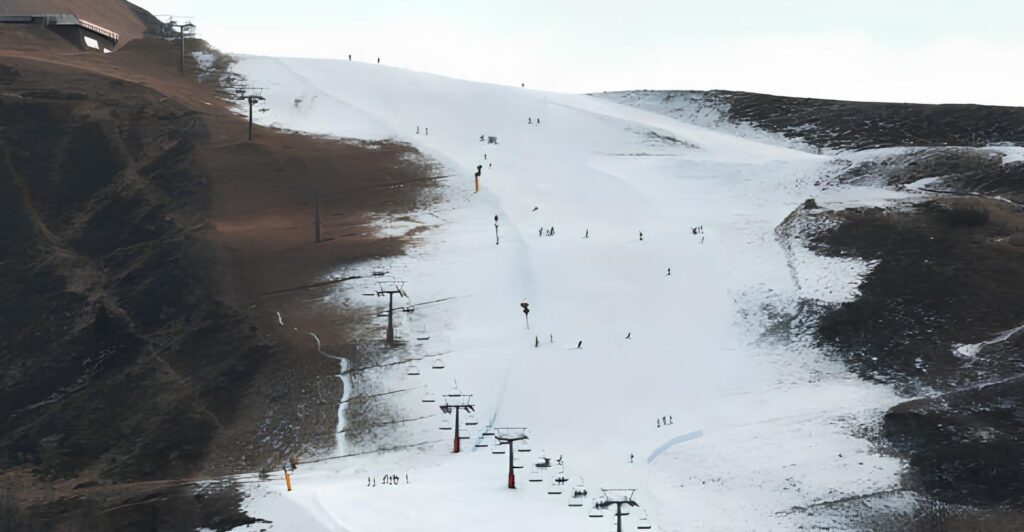
Not just oil. The war against Iran revolves – in line with the types of conflict favored by Trump – around fossil fuels; but an unexpected card has emerged from the war scenario: water. In one of the driest regions of the Planet, the water supply depends largely on large desalination plants that turn seawater into drinking water. A costly procedure both from an energy and environmental point of view (due to the impact on the seabed of concentrated brine discharges). But this is the least of the problems for regimes like that of Moḥammad bin Salmān, who had planned a ski resort in Saudi Arabia.
The issue that seems to have been overlooked by the sheikhs is security. In recent days some strategic water infrastructure has come under the crosshairs. The most cited case involves Bahrain: the government accused Iran of drone strikes on a plant related to the production of desalinated water. The plant is part of the network that supplies the capital Manama and surrounding urban areas, in a country that gets almost all of its drinking water from the sea.
A second incident involves the island of Qeshm in southern Iran, where Iranian authorities have reported an attack on a desalination plant that supplies several coastal communities. According to Tehran, the bombing hit a facility that provides drinking water to several dozen villages on the island, temporarily disrupting service.
Damage to the water system is currently limited, but the attacks show critical vulnerability. Many facilities in the Gulf produce tens or hundreds of thousands of cubic meters of water per day, supplying entire urban areas. The fact that they have become military targets marks a major shift in the conflict. Striking a desalination plant is not just about damaging an industrial infrastructure, but putting at risk the availability of water for hundreds of thousands of people in a region where natural fresh water is almost nonexistent. In the event of attacks or power outages, drinking water production could come to a rapid halt.
In fact, the Arabian Peninsula is one of the least naturally available areas of fresh water in the world. Precipitation is very low, permanent waterways virtually nonexistent, and many underground aquifers have been intensively exploited for decades. To support urban and economic growth, the Gulf countries have therefore turned to a technological solution: producing fresh water from the sea. Today, desalination is the mainstay of the regional water system. In countries such as Kuwait, Oman, and Qatar 80 to 99 percent of drinking water comes from desalination plants. This means that millions of people drink water daily that only a few hours before was seawater.
The Persian Gulf today represents the global center of this technology. Countries in the area supply about 40 percent of the Planet’s desalinated water. Saudi Arabia is the main producer, with giant industrial complexes on the Red Sea and Gulf coasts. The United Arab Emirates, Qatar, and Oman are also investing billions of dollars in new and increasingly efficient plants. The plants must be built along the coast and are often concentrated in a few large industrial hubs. Many are connected directly to power plants because desalination requires huge amounts of energy. If energy stops, water production also stops.
Making the system even more delicate is the level of consumption. In Gulf countries, water is often heavily subsidized by governments, which do not have water efficiency among their priorities. Average consumption exceeds 550 liters per person per day, more than triple the world average of 180 liters. Demand is fueled by a very intensive urban development pattern: large desert cities, tourist resorts, golf courses and sports infrastructure that require huge amounts of water.
Now this system is at risk. The war for oil may thirst the Gulf.