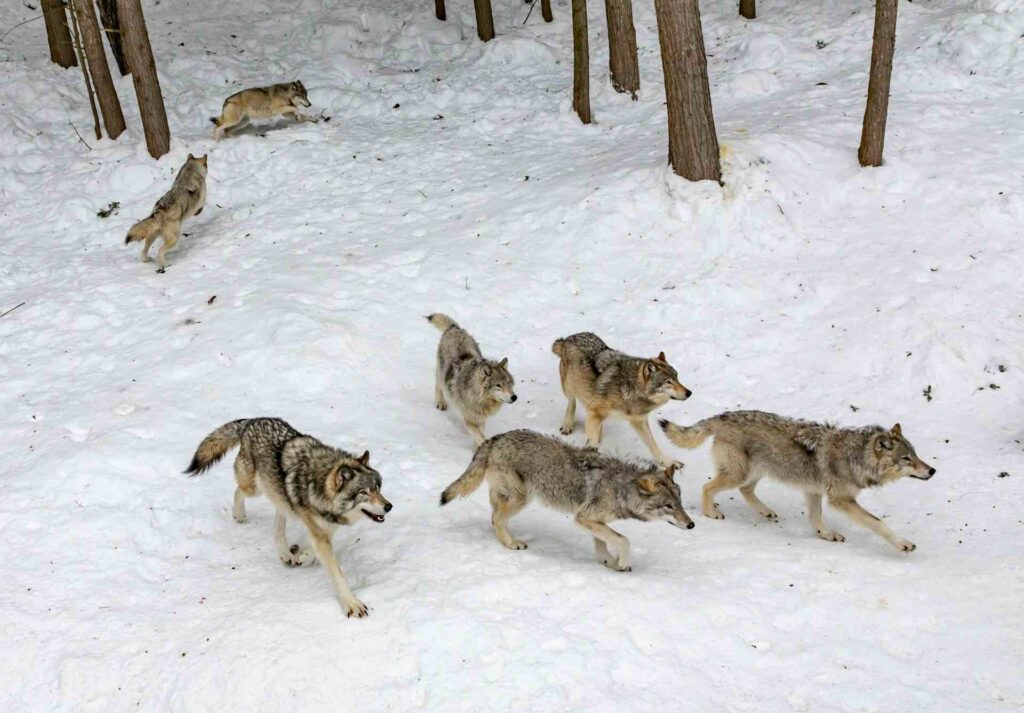
The Scandinavian forest seems motionless, but on the ice something moves. A long, elastic shadow crosses the frozen expanse without hesitation. Steady step, straight trajectory. It is not a gamble: it is strategy. When winter seals lakes and rivers under a solid sheet, wolves do not avoid them. They choose them. Telling the tale are thousands of bright spots on a digital map: more than 50,000 GPS locations collected between 2001 and 2023, tracking 71 adult wolves in 44 territories between Sweden and Norway. A massive archive that allowed researchers to observe, with almost surgical precision, how predator movement changes during periods of stable ice.
The result, published in Animal Behaviour, overturns a common intuition. Water, normally an ecological barrier, changes function in winter. Where there used to be a boundary, a corridor appears. The data show that wolves actively select frozen surfaces and do so especially at night.
Walking in deep snow does indeed cost energy. Every step sinks, every stride requires more effort. Ice, on the other hand, offers a compact, smooth, unobstructed surface. Satellite tracks confirm this: when traveling on ice, wolves travel longer distances with more linear trajectories. Fewer detours, less zig-zagging, more efficiency. In practice, the frozen lake functions as a natural road, similar to the forest tracks that wolves already use to move quickly across vast territories.
The choice of nighttime hours adds another piece. At night it decreases the likelihood of encounters with humans and anthropogenic activities. This is consistent with what has been observed in many European populations: wolves modulate timing and routes to reduce risk. The ice, in the dark hours, becomes an ideal space: open, predictable, uncrowded. A silent highway in the heart of winter.
The most fascinating fact concerns precisely this seasonal metamorphosis of the landscape. A lake divides habitats, interrupts land trajectories, forces detours. When it freezes, it unites. Geography is rewritten, and wolves show that they can read and exploit this change with surprising precision. These are not occasional crossings, but a recurring strategy, observed in different years, territories and individuals.
An interpreter of the environment
The research, led by Wessel Veenbrink, thus adds a new layer to the understanding of wolf ecology. Not just a predator flexible in diet or social structure, but a highly skilled interpreter of the environment. Able to transform an extreme condition – frozen water – into a resource of mobility.
Certainly in a changing climate, shorter winters and less stable ice could reduce these natural corridors, altering movements, spatial dynamics, and potential interactions with humans. Indirect effects, but far from marginal.