His name is Erminio. EUMETNET, the organization that groups 31 European weather services, christened it so, and it is the third Mediterranean cyclone in just two weeks to hit Italy. A depressional vortex that was notable for its slow evolution, remaining stationary over the same area for dozens of hours. It rained nonstop for more than 60 hours between Abruzzo and Molise, with snow accumulations exceeding two meters in some areas.
At its peak, the center of the cyclone was located in the heart of southern Sicily, where pressure plummeted to very low values for the Mediterranean. The storm battered the south-central region, causing torrential rains in the mid- and lower-Adriatic regions, with encroachment into the inland areas of the Apennines and widespread bad weather throughout the south.
The picture that emerged is striking in its magnitude. More than 14 rivers flooded invading towns and countryside, with heavy disruptions to the road system. Blocked roads and trains have isolated entire communities. At the same time, at higher elevations, the Apennines were overwhelmed by historic snowfall-an unprecedented event for early April-with fresh snow accumulations exceeding one meter in many mountain locations.
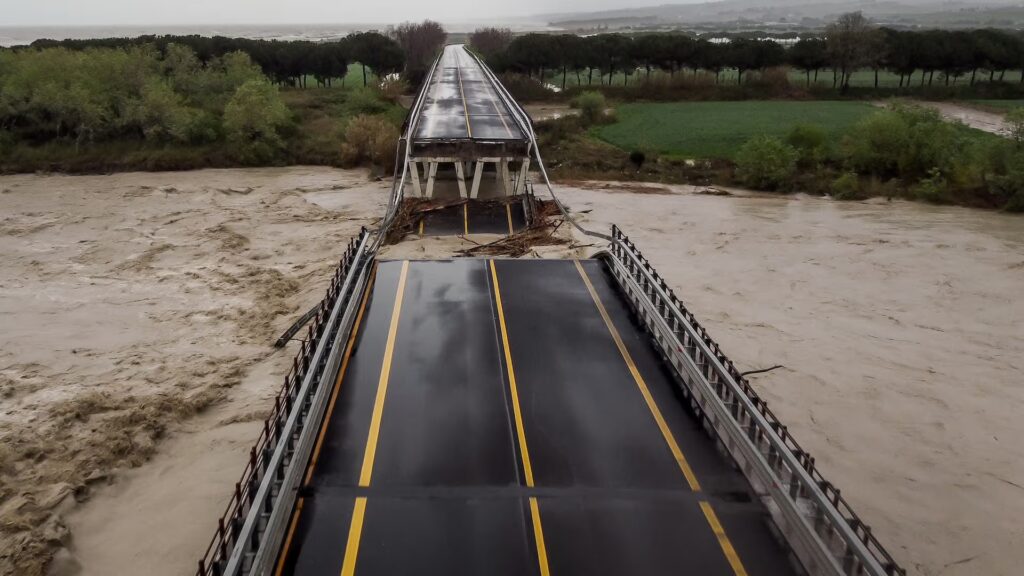
Since midnight March 31, firefighters have completed more than 800 interventions between Abruzzo, Molise and Puglia: 337 rescued in Abruzzo, in the hardest-hit provinces of Pescara and Chieti, and 218 in Molise. In Chieti, 14 people were evacuated from a home threatened by a landslide. In Molise, the bridge over the Trigno River along State Highway 16 Adriatica collapsed, disrupting all road connections with Abruzzo.
In 15 years 794 events: the numbers of the crisis
To understand Erminio, however, it is not enough to read emergency bulletins. One has to look at the long-term numbers that Legambiente has collected in its CittàClima Observatory. From 2011 to the end of March 2026, in the Adriatic regions – Marche, Abruzzo, Molise and Puglia – and in the southern regions – Calabria, Sicily and Sardinia – there have been 794 extreme weather events that have caused damage to the territory. Floods, hailstorms, winds, overflows, storm surges, damage to historical and cultural heritage: a rosary of disasters that grows longer each year.
Stefano Ciafani, national president of Legambiente, does not mince words: “The state of emergency requested for Abruzzo and Molise and the critical situation also in other regions of the Peninsula with flooding rivers, record snowfall, landslides and isolated villages, the collapse of the bridge over the Trigno River and the subsidence of several roads in Apulia show us once again how unprepared Italy is to deal with, manage and prevent the climate crisis, which year after year becomes more and more intense and with increasingly impactful effects on the territories, putting people’s lives and the country’s economy at risk.”
The Mediterranean as a laboratory of the extreme
Erminio is not just an Italian phenomenon. The magnitude of this disturbing system has literally disrupted Europe and North Africa, redrawing seasonal climate boundaries in this early April 2026. On the one hand frost and snow in the Algerian desert, on the other flash floods in southern Italy, and finally Saharan dust in the Hellenic sector.
All of this is an expression of a climate destabilization that starts way back. The Mediterranean has for decades been identified by scientists as one of the planet’s climate “hot spots”: an area particularly vulnerable to ongoing changes, where disturbances tend to intensify and extreme events to become more frequent and violent.
The Italian paradox is that the tools to respond exist, at least on paper. The National Climate Change Adaptation Plan, the PNACC, was finally approved in December 2023 by the Ministry of the Environment. But it has no resources of its own. The text stipulates that it is up to individual administrations to search through direct and indirect funds for money to implement adaptation measures. Nor is specific funding provided in the budget law passed in October 2023.
In fact, the PNACC, two years after its approval, was still at a standstill. Only with a ministerial decree of Dec. 16, 2025, published in the Official Gazette on Jan. 15, 2026, did the first steps begin to be taken, with the establishment of the National Observatory for Climate Change Adaptation at the Ministry of Environment.
This is why Ciafani returns to call on the Meloni government “to work to define as soon as possible a national strategy for prevention with effective mitigation and adaptation policies that can no longer be postponed, starting with the allocation of resources to implement the PNACC, which to date continues to remain a plan only on paper and which the government, after its approval, seems to have totally forgotten about.”
The issue of collapsed bridges becomes a symbol of the country’s structural neglect: the association calls for a comprehensive survey of national infrastructure with a related safety plan, recovering resources from those already allocated for the Strait of Messina Bridge.