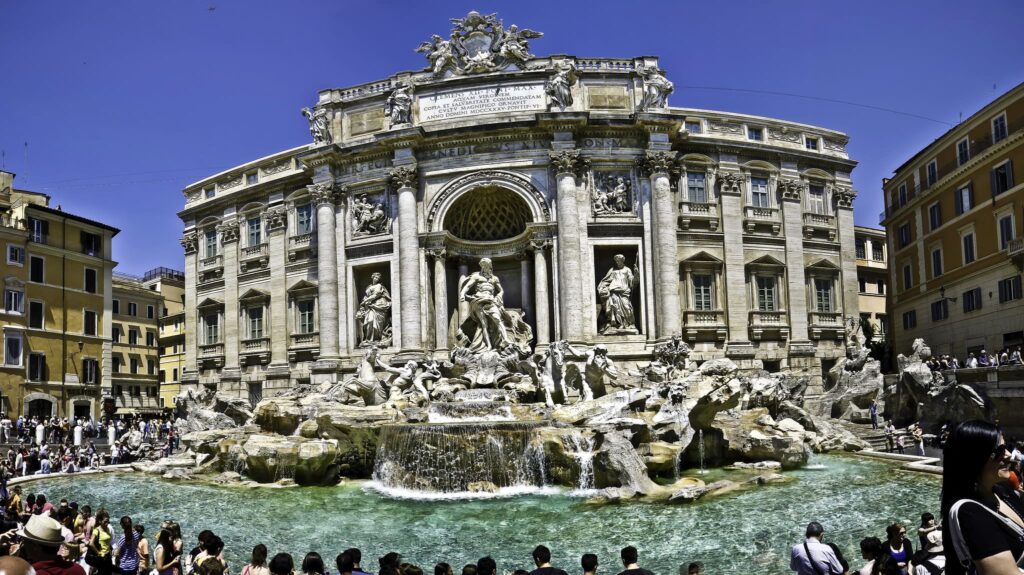
Two euros to go down the steps of the Trevi Fountain. To cross it without jostling and with a little more time on your hands. From January 7, according to a report in Corriere della Sera, the restricted access introduced after the 2024 works could be enriched with a ticket reserved for tourists; for Roman residents it will remain free. A measure that would intervene on one of the most sensitive nodes ofurban overtourism: the intensive use of a fragile, open, symbolic space.
Confirmation (or denial) from the city will follow a press conference, scheduled no earlier than Thursday, 18 December
The numbers driving the choice
The numbers explain the context. In the first six months of 2025 alone, the Fountain recorded 5.3 million visitors; by the end of the year it could exceed 11 million. Hence the estimate of a possible revenue of about 20 million euros, indicated by the Corriere. These are resources that the Capitol would allocate to management, maintenance, and, more generally, to the quality of the tourist experience, as is already the case with the tourist tax.
The new arrangement includes two separate lanes, delimited by brass posts, one for Romans and one for visitors, electronic payment, and an unchanged limit of 400 people at a time. The logic is the same as that pioneered at the Pantheon since 2023: more orderly access (and upon payment of 5 euros), less pressure on the monument, more control. With one major difference: the Trevi Fountain is not a building, but a square. Regulating an open place means intervening in public space.
Between universal access and carrying capacity
This is where the debate becomes most interesting. On the one hand, the argument of universal accessibility: a global icon should remain freely usable. On the other, the empirical observation of permanent overcrowding that makes visiting quick, noisy, and often tiring for both tourists and Romans. Mayor Roberto Gualtieri called the ticket “a very concrete hypothesis” to govern otherwise unmanageable flows; Tourism Councillor Alessandro Onorato spoke of a minimal payment compared to the value of the place, recalling that elsewhere it would cost much more.
From an environmental and urban perspective, the measure should be read as a test. It would not solve Roman hypertourism, but it would introduce a principle: even the most famous spaces do not escape the rule of carrying capacity. To exceed it is to accelerate physical degradation, increase maintenance costs, and worsen livability. In this sense, the two euros are a regulatory tool.
The question of transparency remains open: where exactly would the resources end up, how would they be accounted for, what would be the real impact on the neighbourhood. These are legitimate questions, also recalled in the public debate. The Trevi Fountain, designed by Nicola Salvi as the terminal of the Virgin Aqueduct, was born to distribute water, not tickets. Today it distributes mostly tourist pressure. A ticket would not change its nature, but it would signal that Rome is trying, cautiously, to put a limit back where for years it has let everything flow.