Not with formulas, but with brushes. Not with numbers, but with colours. So the University of Pavia chooses to address one of the most pressing questions of our time: will we manage to have quality food for all, and without losing the diversity that makes the richness of our tables and ecosystems?
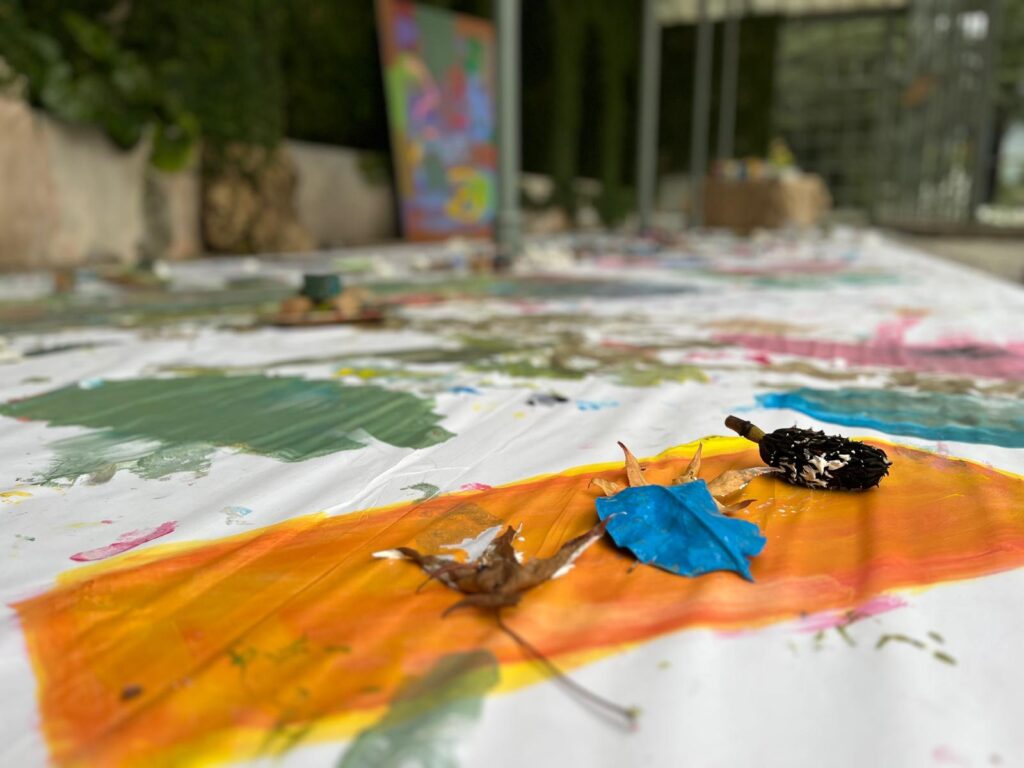
On 18 November, in the tree-lined courtyard of the primary school on Via Bergognone in Milan, more than eighty children between the ages of nine and ten became the protagonists of “Feeding Biodiversity,” a project that combines art and science in an educational path designed to develop a new awareness in young children: biodiversity begins on the plate.
Conceived by Cristina Ciusa, an expert in ethical communication and biodiversity at the Laboratory of Dietetics and Clinical Nutrition at the University of Pavia, the project is part of the activities of the National Biodiversity Future Center (NBFC), funded by the National Recovery Plan with NextGenerationEU funds.
When science gives way to color
The concept stems from a simple and revolutionary idea: let children talk through painting, letting visual language become a way to explore and narrate biodiversity. “A sensory path among the trees, like a forest of biodiversity,” Ciusa explains, “where imagination is expressed with the free gesture of imagination, because only children have the natural ability to create possible worlds.”
The experience, titled Colors Tell Stories® for Feeding Biodiversity, unfolds on an eight-metre-long canvas stretched amongst the trees in the courtyard. Children work with primary colours to create new ones, just as in nature diversity arises from the infinite combinations of a few basic elements.
“The fluidity of the pictorial sign,” Ciusa continues, “encapsulates whole stories. For us nutrition researchers, these gestures become a way to look at the complexity of food and health from a more human and creative perspective.”
Nutrition education begins in the city
Behind the project is a deep reflection on the relationship between food, health and the environment, especially in an urban context where daily food choices directly affect the well-being of the planet. “Nutrition can and should support new urban lifestyles that are more aware of and respectful of the interdependence between human health and environmental health,” stresses Hellas Cena, director of the Laboratory of Dietetics and Clinical Nutrition at the University of Pavia. “Training new generations aware of the link between food and the environment is the first step in building more resilient urban communities.”
The project starts in Milan as an experimental laboratory, but is designed to be replicated in other Italian schools. In 2026, the experience will continue with new events in art galleries and museums, to expand the dialogue between research, art and society. In the historic building on Via Bergognone—an example of urban regeneration—the courtyard will be transformed into a “forest without borders,” with wooden benches and insect houses that are integrated into the creative space.
The young artists will paint in dialogue with Tracce, a work by Cristina Ciusa, creating a collective narrative in which nature enters the school not as a subject of study, but as a lived experience.
The curator thanks Chiara Ferraboschi, head of the school, and Massimo Pellegrini of Pellegrini Brera Bottega d’Arte, “for welcoming and accompanying an idea that aims to bring the language of art back into civic and environmental education.”
From table to canvas: biodiversity as culture
“Feeding Biodiversity” targets multi-ethnic classrooms, valuing the variety of food traditions that coexist in cities. “Art becomes maieutic,” Ciusa further notes, “because it allows children to bring out their own vision of the world, and to become ambassadors of respect for diversity.”
Hellas Cena closes with a summary that sums up the essence of the project: “Biodiversity education starts on the plate and becomes culture. If we learn from an early age that variety in food is an asset for us and for the planet, we will have more aware citizens and healthier communities.”