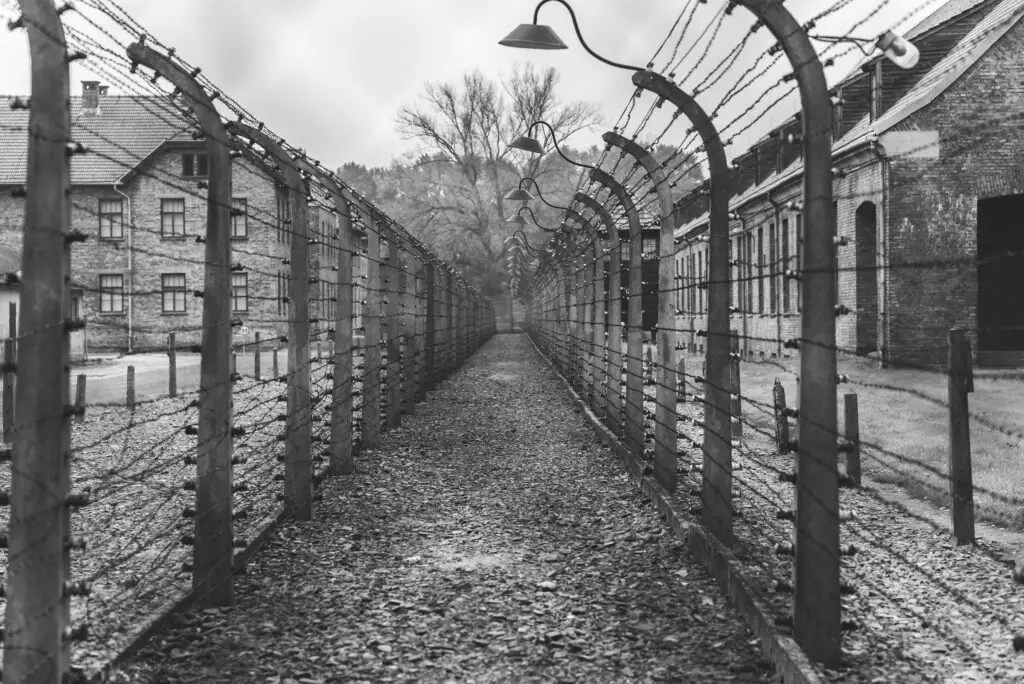
A young man who joined the ranks of the Resistance, in December 1943 Primo Levi was arrested in the Aosta Valley and then deported. He only emerged from Auschwitz III Monowitz at the liberation of the camp on 27 January, on what would become Holocaust Memorial Day.
Repatriated, Levi begins to narrate. If This is a Man is just the beginning; many more books will come. The wound, however, will never heal and the mind will constantly return to the hell of the lager. From the writer’s meditations was born in 1986 The Drowned and the Saved, a work with a different tone, a kind of spiritual testament that closes the circle of his 40-year literary career. A year later, the author took his own life. We will never know the reason, we nevertheless treasure that last book of his and that message: men are capable of building monstrous mechanisms because of which the victim becomes his own executioner.
Levi’s passion for science and particularly his degree in chemistry help to understand the way the narrative is structured, dominated by the need to decipher what is presented as dark and intricate. Out of this need comes a masterpiece of extreme lucidity: less than two hundred pages that anyone today should keep on their bedside table. Among the most comprehensive works on Nazi concentration camps, The Drowned and the Saved is a dazzling essay on the inhumane living conditions of the internees. Not so much in reference to Nazi savagery per se, but to the state of moral degradation: a dehumanization such that death was stripped of meaning.
It starts with a premise: “Human memory is fallacious. It is conditioned by what is heard, read or seen afterwards.” As a survivor, telling therefore is a moral duty for the writer. To tell lest those days, those weeks, those months be turned into a parenthesis to be forgotten or—even worse—denied, disproved. The warning is full of anguish: “What happened can return, consciences can again be seduced and obscured, including our own. Knowing is necessary.” Years later, most survivors learn to live with the obsession that, sooner or later, the suffering they endured may end up relegated to the background. In a recurring nightmare, Levi attempts to speak to an interlocutor who, however, turns away and silently walks away. A hope, this, that the Nazis counted on, certain to wipe away all traces of the heinous crimes committed.
Survivor guilt is a state of mind felt towards those who, from that abyss, failed to come out. Related here is the affliction felt at the moment of liberation, moments when instead of rejoicing, one is guilty of having survived. The author recalls having repeatedly denied his help to others: “There are few who have harmed, robbed or beaten a comrade; on the other hand, almost all of them feel responsible for failure to help,” so much so that they are ashamed of their position and repent for what they committed by the SS.
Two distinct categories come to light in the lager, the submerged and the saved. The former, those who did not find a way to escape death, contrasted with the latter who, after hitting bottom, were able to return to a “normal” existence. Levi makes clear how most of the saved, by becoming functional to the camp mechanisms, managed to survive by agreeing to abandon their morality. This is followed by a description of the systems that led to the creation of “grey zones” of power between oppressed and oppressors. Faced with incessant daily suffering, the human soul did not choose unity against the tormentor, but a struggle between the poor: “One entered hoping at least for the solidarity of fellow sufferers, but the hoped-for allies, except in special cases, were not there.” The discovery that they could not count on the support of other prisoners led many to lose hope, and succumb. The grey zone is thus compromise, cooperation, favour gained through abjection in the struggle for survival. The so-called “crematorium crows”—the internment groups of sonderkommando, German for “special units”—formed the base of the pyramid. Levi is convinced: “To have conceived and organised the sonderkommandos was the most demonic crime of National Socialism.” The rare surviving accounts of these prisoners represent one of the most poignant and stark pages of Auschwitz history.
Killing so as not to be killed. Cremate the bodies of friends and relatives so as not to end up like them. In the concentration camps these were the tasks of the special units, almost exclusively composed of Jewish deportees. “Through such an institution,” Levi points out, “an attempt was made to shift the burden of guilt onto others, and precisely onto the victims, so that, to their relief, not even the knowledge that they were innocent remained.” It had to be Jews who put Jews in the ovens, to corroborate that infamous prejudice that classifies them as sub-humans, a people ready to destroy themselves. On the other hand, delegating to the oppressed the dirtiest part of the job was meant to ease leaden consciences. The sonderkommandos were forced to deal with the collection and cremation of bodies. They also had to accompany the deportees to the gas chambers, cut the hair off the corpses, extract their gold teeth, and retrieve objects and clothing. Meanwhile, they observed with their own eyes a fate they had temporarily escaped. Units, in fact, were periodically eliminated. The next team would cremate the bodies of the previous one. This was how it worked. In this way, secrecy was maintained about the fate of millions of human beings deported from Nazi-occupied Europe.
Those selected for the sonderkommando were obliged to accept the assignment given to them: there was no alternative but immediate death. Unlike others, the few survivors of the crematorium crows decided to tell nothing for years: their role as accomplices of the executioners granted them no peace. “I believe that no one,” Levi explains, “is authorised to judge them, not those who knew the experience of the lager, much less those who did not.” And he clarifies, “Whoever dares to attempt judgement, imagine that he finds himself hurled into an undecipherable hell: here he is offered survival, and a grim but unspecified task is proposed, indeed imposed on him.”
A member of the special units lost all moral inhibitions by reacting with apathy to the horror, with the knowledge that shortly thereafter he would follow the identical fate of those he was collaborating to kill. He was addicted to everything, had no contact with living men. The first Auschwitz commander Rudolf Höss thus described in his memoirs a scene that gives no cause for further comment on the human decay achieved: “In extracting the corpses from a gas chamber, suddenly one of the sonderkommando stopped, stood for a moment as if electrocuted, then resumed his work with the others. I asked the kapo what had happened: he said that the Jew had discovered amongst the others the corpse of his wife. I still continued to observe him for some time, but I could not discern any particular attitude in him. He continued to drag his corpses, as he had been doing until then. When, after a whilst, I returned to the command, I saw him sitting eating amongst the others, as if nothing had happened. Did he possess a superhuman ability to conceal his emotions, or had he become so numb that he no longer knew how to react?”
The Shoah was a mad but lucid criminal act perpetrated through the gradual and meticulous application of both physical and psychological violence. And we return to the beginning: men are capable of constructing monstrous mechanisms because of which the victim becomes the executioner, of himself and not only. What is repeated—cyclically and with subtle nuances—around the world, including Europe.
Faced with the tragic events unfolding in Gaza, one is forced to acknowledge a dynamic so old that it seems, unfortunately, inescapable. We can safely reiterate it today, yet another day when as spectators we witness the genocide of a people on another, less fortunate coast of our own sea. Yet, Primo Levi reiterated it so many times, “Auschwitz is all around us.” Slipping back into the abyss is, therefore, possible. And it is so because the National Socialists, like us, were ordinary men. Just think of the profile of Adolf Eichmann: a bureaucrat of modest rank, unfulfilled by repeated school and work failures, eager to redeem a precarious social status, a Nazi by accident, a criminal—in a sense—by conformity. The value of commemorating this day is all, specifically, encapsulated here: may 27 January always serve as a warning.