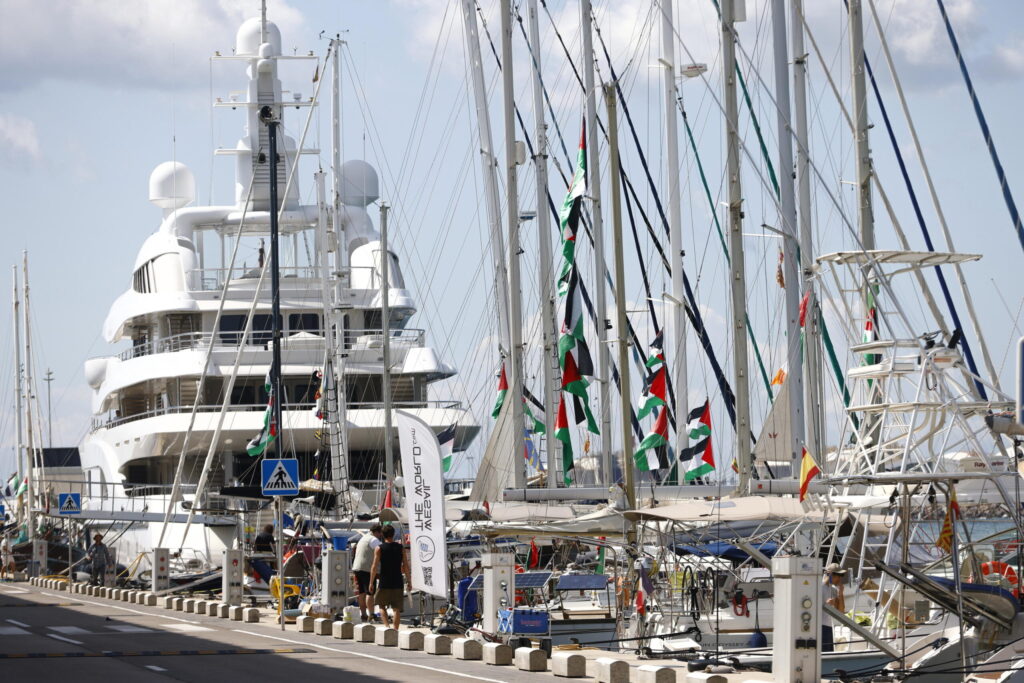
The Global Sumud Flotilla, the largest civilian expedition to the Gaza Strip in years, is officially at sea. The goal of the mission is stated: to bring humanitarian aid and symbolically break the naval blockade imposed by Israel on Gaza, described by organisers as an illegal siege. On board are activists from dozens of countries, including Italy, Greece, Spain and Tunisia. Participating are doctors, parliamentarians, volunteers, journalists, and even Greta Thunberg, who chose to come on board to bear witness with her presence. “When governments fail, we have to act,” said the young Swedish activist shortly before boarding in Tunisia.
The 18 Italian boats are currently in front of Portopalo di Capo Passero, in the province of Syracuse, after setting sail last Saturday from the port of Augusta. They are waiting for boats of other nationalities to rejoin them in international waters and continue their crossing to Gaza. Yassine Lafram, president of UCOII, the Union of Islamic Communities of Italy, is on board one of the Italian ships and said, “We are here for a technical stopover, ready to go all together to Gaza with loads of aid and hope.”
From Greece, two sailing ships set sail from Syros Island, “Oxygen” and “Electra,” are joining the fleet. On board are Greek and international activists, accompanied at departure by a procession of fishing boats waving Palestine flags. “The name Oxygen symbolises life,” said Agisilaos Koulouris, of the March to Gaza Greece movement. Also present were political figures, such as François Piquemal, deputy of the French La France Insoumise party, who boarded with a Swiss delegation. Meanwhile, Spanish boats are leaving the Tunisian port of Bizerte to join the group.
In a statement released just hours before departure, the Global Sumud Flotilla steering committee confirmed the start of the final phase of the mission, highlighting the many difficulties faced in recent days: two drone attacks on boats docked in Tunisia, logistical problems, fuel shortages, threats from Israeli Minister Ben-Gvir, and the need for enhanced security measures. In anticipation of increasingly hostile conditions, organisers made the difficult decision to reduce the capacity of participants on some vessels to ensure their safety. Some vessels were moved to alternate ports to complete preparations, and new technical tests were carried out at sea.
“”Volunteers faced many challenges, partly due to deliberate attacks and partly due to the enormous scope of the people’s initiative,” the statement read. The steering committee expressed gratitude to all participants, stressing that even those who did not leave will continue mobilisation in their own countries to strengthen the global movement of solidarity with Palestine. “When our fleets unite in the Mediterranean, we will send a clear message: the blockade and genocide in Gaza must end. We remain steadfast and determined to challenge Israel’s illegal siege,” organizers conclude. The mission carries loads of humanitarian aid but also a clear message: Gaza is not alone.