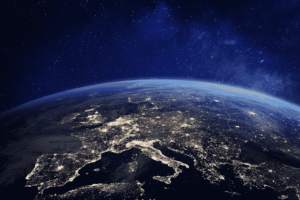
The picture of drought in Europe is getting worse. An analysis conducted by University College London in collaboration with Watershed Investigations and prominently reported by The Guardian reveals that large areas of southern and central Europe—from Spain to Italy, France to Poland—are rapidly losing their freshwater supplies, including groundwater. A wake-up call for the continent’s water security. The data come from satellite surveys that monitor water stored on the continent, revealing a steady loss that has lasted more than two decades.
The resulting picture is one of a divided Europe. In the north, water resources are increasing because it is raining more. In the south and centre of the continent, however, the opposite is the case: Spain, Italy, France, Germany, Switzerland and much of Eastern Europe are seeing water tables thinning, rivers shrinking and soils becoming drier. In these areas the rains are not only diminishing, but when they do come they do so violently, often in the form of rapid cloudbursts that flow away without penetrating the subsoil. The large aquifers, the ones that are supposed to provide us with continuity even in dry periods, can no longer recharge quickly enough.
The first casualty is agriculture
The consequences do not only affect the availability of water in homes. If deep reserves dry up, the first casualty is agriculture: less water means more uncertain harvests, lower yields and an economic account that threatens to explode. And with agriculture also teeters ecosystems linked to waterways, which are already showing signs of stress: fragile rivers, retreating wetlands, thinning biodiversity. In some regions of Europe, drinking water depends almost entirely on groundwater, and the negative trend recorded by satellites is therefore a direct, concrete, immediate wake-up call.
The point is that it is not enough to hope for the “next wet winter.” Europe’s climate is entering a new phase, and it needs to be acknowledged. We need water-saving policies, more efficient infrastructure, water recovery and reuse systems, less thirsty agriculture, structural investments. It’s a change of perspective: it’s not about managing the emergency, it’s about redesigning the way we treat water.
Supplies are consumed
The scenario described by the Guardian is a snapshot of a continent that is slowly depleting its survival stockpile. If we don’t act quickly, the drought that now seems like a seasonal problem will become part of the landscape—and we will no longer be able to say we didn’t see it coming.