When we talk about“+ 1.5 degrees,” we are no longer talking about a concept projected into the future, a fear. It is a threshold that the Earth has already crossed. No longer a datum that one could hope would be transient, an annual anomaly that could fall back by stretching our gaze into a more encouraging future. No, right now it is a structural datum: we live with the certainty of ongoing damage. The future does not encourage us. And to get out of this situation it pays to understand why it does not encourage us, otherwise we will not come out of it.
Of course the heat race is not stopping. But it is something that could be changed. We are not surrendering to a technological, or physical, or financial limitation. Scientists have shown the way back into a climate framework that is compatible with defending our welfare levels. The technology is mature, and in fact for the past few years more than 90 percent of the new energy installed on the Planet has come from renewable sources. Demand from the markets is very sensitive to the environmental issue because those who buy are very sensitive to the environmental issue. In short, there are all the conditions to overcome the difficulty. All except one. Awareness.
We run blindfolded, not noticing the direction, the danger, concerned only to avoid the jostling of the neighbor who with greater frequency than in the past is shaping up as loud, arrogant, violent. We are with our senses dilated with respect to the immediate and blind to the future. It is this situation of cognitive deficit that is the real cause for alarm.
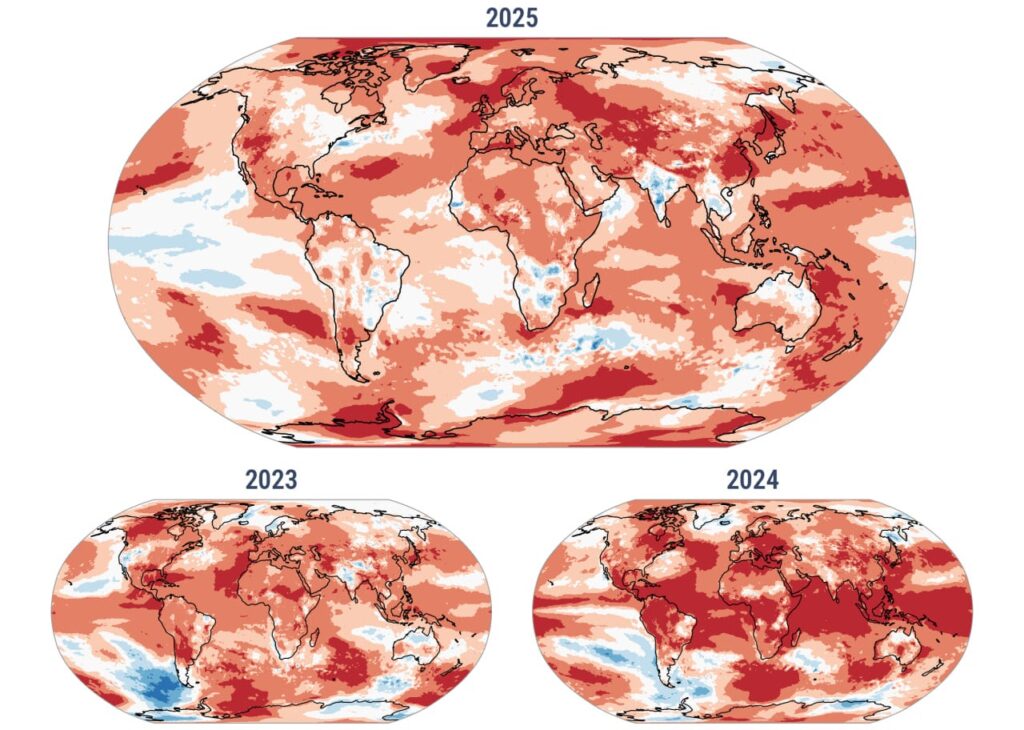
But one must not give up. One must start with the data. The latest are those from Copernicus, the scientific analysis system that Europe has given itself to measure climate risk. Over the past three years (2023-2025) the global average temperature has been more than 1.5 °C higher than in the pre-industrial era (1850-1900). This is the first time a multi-year period has remained above the limit set by the 2015 Paris Agreement. The planet’s average has risen so much that the last 11 years are the warmest in the historical series.
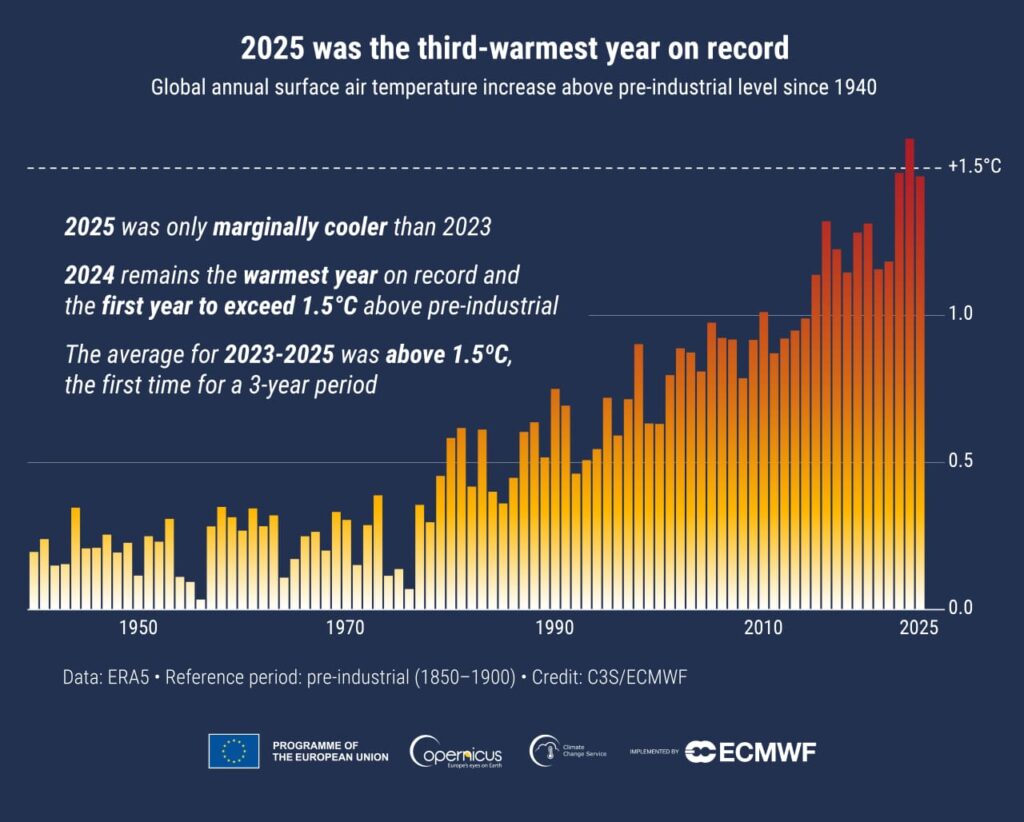
We are thus facing an underlying trend in the climate system, fueled by the accumulation of greenhouse gases in the atmosphere. This is the first time in the history of the Planet that this is happening as a result of the voluntary choices of a single species, ours. We were the only ones who had the choice, and that is extraordinary. But this choice leads to climate change that harms our individual and collective interests. A beautiful contradiction.
This time we cannot get out of it by crossing our fingers and hoping that things will right themselves. The oceans have captured the vast majority of excess energy and record temperatures by 2025, with profound consequences for climate cycles and marine ecosystems. Ocean warming accelerates sea level rise, fuels more intense hurricanes, and leads to the massive bleaching of coral reefs: the 2023-2025 global bleaching event is estimated to affect more than 80 percent of the world’s reefs.
Meanwhile, ice and polar ice caps are showing clear signs of stress, with Antarctica posting unprecedented annual temperatures and the Arctic ranking among the warmest ever. The temperature rise already underway is increasing the frequency and intensity of extreme weather events – heat waves, prolonged droughts, wildfires, flash floods – with social, economic and health impacts on a global scale.
The danger is real but waving the red flag of danger is not enough. We need to build the alternative to fossils and deforestation that are the two causes of the problem. Build it knowing that the transition must be equitable, because otherwise it will lack the necessary consensus. That it must be economically compatible, because otherwise it will be stopped by the market. That it must be fueled by billions of small gestures, because by taking action, convictions are rooted. But that a political framework of economic justice is needed: as long as the petrostates have free rein to exponentially increase the fossil incomes of the few to the disadvantage of the many, the game cannot be won. The decade of record heat demands a change of pace: a blueprint around which to build new balances, including political ones.