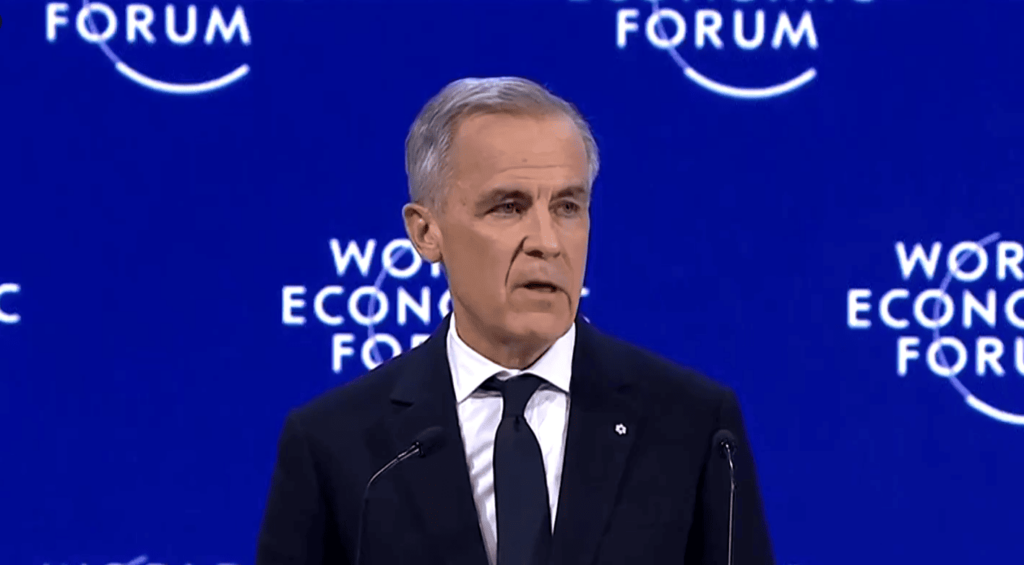
In the great geopolitical game that is reopening over the Arctic, Canada has decided not to remain silent. From the stage of the World Economic Forum in Davos, Prime Minister Mark Carney delivered a clear-cut speech, with no fancy diplomacy: Ottawa stands fully behind Greenland and Denmark, reiterating that the Arctic island’s sovereignty is not a matter for international negotiation.
A clear message, coming at a time when Greenland has returned to the center of the strategic ambitions of the great powers, complicit with climate change, the opening of new routes, and access to mineral resources crucial to the energy transition.
Canada supports the principles of sovereignty and territorial integrity universally, including as they apply to Greenland and the Kingdom of Denmark. As we have consistently stated, the future of Greenland is for Greenland and Denmark alone to determine.
— Mark Carney (@MarkJCarney) January 18, 2026
The security of the…
“The future cannot be bought.”
In his speech, Carney insisted on a simple principle, but one that is far from obvious today: the future of Greenland must be decided solely by Greenlanders, within the framework of relations with Copenhagen. No outside pressure, no geopolitical shortcuts, no global real estate market logic applied to territories and peoples.
It is an indirect but obvious response to recurrent U.S. suggestions on the Arctic island, which in recent years have oscillated between explicit proposals and strategic winks. Carney has chosen to call a spade a spade: to speak of acquisitions or economic levers to influence policy choices is to undermine the foundations of international law.
The talk did not stop at Greenland. Carney widened his gaze to a broader crisis: the international order built after the Cold War is showing increasing cracks. Shared rules, multilateralism and cooperation are being challenged by a competition between powers that increasingly uses tariffs, sanctions and economic pressure as political tools.
In this scenario, according to the Canadian premier, “middle power” countries cannot afford the illusion of neutrality. They must systematize, strengthen alliances, defend common principles together. If you don’t sit at the table, you risk ending up on the menu.
Arctic, security and alliances
The Canadian position also has a very concrete strategic reading. The Arctic is no longer a frozen periphery of the world, but a new geopolitical frontier where military security, global trade and energy are intertwined. For Canada, which of the Arctic is a direct actor, supporting Greenland and Denmark also means defending the stability of the entire North Atlantic region.
Carney reiterated Ottawa’s commitment to NATO and the need to strengthen cooperation between European and North American allies. A message that sounds like a warning: dividing the West on sensitive dossiers such as the Arctic is tantamount to giving room for maneuver to other global players.
Canada’s choice weighs more than it may seem. It is not just diplomatic solidarity with two allies, but a clear political signal: sovereignty is not a negotiable variable and the Arctic is not a land of conquest. At a time when geopolitics tends to simplify everything into power relations, Ottawa is trying to put rules, rights and cooperation back at the center.
Whether this line will be followed by other countries remains to be seen. But one thing is certain: on Greenland, Canada has chosen to speak out. And, in these times, that is no small thing.