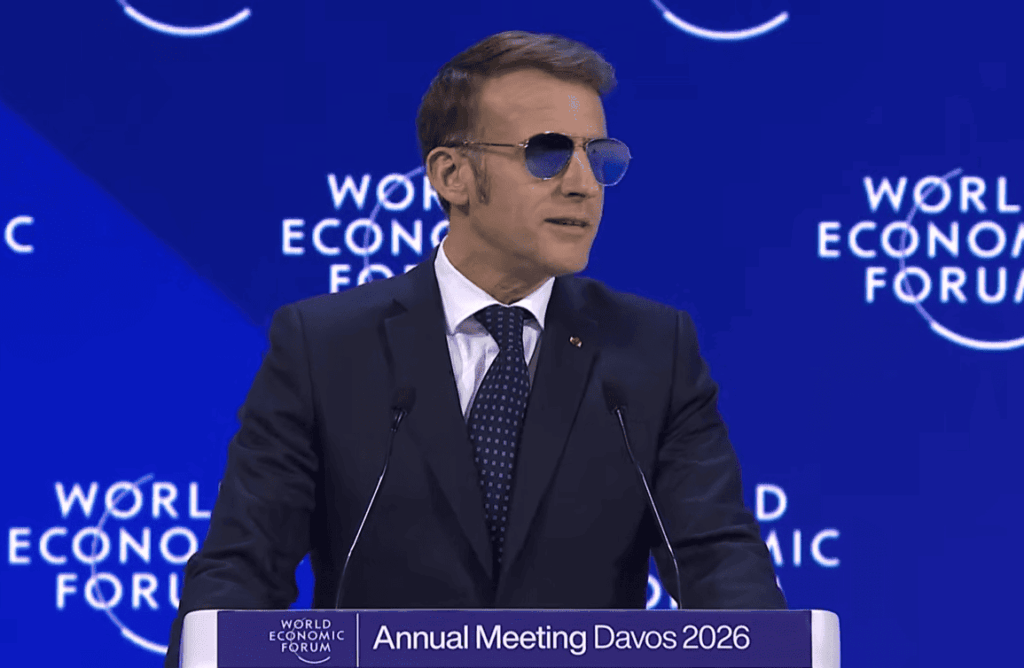
The usual ritual of global dialogue is not being staged in Davos . The Forum became the theater of a real political confrontation, in which Europe stopped lowering its head and responded to American provocations with a hitherto rare compactness. Leading the reaction was Emmanuel Macron, who chose sharp words and an unusually harsh register by European standards: respect yes, subservience no.
The European Union has taken note that the old transatlantic balance no longer holds and that continuing to hope for a return to the past is time lost. Ursula von der Leyen also said this without mincing words, stringing together concepts that sound like a declaration of political emancipation: “Nostalgia will not bring back the old order. It is time to seize this opportunity and build a new independent Europe,” accompanying the warning with an equally explicit promise: “Our response will be firm, united and proportional.”
Hence the European decision to harden the trade line and put all available defense tools on the table to make it clear that sovereignty is non-negotiable and that threats are not an acceptable method of confrontation between allies.
No more international bullying
Macron embodies this turn with a style that mixes irony and firmness. At Davos, he openly accused Washington of using tariffs as a political cudgel and of cultivating ambitions that more resemble a new imperialism than shared leadership. The French president put it bluntly, “We prefer respect to bullies, the rule of law to brutality,” denouncing “a new imperialism” and “a new colonialism” and making it clear that Europe does not intend to have its agenda dictated to it. It is a stance that breaks with years of caution and, at least politically, finds support even in traditionally more cautious countries.
The American response, predictably, was anything but conciliatory. Trump relaunched in even more aggressive tones, threatening very heavy duties on iconic European export products such as champagne and returning to openly claiming strategic interests in territories that do not belong to the United States such as Greenland. At the press conference, speaking about the Arctic island, he used a phrase that has become symbolic of his posture: “You will find out,” answering the question about “how far he is willing to go” in order to get it. And when it was pointed out to him that Greenlanders are against it, he replied, “When I talk to them, they will be thrilled.”
In the United States, the crack widens
But this muscular posture also creates problems in the United States. Malaise is growing in the country. Exporting firms, sectors of the economy and parts of the establishment warn that a trade war risks fueling inflation and hitting American consumers specifically. On the geopolitical level, too, the idea of treating allies as adversaries arouses perplexity: some fear that Europe, pushed to the ropes, will really accelerate toward a strategic autonomy capable of redrawing the Western balance.
Davos thus marks a symbolic transition. On the one hand, a Europe that tries to speak with a more adult and less fearful voice. On the other an America using threats as a foreign policy tool, accepting the risk of isolating itself and opening rifts even within itself. The game is long and far from closed, but the change of pace is evident: the time of silent acquiescence seems to be over. A new season is opening.