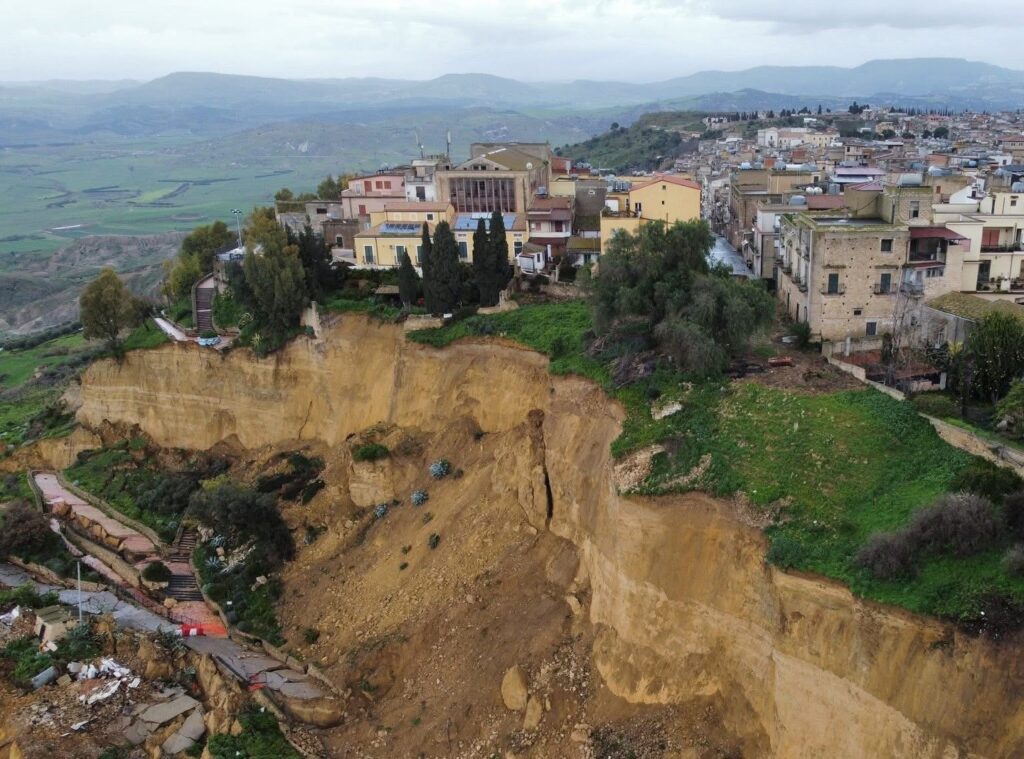
On the brink. Yes, it sounds like a catch phrase, worn out by use, annoying. Yet an image like this one you see next door is enough to restore emotion to those worn-out words. Niscemi is a Sicilian town of 25,000 inhabitants that literally borders the abyss: the last houses are there, hanging over the void, to see them makes one dizzy. The landslide runs for 4 kilometers, with a drop that reaches about fifty meters in height, and draws a surreal landscape, a canyon that has been created right on the edge of the town, with the earth torn up next to the foundations of the houses. Some of the inhabitants have already had to vacate them; it looks like 1,500 evacuees will be arriving soon. And for others, life is certainly not quiet: the landslide is active and the speed unpredictable as new causes are added to the old ones.
Le incredibili immagini della #frana che in queste ore sta colpendo la città di #Niscemi (Caltanissetta), in Sicilia. Il fronte di distacco si estende per 4 km e sta mettendo a rischio interi quartieri della città. La Protezione Civile ha già evacuato più di 1.000 persone. pic.twitter.com/yM47IsJF8T
— Il Mondo dei Terremoti (@mondoterremoti) January 26, 2026
Perhaps that’s also why one gets dizzy looking at that image. It is hard not to empathize: after all, we are all a little bit in Niscemi because the earth is slipping away from under our feet in various ways. And, like the inhabitants of Niscemi, many avoid looking at the precipice, try to pretend nothing is happening, to give daily life a habitual rhythm while all around everything changes and climate disasters surround us ever more closely. Some console themselves by telling a half-truth: everything has always changed, if you went on before you can go on now.
#Niscemi (CL), frana sulla SP 10: da 48 ore #vigilidelfuoco impegnati nelle operazioni di monitoraggio dell’area e nell’attività di supporto alla popolazione per il recupero di beni dalle abitazioni evacuate. Nella clip il sorvolo dell’elicottero Drago 156 [#27gennaio 11:30] pic.twitter.com/0XCcsJhFec
— Vigili del Fuoco (@vigilidelfuoco) January 27, 2026
A half-truth as dangerous as a full lie because it does not take into account the novelty around us: there is a novel element in the scenario, a threat that for the first time is global and requires a global response, the one created by the accumulation of greenhouse gases produced by the burning of fossil fuels. We can only deal with it if we know about it and put the right tools in place. Are we doing that?
Let’s look at what is happening in Niscemi. The landslide is not a new fact. Already in Bourbon archival documents, at the end of the eighteenth century, there is a trace of it. Then, in the twentieth century, urban expansion accelerates in a place where it would obviously have been better not to build and the population is reassured by assuring them that the consolidation engineering interventions of the 1950s and 1960s are sufficient to guarantee safety. In 1997 the denial comes with the landslide that hits the Sante Croci neighbourhood.
So the tools of old engineering already in the last century were unable to cope with hydrogeological disruption. Then came not the unpredictable but the expected denied: the climate crisis that changed the strength of rainfall, the violence of winds, the intensity of storms. Added to the woes accumulated over decades of neglect was Cyclone Harry, which delivered the coup de grace.
To respond to what is happening with only emergency measures is to have understood nothing of the dynamics of the facts that arise from the convergence of two errors. Waterproofing that has covered more than 7 per cent of Italy reducing the soil’s capacity to absorb water and blanket building expansion in defiance of common sense, on the one hand. The climate crisis that has increased the violence of extreme weather phenomena, on the other.
These two errors have greatly dilated the risk, but we would still be able to cope with it by reducing the extent of damage. We would be if we passed the law for soil protection and used the guidance of climate science. But the approval of the law continues to be postponed and a frontal attack has been unleashed against climate science by the President of the United States and far-right European parties supported by the U.S. administration. Denying the evidence, shutting down the sites that offer scientific information, cutting research funding and sabotaging the international institutions created to protect us from global risks is the road that brings us all closer to the Niscemi abyss. Italy lives with more than 90 per cent of its municipalities exposed to landslide or flood risk. We cannot continue to cry after disasters. We cannot continue to close our eyes. Taking action now is possible and necessary.