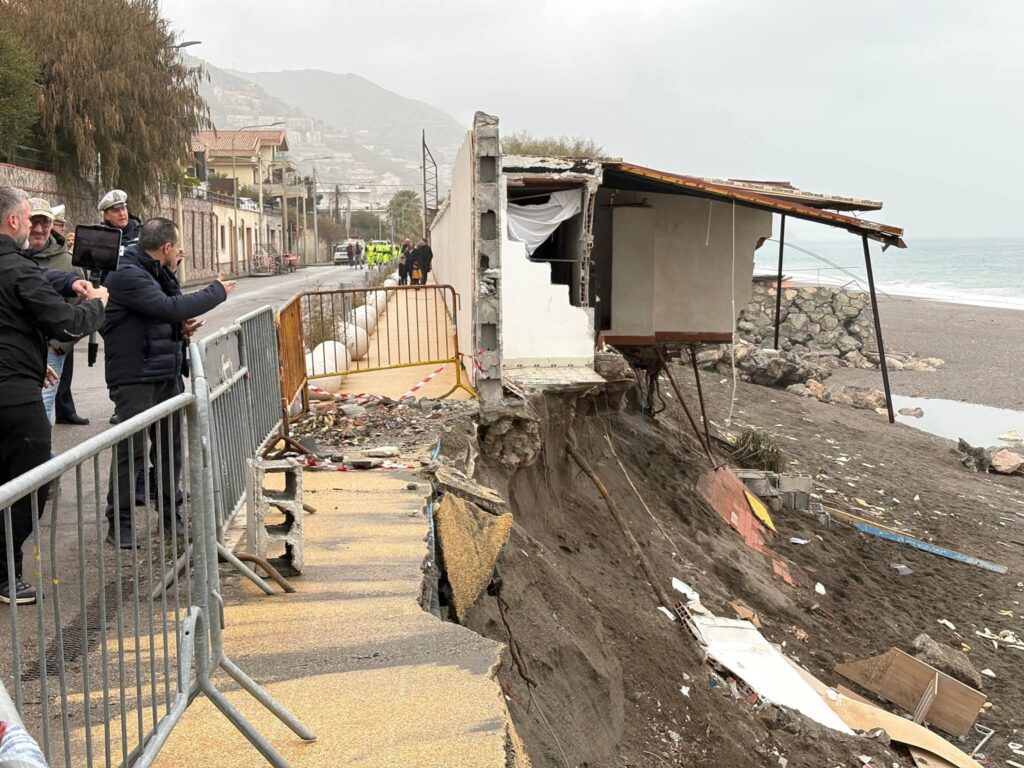
Cyclone Harry has left behind torn-up roads, flooded factories, shuttered businesses and homes to be evacuated. Sicily, Calabria and Sardinia are reckoning with damage estimated at around 1 billion euros. But while mud and debris are being shoveled, the front of mandatory catastrophe policies is opening. A tool designed to shelter the productive fabric even from climatic shocks but which, when tested, risks turning out to be a net full of holes.
The obligation that is not enough
As of March 31, 2025, the so-called Cat Nat – compulsory insurance coverage against catastrophic events – is compulsory for all registered companies, excluding agricultural companies. The rule, introduced in Budget Law 2024, covers earthquakes, floods, landslides, and floods. But Cyclone Harry does not easily fall into these categories. Heavy rain, extreme winds, storm surges, seawater flooding: phenomena that do not always fit the definition of “catastrophic event” according to the insurance lexicon.
The result is that many regularly insured companies risk not seeing a euro in compensation, not because of marginal quibbles but because storm surges and water bombs are often explicitly excluded from the scope of policies. A contradiction that weighs especially heavily on coastal areas, now among the most exposed to the effects of the climate crisis.
Appraisals, definitions and compensation halved
Complicating the picture are contracts. Some strictly distinguish between flood and storm surge; others cover direct water damage but not indirect damage, such as seepage and backwater. In practice, the appraisal identifies the “prevailing” cause of the damage: if it does not coincide with an insured item, compensation may skip or be drastically reduced.
Here the paradox arises. Those who have complied with the insurance obligation may be left uncovered. Those who have not done so risk administrative penalties of between 100 and 500 thousand euros and, above all, exclusion from public grants, incentives and emergency relief. A system that really protects no one and that, instead of reducing uncertainty, multiplies it.
Businesses and the call for urgent correction
The controversy also erupted after the words of Civil Protection Minister Nello Musumeci, who recalled the mandatory nature of the policies. Assoutenti speaks of a tool that is “still experimental” and warns that using it to “discriminate” access to public aid is “profoundly wrong,” especially when the obligation does not correspond to real risk coverage.
Confesercenti goes further and calls for immediate intervention in the Milleproroghe decree. “Beyond the damage, the mockery,” the association writes, calling for an across-the-board extension until at least June 30, 2026, and a revision of the rule. Today the deadlines are differentiated: some sectors, such as administration and tourist accommodation, have more time, others do not. The risk is unequal treatment among businesses affected by the same event.
In Calabria, where beach facilities on the Ionian coast have suffered damage described as “very serious,” Confesercenti is calling for concrete measures: non-repayable contributions, zero-interest loans, moratoriums on mortgages, and simplifications for reconstruction. Demands that tell a simple reality: without consistent rules and adequate coverage, the insurance obligation risks turning into an additional cost, not protection.
A changing climate, tools that lag behind
Making this system even more fragile is the climatic context in which events such as Cyclone Harry develop. From the perspective of climate physics, explains Antonello Pasini, a CNR researcher, this is not just an isolated anomaly.“Climate change is overcoming classical seasonality: events that should not occur in winter are happening today because it is too warm and snow is giving way to heavy rains.” In Harry’s case, attribution studies indicate that the warming of the Mediterranean Sea has helped to strengthen its intensity, making winds significantly stronger than under a “normal” climate scenario.
Such phenomena when they arrive are more violent because they draw energy from an ever-warming sea. And this is precisely where the short circuit emerges.“Insurance companies know the future climate scenarios,” Pasini tells Ultima Bozza, “but entire categories of events, such as storm surges and extreme wind, that are central to the real impacts are missing from the coverages.”
The problem, however, goes beyond policies. “If climate risk management is left to the insurance market alone,” Pasini warns,“the state abdicates its protective role. Without serious adaptation and mitigation policies, we simply chase damage.” This is a widespread tendency, he explains, in a policy that looks at the short term and struggles to confront a structural and long-term crisis such as climate.
Cyclone Harry has made clear what the numbers already suggest: increasingly intense extreme events and regulatory and insurance tools designed for a climate that no longer exists. To continue to ignore this gap is to leave businesses and territories alone just when they would most need certainty.