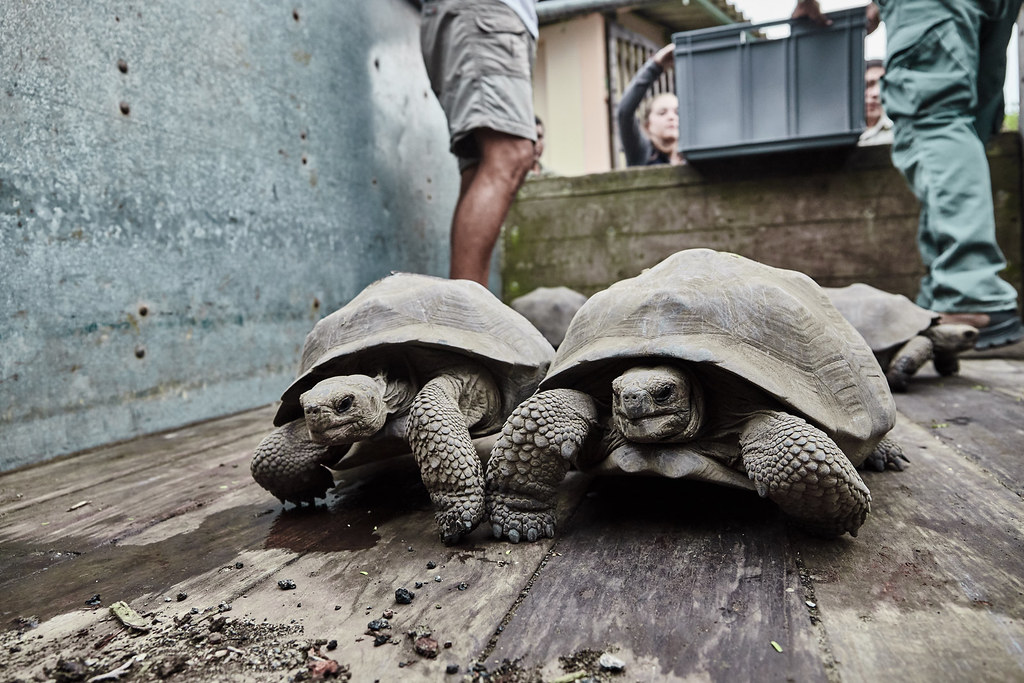
After almost two centuries of absence, giant tortoises have returned to Floreana in theGalápagos archipelago. An event of more than just symbolic significance: these reptiles are considered true engineers of the ecosystem. Through their feeding activities they shape vegetation, promote seed dispersal and contribute to the creation of microhabitats. In essence, they reactivate natural dynamics that their disappearance had interrupted for generations.
Turtles native to Floreana were driven to extinction in the 19th century. What led to their demise was a combination of factors that sealed the fate of many island species: intensive hunting by whalers and sailors, habitat loss, and the impact of human-introduced animals. Rats, cats and pigs preyed on eggs and hatchlings, compromising the ability to reproduce. When the population collapsed, the island lost one of its evolutionary protagonists.
The genetic surprise
The story, however, did not end with that extinction. Decades later, on the island of Isabela, researchers identified turtles with traits compatible with those of Floreana. Analyses revealed that some individuals retained a significant proportion of the genetic heritage traceable to the subspecies thought to be lost. The most widely accepted hypothesis is that in past centuries navigators transported turtles between islands, abandoning them or losing them along the routes. A chance circumstance that ended up preserving valuable genetic fragments.
From that discovery came a selective breeding program coordinated by the Galápagos National Park. Individuals with the greatest genetic affinity were made to breed in captivity to recover some of the characteristics of the original population. On February 20, 2026, the project reached a key milestone: 158 young turtles, between 8 and 13 years old, were released in Floreana. Although they are not genetically identical specimens to extinct ones, they represent a concrete step toward restoring lost ecological functions.
Goal: rebuild a population
This release is just the beginning. The plan is to reach about 700 individuals in the coming years, with the goal of forming a stable and self-sustaining population. At the same time, control and eradication of invasive species continues, a prerequisite for ensuring the survival of new generations. The challenge is not only numerical, but concerns the overall balance of the ecosystem.
About 200 people live on Floreana. Agriculture, fishing and tourism depend directly on the environmental health of the island. The return of the turtles can strengthen ecological resilience and, indirectly, support more sustainable economic activities. It is one piece of a strategy that weaves together conservation, science and local community involvement.
Reintroduction shows that even local extinctions, when there are still recoverable genetic traces and habitats, are not always final. It takes time, solid data and considerable perseverance. The slow pace of giant tortoises today tells just that: ecosystem revival may be long, but it is not impossible.