For many pollutants, today’s Italy is unrecognizable from that of the 1990s. Sulfur dioxide has fallen dramatically, as has lead, and nitrogen oxides and carbon monoxide have also seen deep declines. Overall, greenhouse gas emissions have decreased by about one-third.
The numbers in the latest ISPRA reports tell an environmental success story that, at first glance, seems stark. But one only has to look at them more closely to see that a substantial portion of this progress does not stem from deliberate climate policy choices.
Behind the reductions are profound economic transformations: less heavy industry, less coal, years of crisis that slowed production and consumption. In other words, a significant share of emissions has decreased because the economic system has changed, not because it has been rethought in a sustainable way.
This is where the limitations emerge. The sectors most difficult to decarbonize-transport, agriculture, building heating-are also those where progress has been slowest, when not entirely insufficient. And it is precisely on these fronts that the game of the coming years will be played.
With 2030 now approaching, the room for maneuver is narrowing. Europe’s climate goals require an acceleration that so far has not been seen. After the relatively “easy” results, the more complex ones remain: acting on established habits, widespread infrastructure and economically and socially sensitive sectors.
Thirty-four years in two reports
The data come from two documents published in April 2026: theItalian Emission Inventory 1990-2024 – Informative Inventory Report 2026 (ISPRA Report No. 426/2026) and the National Inventory Document 2026 – Italian Greenhouse Gas Inventory 1990-2024 (ISPRA Report No. 428/2026). They cover more than three decades of emissions, from traditional air pollutants – sulfur, nitrogen oxides, ammonia, particulate matter and volatile organic compounds – to the main climate-altering gases: carbon dioxide, methane and nitrous oxide.
Comparison with the 1990s returns a picture of a country profoundly changed. But the comparison with the European 2030 goals shows how far we still have to go.
Achievements
For several air pollutants, reductions have been dramatic. Sulfur dioxide fell from 1,784 to 70 gigagrams between 1990 and 2024 (-96%), with direct effects on acid rain as well. Lead followed a similar trajectory (-96%), while carbon monoxide decreased by 77% and nitrogen oxides by 75%.
Significant reductions are also recorded for black carbon (-67 percent), mercury (-65 percent) and cadmium (-64 percent). Leaving behind the most polluting fuels, European directives on industrial emissions, and improved technologies, particularly in the transportation sector, were the main factors.
On the greenhouse gas front, the overall decrease was 30.2%: from 521 to 363 million tons of CO₂ equivalent. Carbon dioxide, which accounts for more than 80 percent of the total, decreased by 31.9 percent. Methane fell by 21.8%, while nitrous oxide decreased by 39%.
The transportation hub
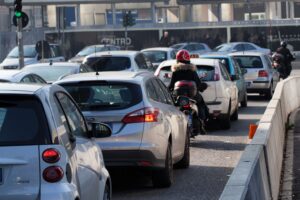
Despite the overall positive picture, one sector is moving against the trend. Within the energy sector-responsible for 81 percent of climate-changing emissions-transport is the only area where emissions have increased: +10.9 percent between 1990 and 2024.
Today they account for 38.5 percent of national energy emissions. Over time, vehicle efficiency has improved, but increased mobility has more than offset this progress. It’s the so-called rebound effect: more efficient consumption yet growing in volume.
Agriculture and ammonia
Another critical issue concerns ammonia (NH₃), a pollutant that contributes to fine particulate matter formation and water eutrophication. Emissions fell from 529 to 356 gigagrams, a 33 percent reduction-much smaller than for other pollutants.
The most striking fact is its origin: 91 percent comes from the agricultural sector, particularly from livestock farming, wastewater management and fertilizer use. This is an area where emissions are difficult to abate and where containment policies have produced limited results.
The 2030 targets
European commitments set precise targets. The National Emissions Ceilings Directive (NEC, 2016) calls for reductions from 2005 levels: some targets have already been met, such as those for sulfur dioxide and nitrogen oxides. Others, such as those on volatile organic compounds and ammonia, remain uncertain.
On the climate front, the European Union is aiming for a 55 percent reduction in emissions by 2030 compared to 1990. For Italy, theEffort Sharing Regulation sets a 43.7 percent cut from 2005 levels in sectors not covered by the emissions trading system: transport, buildings, agriculture, waste and small industry. Time is limited. And 2030 is much closer than it seems.