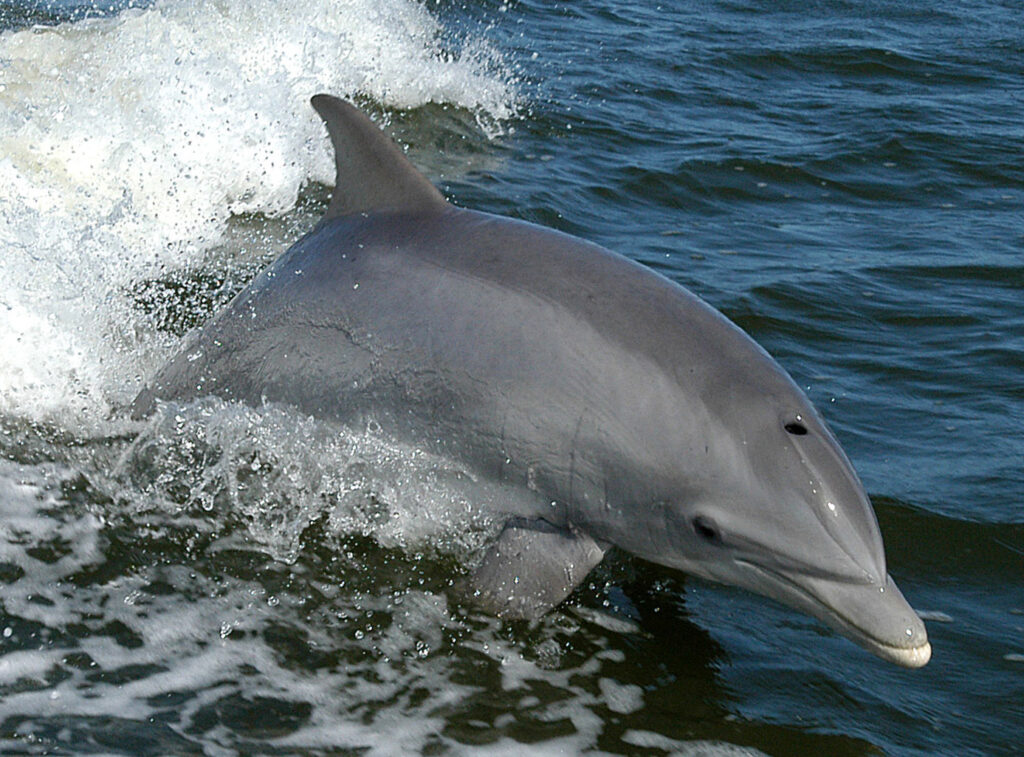
In the busiest and most touristy stretch of water in Venice, in front of St. Mark’s, swims a dolphin. His name is Mimmo. In just a few months he has become one of Venice’s most striking symbols and, at the same time, a test of how well we are able to coexist with nature in one of Europe’s most delicate urban environments.
According to scientists at the University of Padua and other Italian research centers, who have been monitoring him since last summer, Mimmo is not a problem. On the contrary, “What is really unusual is not the presence of the dolphin, but the persistent difficulty humans have today in respecting these animals,” explains Giovanni Bearzi, a marine biologist who has been studying dolphins in the Adriatic Sea for more than four decades.
An adaptable host
Mimmo is a bottlenose dolphin, the most common species of dolphin in Italian seas. It appeared in the lagoon in June 2025 and has since moved among its different areas, eventually settling mainly near San Marco. Here it finds abundant food-mostly mullet-and conditions that, for such an adaptable animal, are by no means prohibitive.
The preview of the study, soon to be published in Frontiers in Ethology, recounts a striking adaptation: Mimmo appears healthy, feeds regularly, and exhibits behaviors entirely compatible with his species. Nothing suggests a state of chronic stress or malaise. Historically, after all, dolphins were part of the lagoon ecosystem, although since the 1970s reports had become increasingly rare.
When curiosity becomes disorder
The real risk comes from humans. Mimmo’s sudden popularity has triggered boat chases, attempts to approach him, people trying to touch or feed him. “Themed” excursions and daring approaches, often at high speeds, have multiplied. A dangerous cocktail in an area already congested with water traffic.
Scientists have documented signs of disturbance and even some injuries, probably from being too close to boats. An acoustic removal was attempted in November to push him to less crowded areas, but Mimmo returned almost immediately to his favorite spots. A clear signal: it is not the animal that needs to adapt, it is us.
Managing people, not the dolphin
The researchers’ proposal is clear: reduce the speed of boats, impose mandatory minimum distances, intensify controls and strongly discourage inappropriate behavior. We do not need spectacular operations, but clear and enforced rules.
“Historical and contemporary documentation shows that dolphins have accompanied human maritime activities for millennia,” Bearzi recalls. “Yet we still struggle to coexist with them properly.” Mimmo, with his dogged presence in the tourist heart of Venice, puts his finger on the sore spot: the difficulty of accepting that the city is not just ours.
At stake is not just the safety of an individual dolphin, but a model of possible coexistence between humans and wildlife in urban spaces. Venice, fragile by definition, could turn this story into a laboratory of best practices, demonstrating that protecting an animal means first of all changing ourselves.
Mimmo continues to swim through the waves rippled by the engines. The question now is not whether he will be able to stay. But whether we will be able to make him stay the right way.