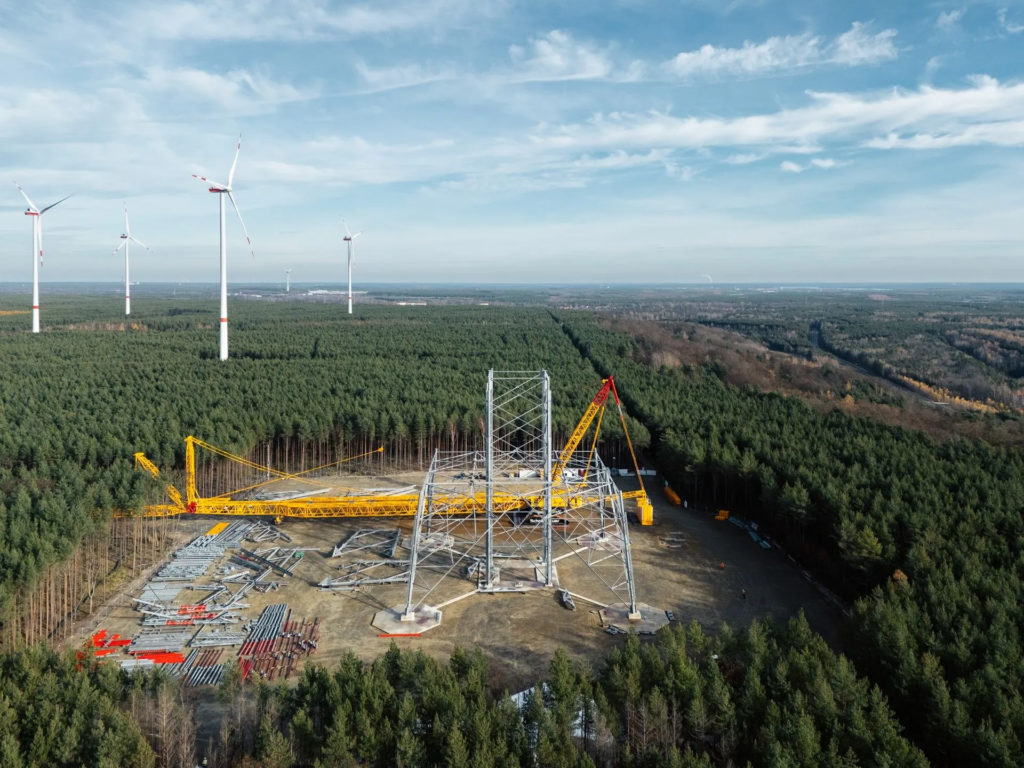
In Schipkau, in German Lusatia, one of Europe’s most advanced new wind generation projects is taking shape. In the area marked for decades by lignite mining, a turbine destined to reach a height of 360 meters is under construction, among the most impressive structures in the country.
The goal is to significantly increase production by taking advantage of stronger and more regular currents found above 300 meters. According to the promoters, the plant will be able to generate between 30 and 33 gigawatt hours per year, with up to 220 percent higher output than conventional turbines installed in the same area. The energy produced would cover the needs of about 7,500 households.
The high-stakes bet
Measurements taken near the site indicate that as the wind rises in altitude, it maintains greater continuity and intensity. This makes it possible to reduce fluctuations in electricity production, a major limitation of renewables.
The technology adopted involves a telescopic structure: the tower is assembled up to about 150 meters and then raised to its final height. A necessary solution, given the impossibility of using traditional cranes for such dimensions.
A test for less windy Europe
The project also directly affects other European areas. In many regions, especially in eastern and southern Europe, weak winds on the ground limit wind development. Access to more stable currents at higher altitudes may expand the number of suitable territories.
Against this backdrop, Germany strengthens its position in the sector: more than 77 gigawatts installed and the highest annual growth recorded by 2025. Government plans call for new auctions and additional capacity to be connected to the grid by 2030.
Schipkau is part of Lusatia’s broader transformation from a mining district to a renewable energy hub. The site will be developed as a hybrid plant: multi-level wind and a ground-mounted solar farm. The combination should increase overall output and better distribute generation throughout the year.
The limit remains the net
The expansion of renewables highlights a structural problem. In Germany, when wind generation exceeds transmission capacity to areas of higher consumption, installations are slowed or stopped. This results in fossil sources being used to cover the remaining demand. About 9.3 terawatt-hours of wind power were lost in 2023, while congestion costs approached 3 billion euros, transferred into bills through grid tariffs.
High-altitude turbines can improve efficiency and encourage a wider distribution of plants. Without infrastructure upgrades, however, output growth is likely to remain partial. Schipkau represents a key transition: on the one hand technological innovation and increased yield, on the other the need to upgrade the electricity system. The resilience of the European energy transition depends also, and above all, on the balance between these two elements.