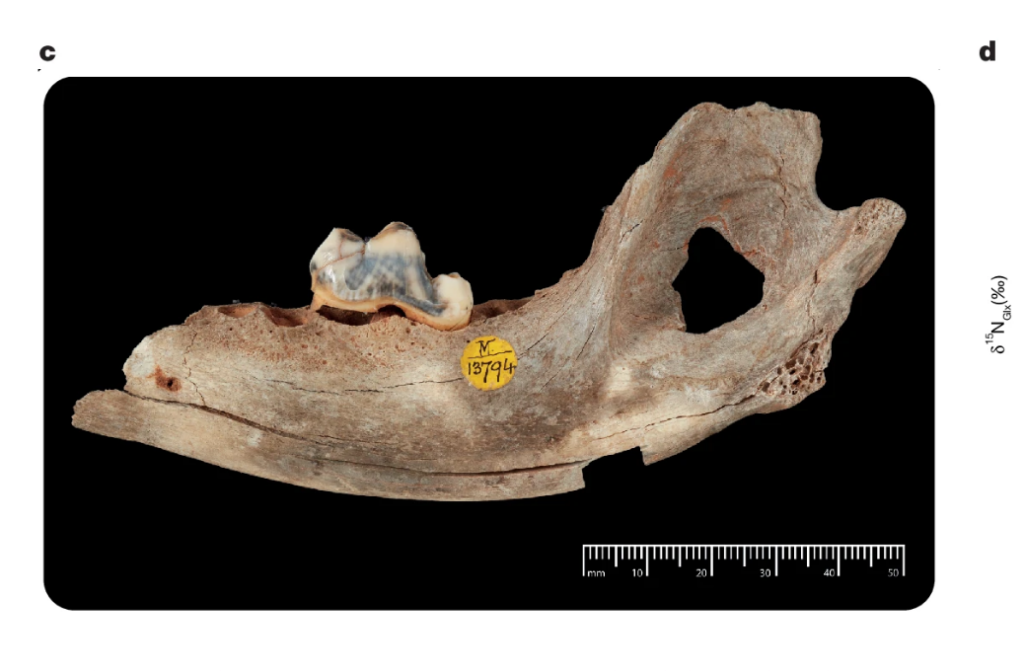
When did dogs start living alongside humans? The answer must be found in the Paleolithic. Two impressive studies published in Nature explain(here and here) that the link between us and canids is much older, deeper and more complex than we imagined. As early as 15,000 years ago, while our ancestors were still nomadic hunter-gatherers, dogs were already a settled presence, distinct from wolves and widely distributed throughout Eurasia.
The primacy of Pınarbaşı
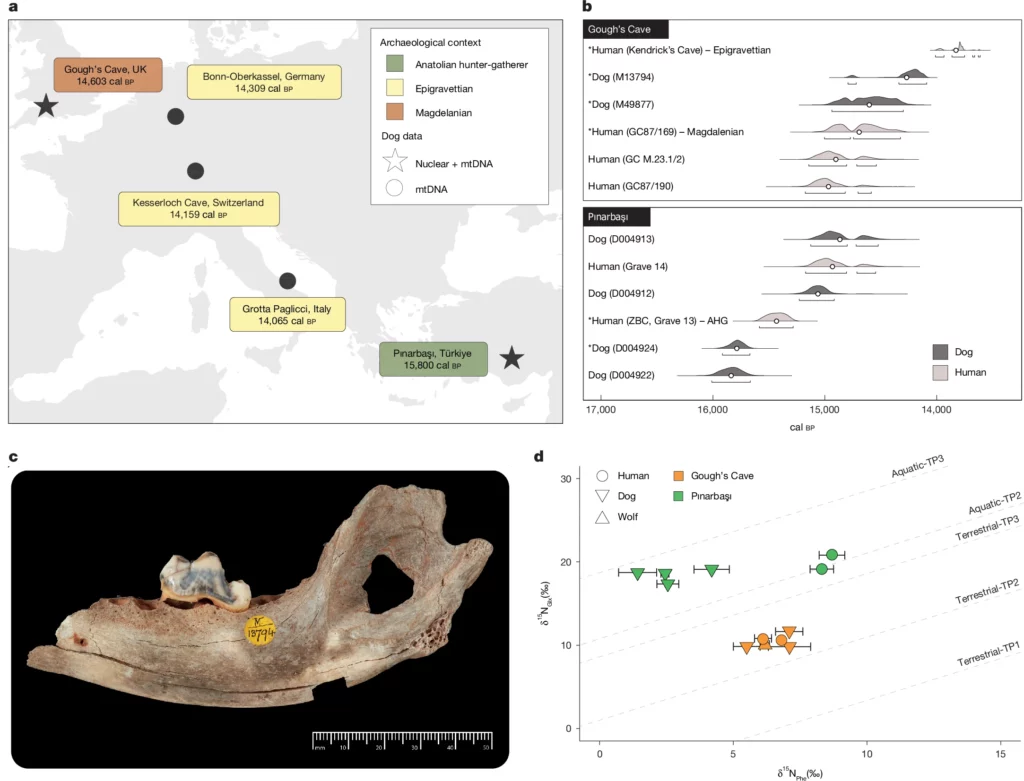
The new analyses are based on a monumental database of more than 200 fossil remains. Although the famous dog from Kesslerloch, Switzerland, remains a mainstay of research, the new data brings the spotlight to Pınarbaşı, Anatolia: here a specimen dating back some 15,800 years has been identified.
Genomic data reveal a surprisingly homogeneous dog population that stretched from England (Gough’s cave) to Turkey. This uniformity suggests that dogs were animals already fully embedded in a human social structure, ready to migrate with their masters or to be exchanged between different tribes.
The mystery of “double ancestry”
One of the most interesting findings concerns the family tree. The data rule out that European dogs are descended from the wolves that then populated Europe. Instead, genetics tells a story of “dual ancestry”: modern dogs appear to derive from at least two distinct wolf populations, probably one located in eastern Eurasia and the other in southwest Asia or the Near East.
Ice Age European dogs arrived on the continent already “trained,” accompanying human migrations. But there’s more: their genetics were more uniform than those of the humans who housed them. This means that dogs moved between communities faster than people, perhaps as valuable gifts or commodities of exchange between different cultures.
Evidence of an emotional bond
At some sites, such as Bonn-Oberkassel in Germany, remains of dogs have been found that show signs of serious diseases overcome only by prolonged human care. Those animals could not hunt, yet they were fed and protected-a proof that, as early as 14,000 years ago, the dog was not just a tool, but a member of the human family.
Analyses confirm this intimacy: dogs and humans shared the same living space and, often, the exact same diet. The boundary between wild and domestic, which we thought had been drawn by agriculture, now appears completely blurred even at the end of the last glacial maximum.
The first archive in our history
The process of domestication today appears to be a long and nonlinear journey of interbreeding, migration and co-evolution. The dog was the first domesticated animal and, together, our first biological mirror.
Canine DNA on the one hand tells the story of the wolves who chose to stay by the fire and on the other hand holds, in its genetic folds, the map of the first great human migratory routes. Before cities, before grain and before writing, we already had someone waiting for us when we returned from hunting. And that someone was already, for all intents and purposes, a dog.