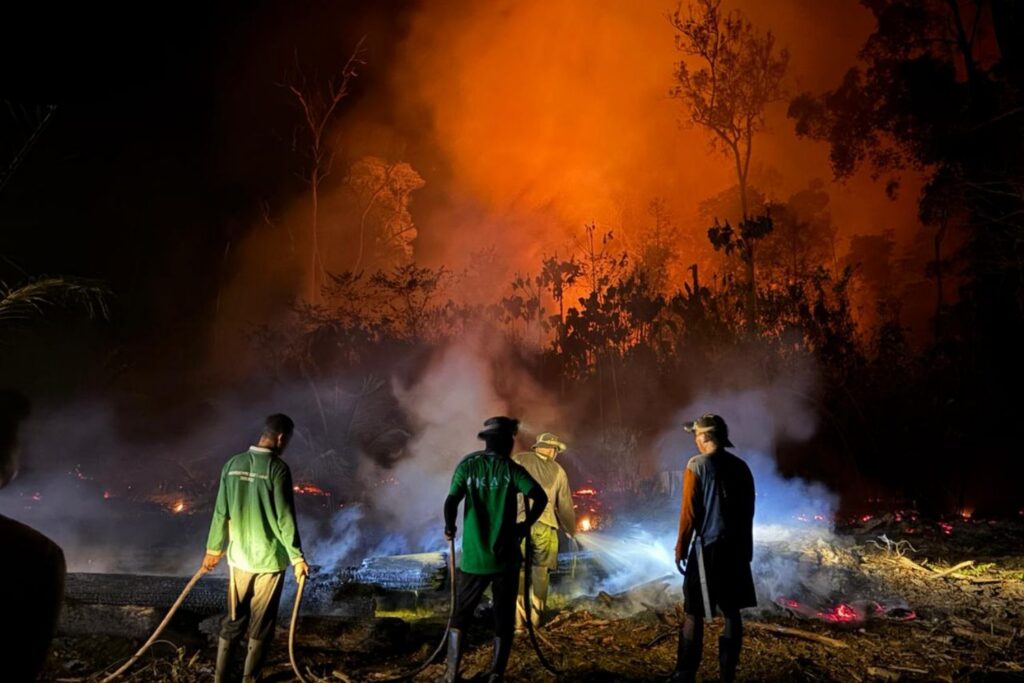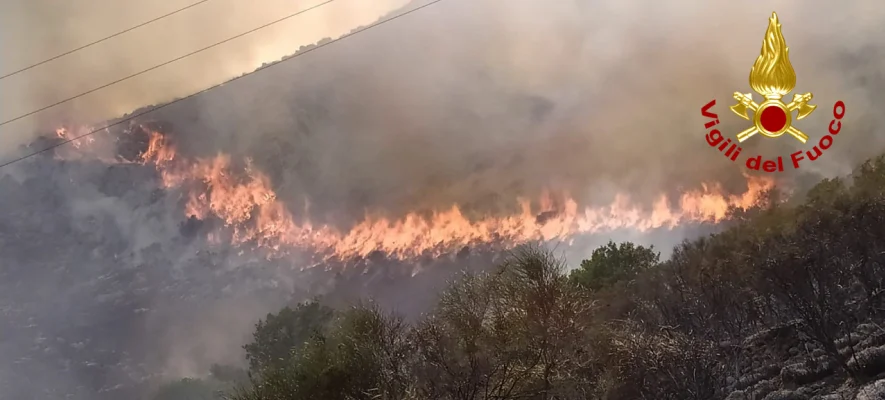
Wildfires in Italy no longer wait for summer. The climate crisis and record-breaking temperatures are extending the critical wildfire season, with fires now breaking out even in spring and winter, before the official start of the forest fire prevention season (AIB), which runs from June 15 to October 15. This is the picture painted by Legambiente’s new report,“Italia in fumo 2026,” released on July 16, at the height of the heatwave. From January 1 to June 15—months that are typically low-risk— there have already been 469 fires —36.3% more than during the same period in 2025 —and 9,545 hectares have gone up in smoke, equivalent to 13,368 soccer fields. At this rate, these figures are likely to exceed the 2025 total: an annus horribilis in which 96,517 hectares were burned, nearly double the figure for 2024.
The New Geography of Fire
It’s not just the calendar that’s changing—the map is changing, too. Regions that until recently were considered low-risk during the pre-summer months are now on the front lines. In the North, Piedmont stands out, with 355 hectares burned compared to 23 during the same period in 2025, and Liguria, with 386 hectares and 10 fires. In central Italy, Tuscany is a cause for concern, where 623 hectares were burned in the province of Lucca in the month of May alone.
Southern Italy, however, remains the epicenter: Sicily leads with 4,769 hectares and 175 fires, followed by Calabria with 1,543 hectares. And once again, Sicily holds the most bitter record, with 1,800 hectares destroyed within Natura 2000 sites—areas of great natural value.
New this year is the Municipal Recurrence Index, which Legambiente is using for the first time to measure the persistence of wildfires in the same areas. The ten most affected municipalities—with between ten and more than twenty fire outbreaks each, all occurring before the AIB season—are all located in Sicily and Calabria: from Montalbano Elicona to Reggio di Calabria, all the way to Papasidero. This is a sign that many of these fires stem from specific vulnerabilities.
Prevention as the True Defense
The association has submitted 14 proposals to the government, starting with a request to move up the start of the AIB season to at least May 15. Among the unresolved issues are the registry of areas affected by wildfires—which many municipalities have never established—and a serious delay in forest planning: only 21% of Italy’s forested area is currently subject to forest planning.
Legambiente is also calling for a transparent and user-friendly national system, modeled after the European EFFIS, as well as stricter penalties for those who start fires. “Prevention is the only truly effective defense against wildfires, along with proper forest management and combating rural abandonment,” emphasizes Stefano Ciafani, national president of Legambiente. According to Antonio Nicoletti, the association’s head of protected areas, fire is now “a cyclical and predictable phenomenon”: the only way forward is to shift “from a response-based approach to a care-based one.”