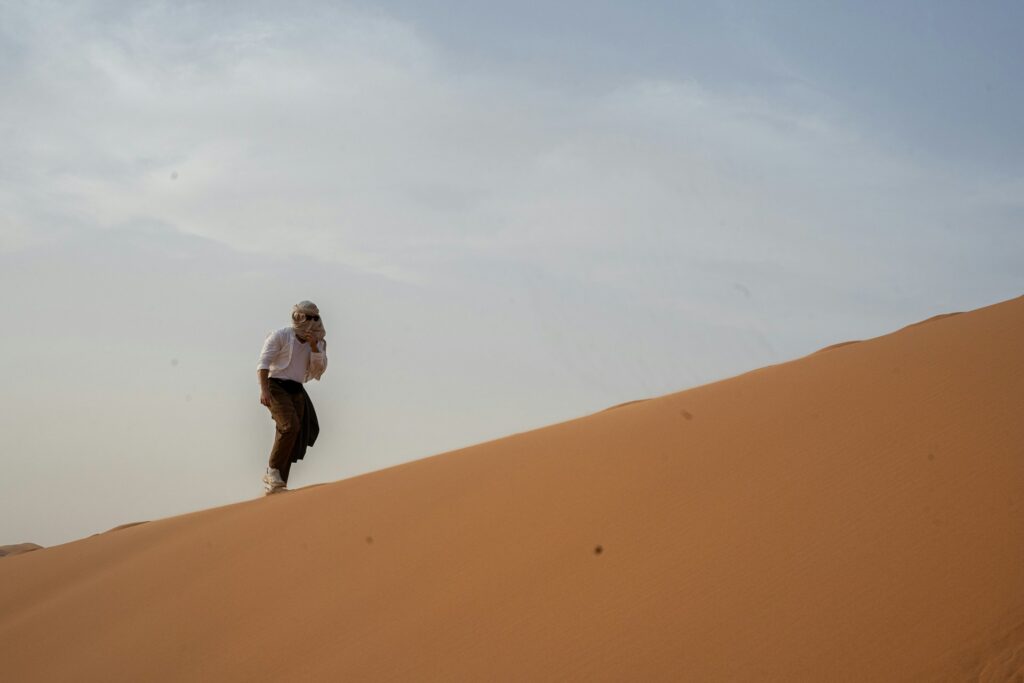
The sky loses its blue hue, the sun appears dull, and cars are covered with an ochre-colored patina. Dust from the Sahara once again drifts over Italy, and, as always, the phenomenon is dismissed as a meteorological curiosity. In reality, it tells us of the vast atmospheric movements linking Africa and Europe, of the Mediterranean as a space of constant exchange, and of a summer in which air masses originating in the Sahara seem to be making the news more and more often.
According to forecasts generated by the Skiron model at the National and Kapodistrian University of Athens, the cloud of mineral dust will gradually affect Italy after crossing the western Mediterranean, with particularly high concentrations over Sardinia and the Tyrrhenian regions before spreading to most of the peninsula.
Much More Than Sand in the Sky
Saharan dust is formed when strong winds lift enormous quantities of mineral particles from the desert. Once they reach high altitudes, these particles are carried by atmospheric currents for thousands of kilometers, all the way to the Mediterranean and southern Europe. This phenomenon occurs several times a year, especially between spring and summer, when atmospheric circulation favors this transport.
On this occasion, however, the phenomenon is intertwined with a new, intense heat wave originating in Africa. As meteorologist Daniele Ingemi notes on Meteo.net, the rise of scorching air from the Sahara will be accompanied by a vast cloud of desert dust, while temperatures in various parts of the country may reach or exceed 40 degrees, with particularly high readings in Sardinia and the inland areas of Sicily.
The Effects You Can’t See
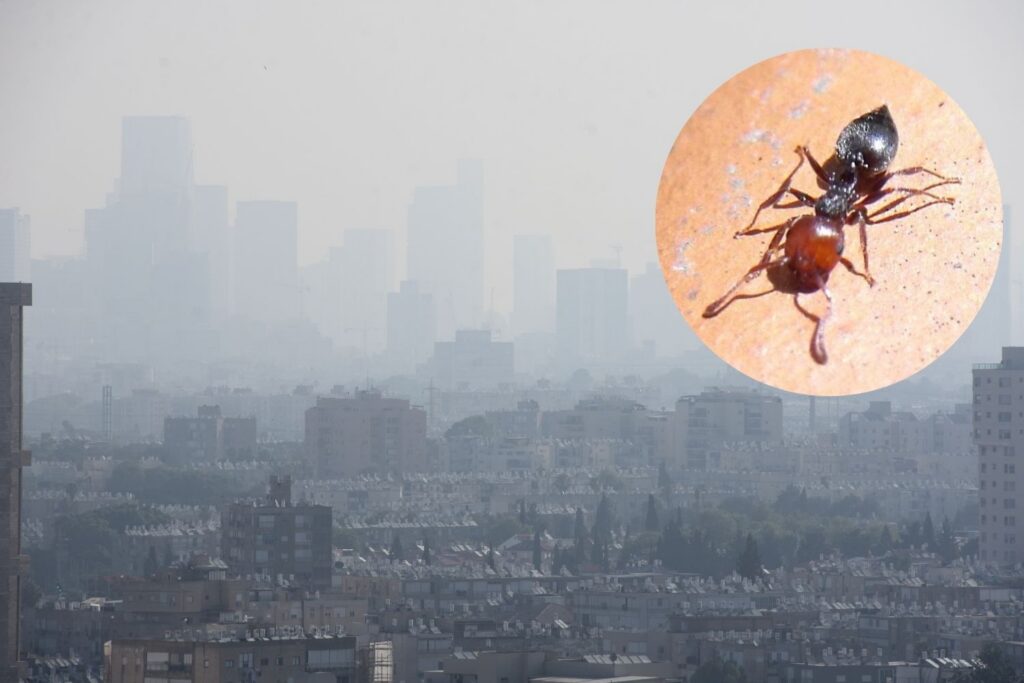
The most noticeable aspect is still the visual one. The sky takes on milky, yellowish, or reddish hues, and visibility can be significantly reduced. After any rainfall, the so-called “red rain” leaves a characteristic layer of sand on cars, windows, and balconies.
But to stop there is to miss the most interesting part of the story. Saharan dust, in fact, carries nutrients—particularly iron—that are a valuable resource for phytoplankton, the organisms at the base of marine food chains. Researchers have also documented that microorganisms capable of reaching new environments can travel alongside these mineral particles: traces of microbial communities originating from the Sahara have even been detected on the glaciers of Mont Blanc.
A Natural Phenomenon in a Changing Climate
It would be incorrect to attribute the formation of Saharan dust to climate change: the transport of dust from the desert to the Mediterranean is a natural process that has been known since time immemorial. What is changing is the context. More intense and persistent heat waves amplify the impact of these intrusions of African air, fueling extreme temperatures and reinforcing the perception of a summer increasingly dominated by exceptional weather conditions.
That is why the Saharan dust cloud is really just one of the many pieces of a complex climate system, where what happens in the desert can affect the skies over Italy, marine ecosystems, and even Alpine environments. This serves as a reminder, once again, that there are no national borders when it comes to the climate: the connections are far more extensive than the weather maps we glance at every day.