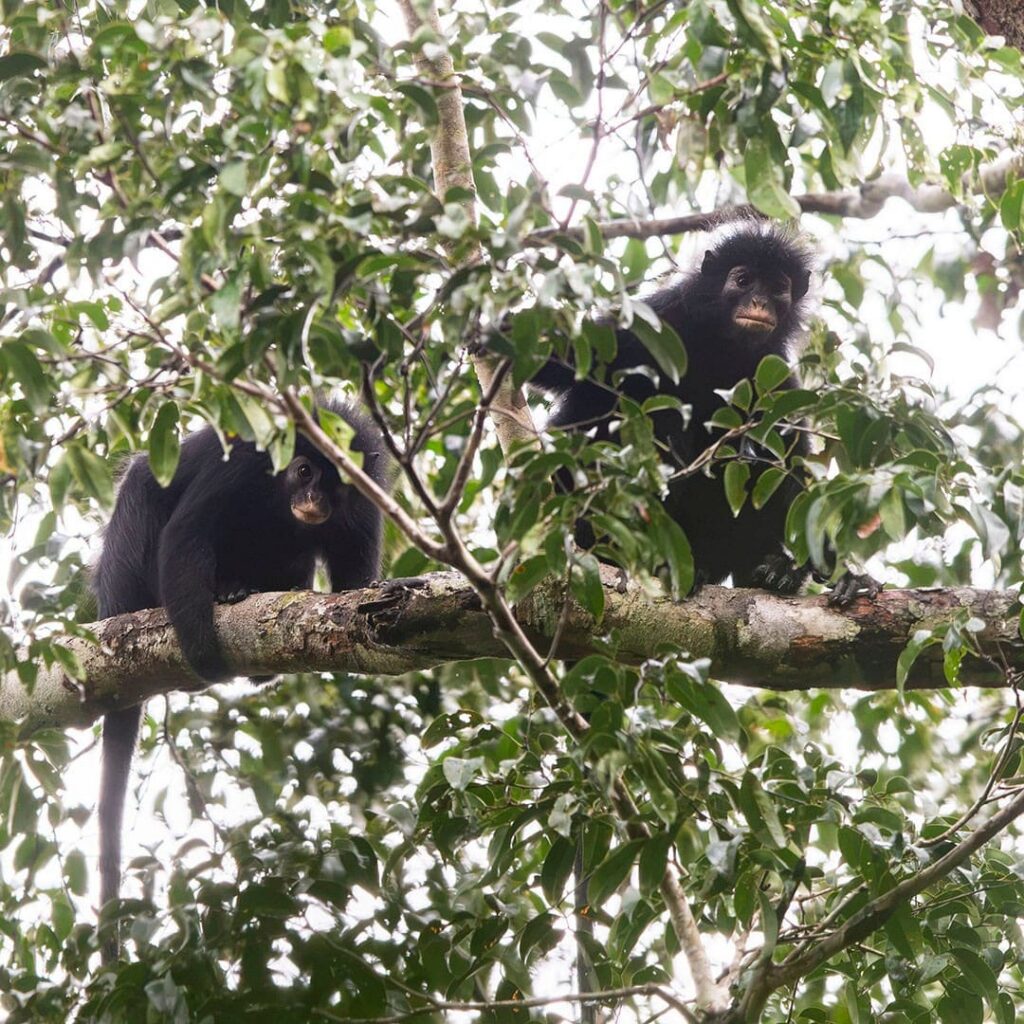
Black, silky fur; a long, flowing tail; a crest of tousled hair around the muzzle; dark eyes framed by slate-gray cheekbones; and, above all, a pair of pinkish-orange lips that stand out like a mask. This is the description of the new monkey species discovered in the forests of the Democratic Republic of the Congo, in the region between the Lomami and Lualaba rivers. Researchers have named it Colobus congoensis; for the Bangala people of the area, it is the “likweli,” while the Mituku call it kasabankoni, meaning “the one who shakes the branches.” The discovery, published in the journal PLOS One, is anything but ordinary: it is only the fifth species of African monkey described in the last 75 years.
Nearly twenty years on his trail
It wasn’t easy to track it down. The first sighting dates back to 2008, when two conservationists from the Lukuru Wildlife Research Foundation took a blurry photo of an unidentified primate in what would become Lomami National Park in 2016. Then there was silence, until November 2018, when a surveillance patrol led by Jean Pierre Kapale managed to photograph the animal again. From there, sightings multiplied: ultimately, the research team compiled 114 field observations, collected between 2018 and 2022 across an area of just 1,700 square kilometers.
An ancient branch of evolution
Genetic and anatomical analyses confirmed that it was indeed a distinct species. Its closest relative, Colobussatanas, lives more than 1,200 kilometers away in central-western Africa; yet the two lineages diverged between 4 and 5 million years ago, one of the oldest evolutionary splits ever documented among colobus monkeys. Its call also sets it apart: recordings show that its deep sounds have a unique acoustic signature.
Discovered Just in Time
However, this enthusiasm is accompanied by a real concern. The likweli’s range is minuscule, and the species is already under pressure from hunting and habitat loss; for this reason, scientists recommend that it be listed as an endangered species. They warn that this story serves as a reminder of just how much biodiversity remains hidden in the Central Congo Basin—and how real the risk is that some of the planet’s rarest creatures will disappear before the world even knows they exist.