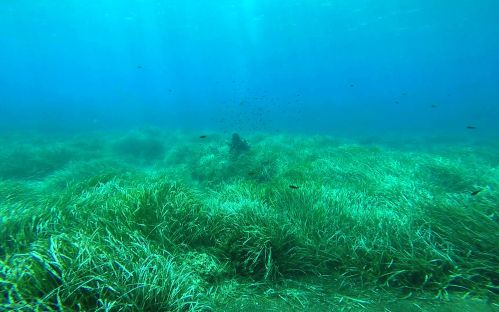
At a depth of 50 meters, light is a rare commodity. Water absorbs red and infrared radiation almost completely, allowing mainly blue light to reach the seabed—light that is less conducive to photosynthesis. Yet Posidonia oceanica continues to grow, forming extensive and highly productive seagrass meadows that are essential for the Mediterranean’s biodiversity and for the sea’s ability to store carbon. How it manages to do so has long remained an open question.
Now, a study published in *Nature Communications* provides an answer. The study, coordinated by the Anton Dohrn Zoological Station in Naples and the University of Verona, with contributions from the National Research Council and the Polytechnic University of Milan, has identified the evolutionary mechanism that allows Posidonia to make extremely efficient use of the limited light available on the seafloor.
An Extraordinary Photosynthetic System
The study, titled“Structural and Spectral Adaptation of the Seagrass Posidonia oceanica Photosystem I to Seabed Light,”shows that, over the course of evolution, the plant has altered the structure of photosystem I, one of the molecular complexes responsible for photosynthesis.
Thanks to a light-harvesting system that is more extensive than that of terrestrial plants, Posidonia is able to capture a greater number of photons. This is an essential advantage in an environment where light is limited, but it also presents a challenge: as the size of the photosynthetic antenna increases, so does the distance the energy must travel to reach the reaction center, with the risk of it being lost along the way.
The Adaptation That Makes All the Difference
To understand how the plant overcomes this limit, the researchers used two-dimensional electronic spectroscopy (2DES), a technique that allows them to track energy transfer on time scales of a few femtoseconds—that is, millionths of a billionth of a second.
The analyses revealed a highly precise molecular adaptation. Over the course of evolution, Posidonia has gradually abandoned certain specific chlorophyll conformations—known as“red spectral forms,” which are common in terrestrial plants—and instead selected configurations capable of accelerating energy transfer to the photosynthetic reaction center. The result is a system that compensates for the larger size of the antenna and maintains high photosynthetic efficiency even under the most challenging light conditions.
To achieve this result, the researchers reconstructed—for the first time and at atomic resolution—the three-dimensional structure of Posidonia’s photosystem I using cryo-electron microscopy.
From the Sea to the Farmlands
The evolutionary history of *Posidonia oceanica* is unique. Between 70 and 100 million years ago, certain groups of higher plants, after adapting to life on land, returned to colonize the marine environment, giving rise to the submerged seagrass meadows that today characterize much of the Mediterranean.
Research suggests that these changes could have implications beyond marine ecology. Understanding the mechanisms that allow Posidonia to use light with such high efficiency could, in fact, provide new tools for synthetic biology applied to agricultural crops. Reproducing similar adaptations in cultivated plants would mean improving the use of available radiation, thereby increasing productivity without expanding agricultural land.
For now, this is merely a research prospect. But it demonstrates how the study of marine ecosystems can yield useful knowledge even in seemingly unrelated fields. Posidonia seagrass meadows are already considered essential to the health of the Mediterranean; now they tell the story of an evolutionary process capable of finding solutions that science is beginning to explore in greater depth.