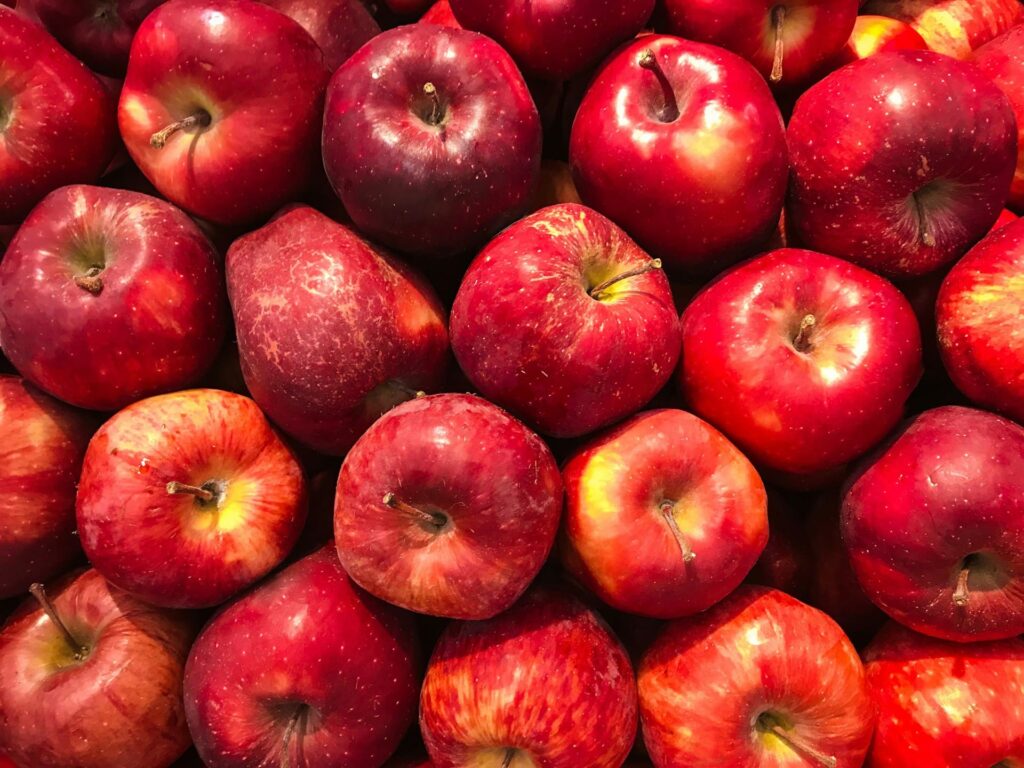
That apples are among the most pesticide-treated fruits is nothing new. And now further confirmation comes from“Pesticide cocktails, PFAS and neurotoxins in most European apples,” the report just published by PAN Europe, a European coalition of nongovernmental organizations. The study is based on analysis of 59 samples of apples purchased in 13 European countries, including Italy. The picture that emerges is consistent with what has been documented in the past: the vast majority of conventionally grown apples have multiple pesticide residues at once. Not one, but two, three, up to real “cocktails” of chemicals on the same fruit.
The reason is partly agricultural and partly commercial. Apple trees are particularly vulnerable to fungi, insects and diseases such as scab, and the fruit industry demands perfect, shiny, spotless fruit with a long shelf life. The result is that apples are historically among the crops that receive the most phytosanitary treatments each year. Moreover, from a commercial point of view, criteria of formal homogeneity prevail in large-scale distribution, which is another impetus for the intensive use of synthetic chemical products.
The node of the “cocktail effect“
European regulations set safe limits for each pesticide taken individually. In many cases, the residues detected are formally within legal parameters. The problem, however, is a different one: the coexistence of multiple substances on the same food and the possible interactions between them once ingested: attention is growing not only to the single substance, but to their combination that escapes regulation.
This is the so-called “cocktail effect,” an issue the scientific community has been harping on for years. Even doses considered safe, when combined, can produce different – and potentially more harmful – effects than those assessed individually. A gray area that regulation still struggles to address systematically.
PFASs also
The residues identified also include substances that are particularly persistent in the environment, including molecules belonging to the PFAS, so-called “eternal pollutants.” Compounds that do not easily degrade and can accumulate in soil, water and living organisms.
Pesticides classified as “candidate for substitution,” i.e., substances that the European Union considers to be among the most problematic and should be phased out, also appear in many samples.
One striking finding concerns the comparison with the limits set for baby food. Applying the most stringent parameters valid for young children, most of the apples analyzed should not be sold.
This survey thus sounds like a confirmation of the risks associated with intensive use of chemically synthesized pesticides of which the dominant agricultural model continues to make extensive use. For consumers, the indications remain the same for years. Organic is the choice that offers the most guarantees. While thoroughly washing fruit or peeling it often does not solve the problem because many chemical synthetic pesticides used are systemic, that is, they can seep into the flesh of the fruit.