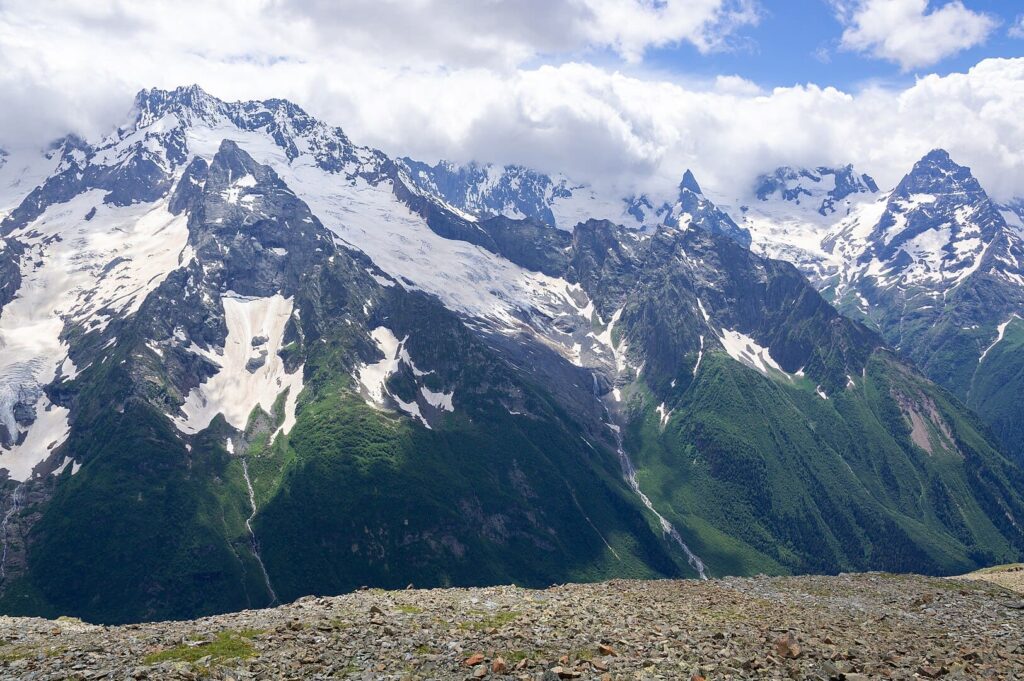
In the South Caucasus, the total area covered by ice and snow (the cryosphere) is receding at a rate that has no equivalent except in very few other regions of the Planet. The new policy brief from UNEP‘s Adaptation at Altitude Programme,“Melting Heritage: Adapting to a Changing Snow and Ice Cover in the South Caucasus,” confirms that the area is experiencing the world’s second-highest rate of ice mass loss relative to total volume.
A rapidly declining cryosphere
Between 2000 and 2020, the area occupied by glaciers has in fact shrunk by more than 23 per cent, with marked variations from country to country: in Azerbaijan the decrease reaches 77 per cent, in Georgia 24 per cent.Armenia, with no glacial cover, however, observes a change in seasonal snowfall, which now lasts eleven days less and shows a reduced average depth of three centimetres.
The response of Caucasus glaciers to rising temperatures is above the global average. According to the analyses presented, keeping warming within +1.5 °C would preserve about 40% of the ice mass. An increase of +3 °C, on the other hand, would almost lead to total deglaciation. Current international commitments place the Planet along a trajectory between +2.3 °C and +2.5 °C-a scenario that brings the region closer to the real possibility of losing most of its glaciers by 2100.
Water resources and increasingly exposed territories
The shrinking cryosphere is changing the hydrological dynamics of the Caucasus, on which water supply, agriculture, and even energy depend. Shrinking snowpack and glaciers are altering seasonal river flows and increasing pressure on groundwater resources. And meanwhile, since 2000,
Slope destabilisation, caused by glacial retreat and permafrost degradation, amplifies natural hazards such as landslides, rockfalls, ice avalanches, and GLOFs (flooding from glacial lakes). The 2023 incident in Shovi, Georgia, where a rock and ice avalanche caused a deadly debris flow, highlights how vulnerable the territories already are.
In the face of these changes, cryosphere monitoring remains insufficient. Regional systems to observe permafrost and glacial lakes are lacking, whilst access to environmental data-including snow and ice data-remains limited in Armenia, Azerbaijan, and Georgia, despite international commitments. The policy brief, a result of the Regional Adaptation Dialogue in the South Caucasus (RAFISC), recommends integrating the snow-ice component into National Climate Adaptation Plans and building a coherent monitoring network, combining in situ and satellite observations.
Such a rapidly dissolving glacial heritage calls for technical measures and, above all, imposes responses capable of holding together ecology, security and access to resources, before the point of no return is reached.