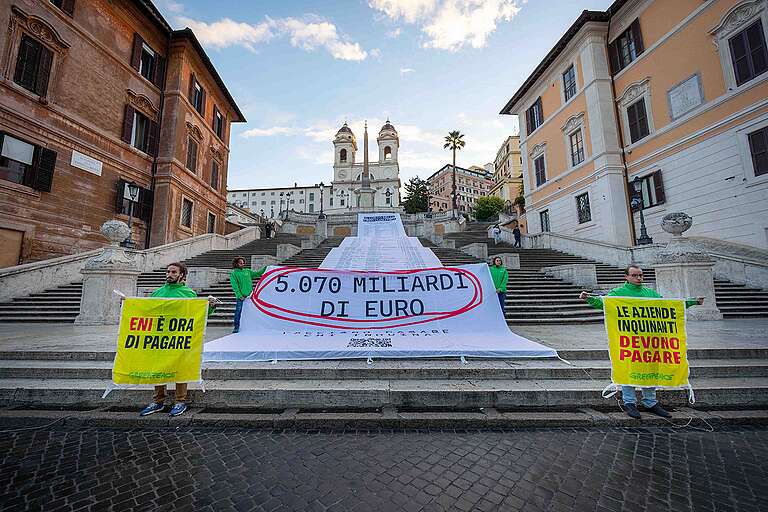
A metre-long receipt unrolled in Rome’s Piazza di Spagna. It is not a receipt from a shopping spree, but the bill that Greenpeace Italy presented to the government and big oil companies on 29 October: more than 5 trillion euros. That is the figure the environmental organisation attributes to the economic damage caused by emissions from six fossil fuel giants between 2016 and 2025.
The initiative comes as extreme weather events, not least Hurricane Melissa, multiply around the world. A list of 200 climate disasters over the past decade stands out on the giant receipt: from the Emilia-Romagna flood of 2023 to devastation that has affected communities on every continent from the Pacific to Africa.
The methodology: how much does a ton of CO₂ cost.
The new analysis published by Greenpeace quantifies for the first time in monetary terms the impact of emissions from six of the world’s largest fossil fuel companies, including Italy’s Eni, in the period following the signing of the Paris Agreement. The methodology used is based on the Social Cost of Carbon (SCC), a tool that translates each tonne of CO₂ emitted into an economic loss calculated by considering the effects on health, food security, sea level rise and extreme events for the entire period that carbon dioxide will remain in the atmosphere.
According to the analysis, conducted by independent scientists, Eni alone would be responsible for 460 billion euros in damages. This is a mind-boggling figure, especially when compared with the record profits recorded by oil companies in recent years.
“It’s time to change the rules of the game,” declares Simona Abbate of Greenpeace Italy. The organisation is calling on governments to tax big polluters and allocate revenues to energy transition and land security. The proposal will be the focus of two international events in November: the COP30 and the UN Global Tax Convention negotiations.
The numbers emerging from the Lancet Countdown on Health and Climate Change 2025 report give a concrete sense of the emergency in Italy: in 2024, Italians faced an average of 46 days of heat waves, with a loss of 364 million potential work hours. A record 15 hours per person.
Eni’s retort: “Misleading analysis.”
Eni’s response was not long in coming. In a note, the company radically disputes Greenpeace’s approach: “Greenpeace misrepresents the scope and purpose of the Social Cost of Carbon,” writes the Italian giant’s press office. According to Eni, SCC estimates are designed to provide aggregate cost-benefit indications of climate policies, not to attribute direct economic responsibility to individual companies.
The company calls the exercise “simplistic and even misleading,” pointing out that it does not take into account individual consumption choices or the role of governments in climate policies. Eni also points out that SCC estimates can vary enormously depending on the parameters chosen, such as the discount rate applied, and that the scientific community has not commented on whether specific shares of the global climate cost can be imputed to individual companies.
The debate touches a nerve: who should foot the bill for the climate crisis? According to a poll cited by Greenpeace, eight out of ten Italians would support raising taxes on fossil fuel companies to cover climate damage, as long as the burden does not fall on consumers’ bills.
The call to tax big polluters will be taken to the streets on 15 November at Climate Pride in Rome, the national mobilisation that will coincide with the days of the Belém COP. An event that promises to be crucial in the tug-of-war between environmentalists, companies and governments over the Planet’s energy future.