The news was expected, but the outcome was by no means a foregone conclusion: never before had a country seen the totality of its gastronomic tradition recognised by UNESCO. True, in the past, some countries had seen individual gastronomic practices celebrated-from
But now the UNESCO Intergovernmental Committee, meeting in New Delhi, has placed the whole of Italian cuisine on the World Intangible Cultural Heritage List. A record that says a lot about the international weight of our food identity, as well as Italy’s ability to present a dossier – necessary for candidacy – that is rigorous, cohesive and convincing.
A living heritage
Promoted by the Ministry of Agriculture, Food Sovereignty and Forestry and the Ministry of Culture, the bid was based on one idea: to describe Italian cuisine as a social practice. Indeed, in the dossier, which was approved with an initial positive opinion as early as Nov. 10, the definition of“cuisine of the affections” recurs: an expression that sums up a tradition in which knowledge, rituals, daily gestures and a plurality of local histories are interwoven.
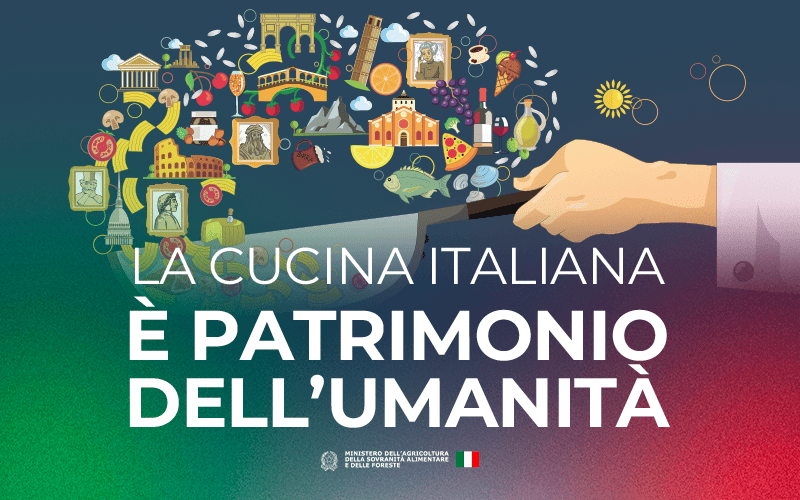
The strength of the candidacy is this: to avoid the temptation to “musealise” cuisine and instead restore it in its dynamic, ever-evolving nature. A model that reflects the relationship between territories, seasons, communities and, today,
The measurable effects of the title
According to models based on data from the Bank of Italy, Unioncamere and Movimprese, UNESCO inscription could generate between +6 per cent and +8 per cent in tourist presences, equivalent to about 18 million additional visits in two years. This is not a gamble: there are precedents that show the multiplier effect of intangible heritages.
This is the case of Pantelleria’s “bush vine,” which was inscribed amongst the intangible heritages in 2014: since the recognition, local agritourism businesses have registered an average annual growth of 24.7 per cent, with an overall increase of 500 per cent in ten years. The UNESCO title has transformed an agricultural tradition into a real tourist and commercial driver, making the island more visited even out of season.
Similarly,“the art of the Neapolitan pizzaiuoli,” recognized in 2017, has had a direct impact on training and export of the tradition: professional courses have increased by 284 per cent, while accredited pizza schools abroad have increased from 5 to 26. In both cases, UNESCO recognition has not only enhanced culture, but created concrete and sustainable economic opportunities for the territories involved.
A long journey
Cooking as an element of identity becomes, thus, also an economic asset. The UNESCO candidacy was supported by a national campaign involving territories, associations, cooking schools, institutions and communities. The goal was to show what cuisine represents for the country: a shared language before even a productive sector.
The end result is a framework that officially recognises what has always been evident in Italy: the kitchen is a place where modernity does not erase tradition but renews it.
By joining the UNESCO List, Italian cuisine becomes the first in the world to be recognised in its entirety as an intangible heritage. It is a title that engages, because it calls for the protection of a wealth that must be nurtured and told. A heritage that is cultivated and passed on every day, from breakfast to dinner.