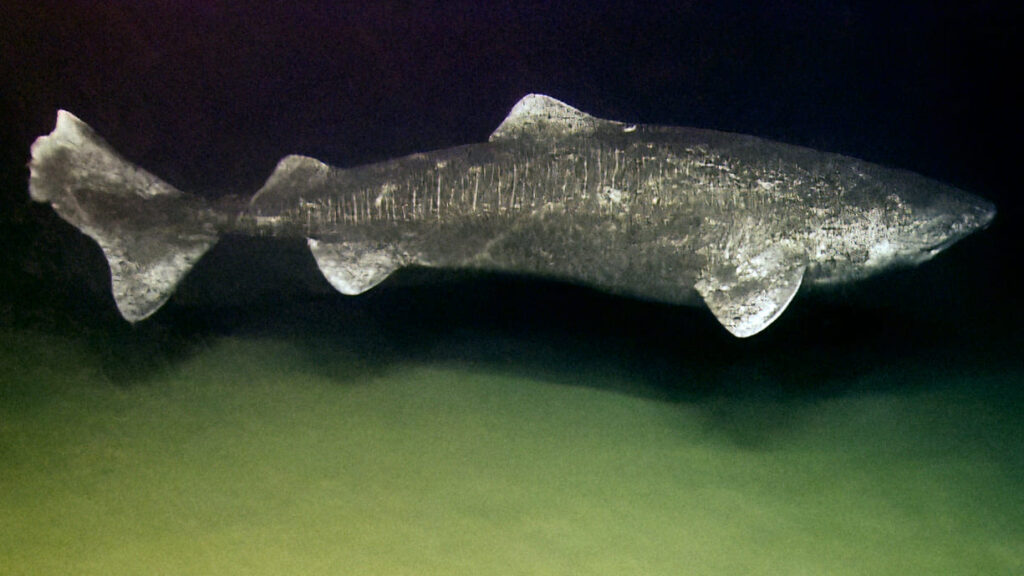
For years, the longest-lived vertebrate on Earth has been described as a clumsy, nearly blind and particularly slow-moving animal. A survivor from the past that roams the cold waters of the Arctic feeding on carcasses. Greenland shark, Somniosus microcephalus, has entered the scientific and media imagination as a kind of living relic. Today, however, that image is beginning to creak.
New research is challenging some of the most deeply held beliefs about this species, considered among the least understood on the Planet. Starting with one of the most widespread: the idea that it was functionally blind.
The discovery that changes perspective
In early 2025, a team of researchers from five universities published a study that overturns decades of assumptions. Analyzing in detail the structure and function of the retinas of Greenland sharks, the scientists found that these animals are able to perceive light and contrast.
A result that is far from obvious. Sharks’ eyes often appear opaque and infested with parasitic copepods hanging from the cornea. This very feature had fueled the idea of near-total blindness. Instead, the retinas turn out to be structurally intact and surprisingly resilient, despite extreme Arctic conditions and prolonged exposure to parasites.
“Greenland sharks represent an absolute mystery,” Jena Edwards, a Canadian marine ecologist, explained to the Guardian.
A more active predator than expected
The revision is not just about vision. Field observations are also redrawing the behavior of this species, which can exceed six meters in length. Remains of caribou, moose, polar bears, belugas and narwhals have been found in their stomachs. Not all of these findings can be explained by simple carcass consumption.
Nigel Hussey, among the world’s leading experts on Greenland sharks, told the British newspaper that he has observed them moving with astonishing precision. Five years ago, during a submersible expedition off Svalbard Islands, he saw these sharks dive almost vertically between the surface and the seafloor, covering a much wider range of movement than previously thought.
“We greatly underestimate them,” Hussey pointed out. According to him, they could be opportunistic predators capable of ambushes, a hypothesis also reflected in Inuit oral tradition.
Doubts about record longevity
Another key question remains open: age. A study published in Science in 2016 had estimated, through radiocarbon dating of the lens, that some specimens could be nearly 400 years old, making the Greenland shark the longest-lived vertebrate known.
But that estimate is looked at more cautiously today. The methodology used, based on the carbon-14 “pulse” produced by nuclear tests in the 1950s, has significant margins of error when applied to time intervals of a few centuries.
“This kind of method is difficult to use for animals that are hundreds of years old,” Hussey explained. Longevity remains exceptional, but the 400-year idea may be less solid than previously thought.
A future full of unknowns
Uncertainties increase as we look at climate change. The Arctic is warming faster than any other region on the Planet, and this could push Greenland sharks into deeper, colder waters.
According to Hussey, their generalist diet may help them adapt. But huge holes in knowledge remain, especially about reproduction: the last documented pregnant female was in 1950, and even today it is not known where they breed or how many young they have.
The Greenland shark, more than a living fossil, thus confirms itself as a mirror of the limits of scientific research in the deep oceans. An animal that continues to elude simple definitions, forcing science to revise its certainties.