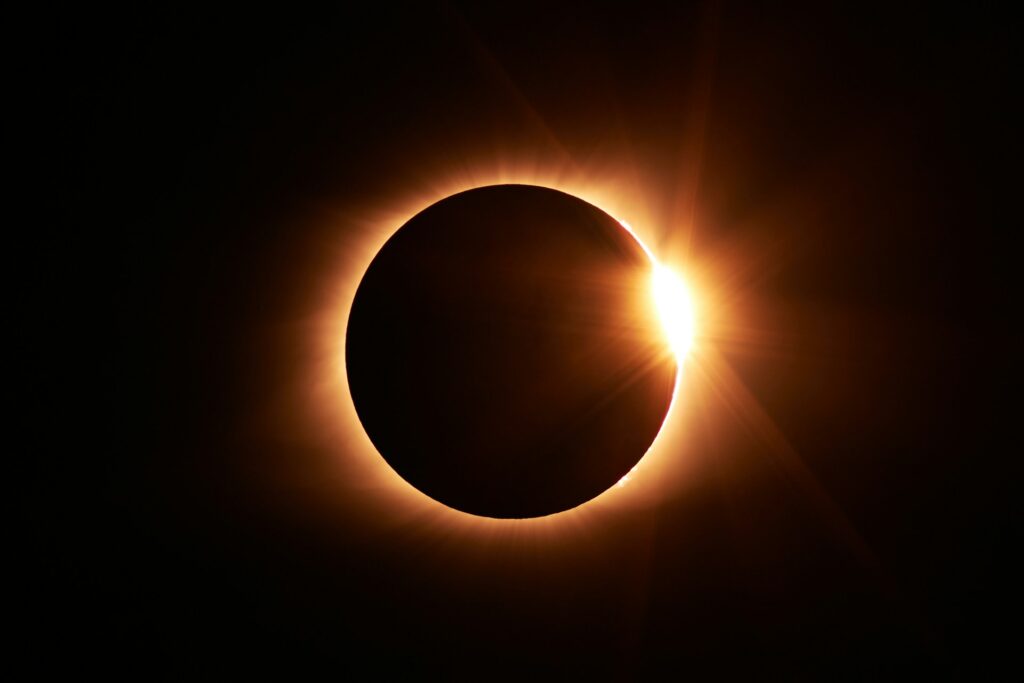
If you like celestial phenomena, August 2, 2027 is a date to circle in red. On that day, the Sun will disappear behind the Moon for 6 minutes and 23 seconds, an exceptional duration for a total solar eclipse: about three times a “normal” one. The number comes from astronomical calculations confirmed by international observatories and space agencies.
Be careful, however, not to overdo the superlatives: it will not be the longest eclipse ever in Earth’s history (some prehistoric eclipses have exceeded seven minutes, according to astronomers’ calculations), but it will be the longest in the 21st century and one of the most extensive ever observed in modern times. Which is no small thing, indeed.
Because it will last so long
The explanation is all in celestial geometry. On August 2, 2027, Earth, Moon and Sun will be aligned almost perfectly. What’s more, the Moon will be relatively far from Earth, whilst our Planet will be close to aphelion, i.e., the farthest point from the Sun. That is, the Moon will appear “just right” to completely cover the Sun’s disc, and it will do so slowly, without rushing.
From Italy the spectacle will be only partial, so no night in broad daylight. Instead, the total eclipse will be clearly visible in North Africa and the Middle East, where the sky will really go dark for more than six minutes.
A very exclusive club
Such long eclipses are extremely rare. On average, a total one lasts less than two minutes. To find something comparable one has to go back in time or look at very select events.
In 1999, the total eclipse visible across much of Europe-including Italy, though not at its maximum-lasted just over two minutes and has remained etched in the collective memory.
In 2017, the “Great American Eclipse” crossed the United States from coast to coast, lasting a maximum of about 2 minutes and 40 seconds, becoming a global media event.
In 2024, another total eclipse in North America exceeded four minutes, but we are still a long way from the abundant six in 2027.
And then there is the 1919 eclipse, famous not for its duration but for its scientific consequences: by observing it, astronomer Arthur Eddington confirmed a prediction of Einstein’s general relativity. A case in which darkness shed light on modern physics.
Looking at the sky, but with judgement
The 2027 eclipse will therefore be a major astronomical event, destined to enter books and documentaries. Even if it will not be total from Italy, it will be worth observing – always with appropriate filters, because the Sun does not forgive distractions.
In short, it won’t be the longest ever, but it will be long enough to remind us of one simple thing: every now and then the sky still manages to amaze us, without the need for special effects. All we have to do is look up. And know when to do it.