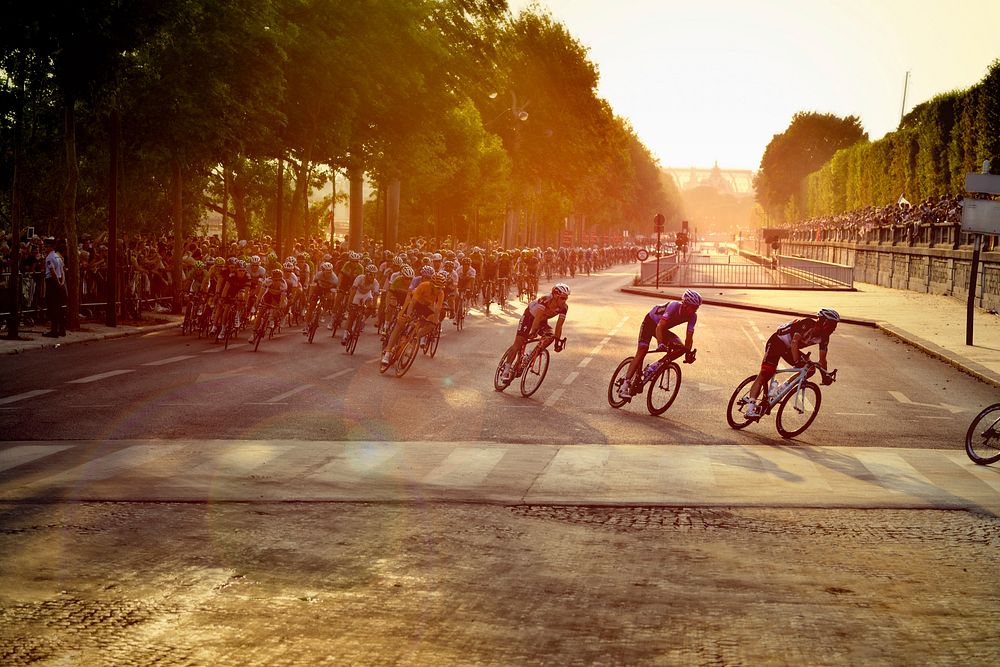
Over the past half-century, the risk of heat stress along the Tour de France has increased with a regularity that leaves no room for doubt. This is said by a study published in Nature, led by Ivana Cvijanovic (IRD) together with researchers from ISGlobal and London School of Hygiene & Tropical Medicine. The analysis cross-referenced climate data from more than 50 editions of the race, from 1974 to 2023, showing how the high-risk threshold defined by UCI protocols has been increasingly approached.
The key parameter is the WBGT, the index that is not limited to air temperature but combines humidity, solar radiation and wind to estimate the real impact of heat on the human body. Because it matters not only how many degrees the thermometer reads, but also how much that heat weighs on the body. Exceeding 28 °C WBGT means entering a critical zone for athletes’ health.
Closer and closer to the threshold
The results show a clear trend: potentially dangerous conditions have increased, especially in the last decade that concentrates the greatest number of extreme heat episodes. Paris, for example, exceeded the high-risk threshold five times in July, four of them after 2014. Many other French cities have experienced numerous days of intense heat, although-due to a combination of timing and geography-not always coinciding with the passage of the race.
A “climatic fluke” that may not last, however. Heat waves are becoming more frequent, longer and more intense. Avoiding extreme conditions for a few days or a few tenths of a degree is not a strategy that can last.
New heat hotspots
The study identifies some particularly exposed areas. In the southwest Toulouse, Pau and Bordeaux stand out; in the southeast Nîmes and Perpignan. But the most interesting finding concerns large cities: even Paris and Lyon are emerging as new heat stress hotspots. This signals that the problem is not confined to the traditionally more torrid regions, but now involves much of the country.
In contrast, the mountain stages-Col du Tourmalet, Alpe d’Huez-historically remain within low to moderate risk thresholds. Altitude offers a kind of “thermal insurance,” at least for now.
Not only where, but also when. Morning hours turn out to be the safest time slot, while in the afternoon high levels of heat stress may persist until late. An operational detail that weighs: anticipating departures or arrivals may become an increasingly necessary measure.
Performance vs. health
Heat also affects performance, sure, but more importantly it poses a real health risk: dehydration, heat stroke, collapse. The UCI has introduced safety protocols based on climate thresholds, but a universal standard shared across disciplines and federations is still lacking.
The Tour thus becomes an open-air laboratory of the challenges posed by global warming to European summer sporting events. With rising temperatures, adapting calendars, routes and protection strategies is no longer a prudent option, but a necessity. To protect athletes, staff and spectators.
Cycling is used to epic feats. But this is not about enduring a few extra kilometers: it’s about racing against a changing climate. And which, unlike cyclists, knows no finish lines.