As travel resumes after the Covid break, the issue of the environmental impact of transportation will also return to centre stage at COP30, the United Nations climate conference in November in Belém, Brazil.
The point most often stressed is the impact of air travel, which is undoubtedly high and is likely to require a switch to aircraft power systems that have not yet been perfectly fine-tuned (we talk mainly about the latest generation of biofuels and hydrogen).
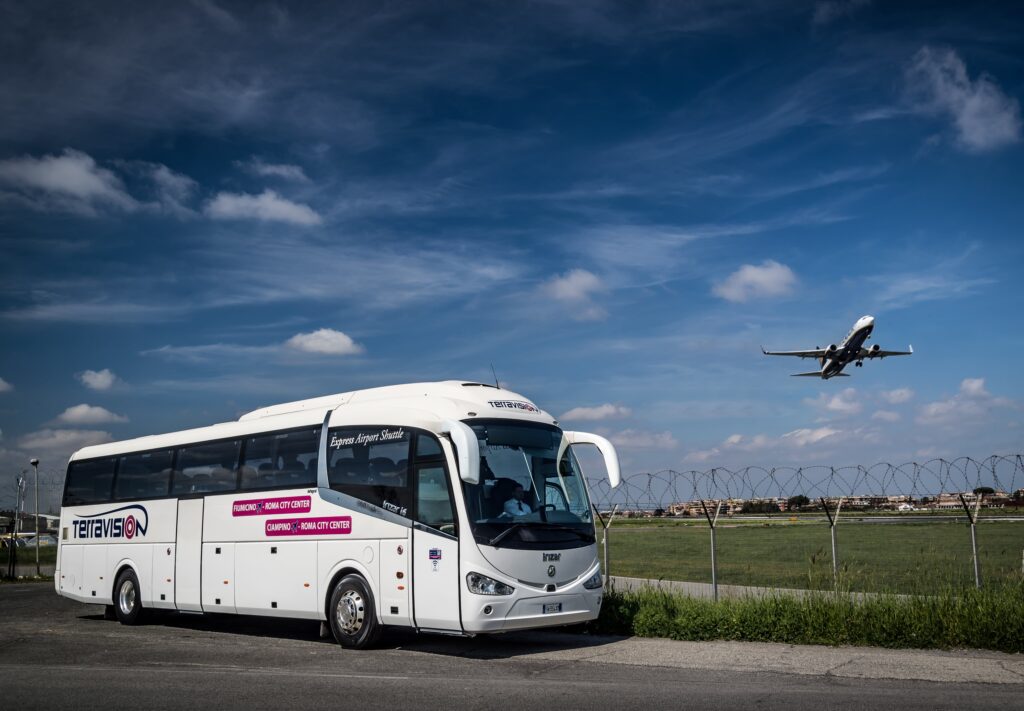
But there is another aspect that should not be underestimated and on which immediate action can be taken: the so-called last mile, i.e., the urban leg of the traveller’s route when choosing to fly. How to move from the city to the airport?
The emissions of a petrol car
In cities where the rail option is not there, there are two alternatives: car or bus. Let’s try to compare the respective impact. Analysis of average emissions shows that car registrations in January 2025 were just under 120 g/km of CO₂. Previously registered cars have higher emissions, so the average is higher. But suppose the emissions of a person travelling by car to the airport are only 120 grammes per km.
An intercity bus (typical for airport transfers) emits about 822 g CO₂/km in total. Let us conservatively calculate that the average number of passengers is 35 passengers: this means 23 g CO₂ per passenger per kilometre. Thus, for a single traveller to choose the bus instead of the car means cutting down the impact of urban travel by 5 times.
Sharing the journey
In addition, sharing the trip with other passengers decreases the number of vehicles on the road, contributing to less traffic congestion. And airport shuttle services—considering fuel, tolls, and parking—are often cheaper than the costs associated with using a private car.
In conclusion, travelling by coach to and from the airport is significantly more sustainable than using a private car, especially if it is used by a single person. And the gap could widen if coach fleets adopt a shift to less impactful fuel systems ahead of private cars. A possibility that governments could make more likely by incentivising the shift to electric buses with facilitation and charging systems at airports.