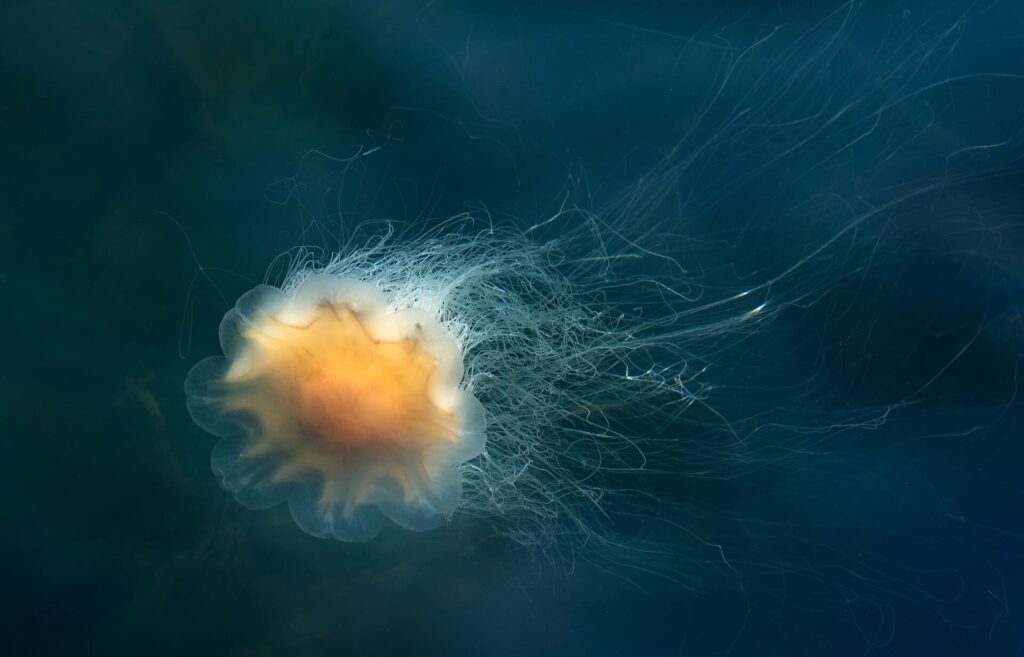
The beaches of Melbourne, South Australia, have turned into an unusual, almost surreal scene in just a few days. The waters of Port Phillip Bay have become saturated with red jellyfish, the so-called lion’s mane, pushed ashore by seasonal currents and winds. The sea, especially in the more sheltered parts of the bay, has filled with gelatinous shapes floating on the surface that, in some stretches, make swimming impossible.
The phenomenon has affected several coastal locations from Altona to the Mornington Peninsula, forcing authorities to temporarily close some beaches for safety reasons. The jellyfish observed these days are not gigantic: many are about the size of a peach, but have long stinging tentacles that can cause painful stings even when the animal is already dead and lying on the shoreline.
A combination of factors
The species involved is a jellyfish native to Australian waters that has always been present in the area. So this is not an alien invasion, but a sudden increase in visible population, an event that occurs cyclically but this time has taken on particularly noticeable proportions. Jellyfish, after all, are not great swimmers: they follow currents and are carried along by the wind. When conditions are favorable, they tend to concentrate in large clusters that easily end up near the coast.
Underlying this “onslaught” would be a combination of environmental factors. Water temperatures, higher than the seasonal average, favor the growth and survival of jellyfish. Added to this is a greater availability of nutrients in the sea, which feeds the plankton on which they feed. Finally, the weather conditions of the past few days have done the rest, pushing these gelatinous masses toward the most frequented beaches.
The risks to children
From a health perspective, the situation is not considered serious, but also not to be underestimated. Lion’s mane stings are not lethal, however they can be very painful and cause irritation that lasts for several days. The greatest risks involve children, sensitive people or allergy sufferers. For this reason, lifeguards have urged caution, reminding people not to enter the water in the presence of visible jellyfish and not to touch them even when they now seem to be inert on the sand.
As is often the case, the phenomenon has reignited the climate change debate. Is it correct to attribute these massive presences to global warming? Experts urge caution. A single event, however spectacular, is not enough to prove a long-term trend. It is true, however, that warmer, nutrient-rich seas may favor increasingly frequent blooms of jellyfish over time. Long time series and solid data are needed to understand whether these episodes will become the norm or remain exceptions.
Beyond the immediate impact on tourism and bathing, jellyfish are not “the evil of the sea.” They are part of marine ecosystems and play a definite role in the food chain. The problem is not them, but the overall balance of the environment in which they live. And that, increasingly, is showing signs of stress.