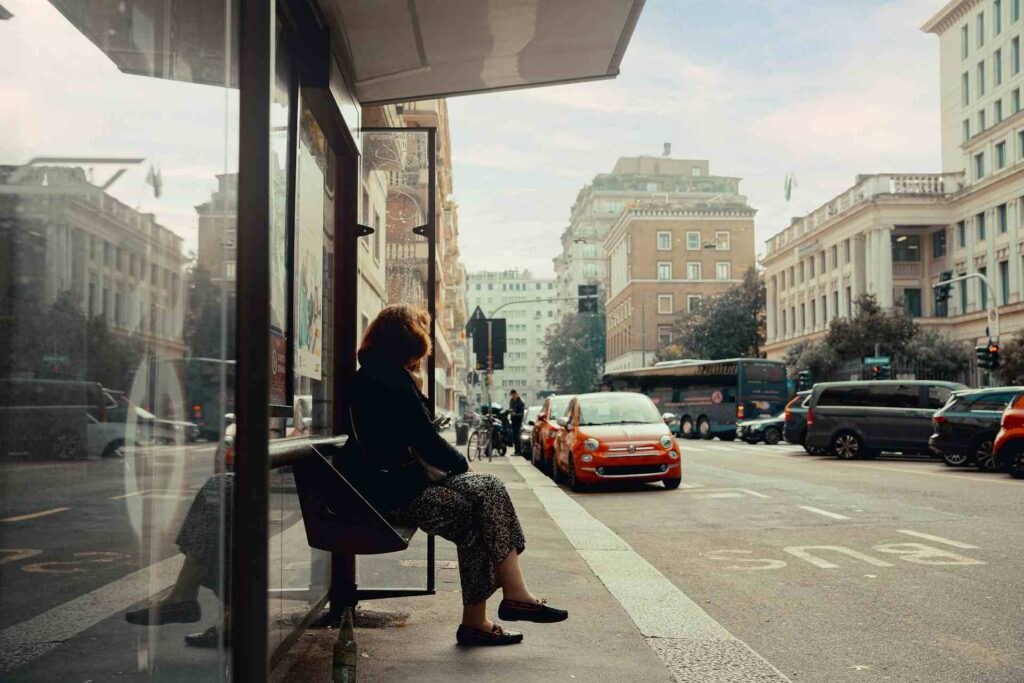
In Italy, public transportation is used little, poorly and by an increasingly small share of the population. According to the new report“Access Denied: TransportPoverty in Europe,” conducted by theOeko-Institut for Greenpeace CEE, 80 percent of Italians use buses, streetcars or trains less than once a month or never. This is the second worst figure in Europe after Cyprus, and it shares this strong criticality with Portugal: in both countries, in fact, more than 75 percent of the population says they never use public transportation. A radically different picture emerges in Switzerland, Luxembourg and Estonia, where more than half of citizens use local public transport on a regular basis instead.
In Italy, getting around thanks to public transport is not always a choice related to the sensitivity of individuals. Even today, in too many areas of the Peninsula, giving up the car means being cut off from essential services.
Is the automobile an essential service?
The report talks about transportpoverty: transport poverty is the inability to reach work, health, education or essential services in an accessible and dignified way. A definition that takes on very concrete contours in Italy, especially outside of large urban centers.
In the country’s inland and peripheral areas, the public transport network suffers from severe deficiencies, including cutbacks in ridership and continuous disruptions. The study shows that the share of the European population that does not use public transportation due to its total absence, low frequency or inadequate schedules peaks precisely in Cyprus with 56 percent, followed by significant percentages in France (29 percent) and Germany (21 percent).
The result is so-called forced car ownership: the car not as a choice, but as an economic obligation that burdens even the most fragile and disadvantaged social groups. Greece is the European country where this economic burden is most widespread (it affects 19 percent of the population), closely followed by Spain and Bulgaria with 10 percent.
It is also an Italian problem, where entire territories have been designed around private mobility: out-of-town shopping centers, hospitals and public services concentrated away from residential neighborhoods. Without a car, one is cut off.
Rare runs, long times, weak security
The research also dismantles the idea that the problem with public transportation is only fares. One aspect that emerges from the report concerns costs: ticket price matters, of course, but what discourages citizens most is the poor quality of service. Between missed rides, difficult connections, and endless travel times, getting around often becomes an undertaking. In countries such as Slovenia, 9 percent of people give up transportation precisely because travel times are excessive, a share that stands at 8 percent in Belgium and 7 percent in Cyprus.
Then there is the issue of safety and physical accessibility, two factors that weigh heavily on the daily lives of women and the elderly. In Italy, 5 percent of the population avoids buses and trains because they do not feel safe or find it too difficult to use them, a percentage identical to that in France, Germany and Belgium. In contrast, the problem touches 10% in Cyprus. In our country, this discomfort manifests itself in isolated stations, poorly lit stops, elevators that are often out of service, and lack of staff. These deficiencies also drive many citizens to rely on the private car. At the European level, the study confirms that women more often forgo public transportation for fear of harassment or theft, while for the over-65s the main obstacle remains architectural barriers.
The link between social justice and the climate crisis
The report highlights a huge challenge for the environmental world: the European Union is pushing to decarbonize transport with the ETS2, which will introduce a tax on fuel and heating emissions. But where public transport doesn’t work, increasing gasoline doesn’t convince people to pollute less-it just turns into a forced expense that affects those who have no alternatives to get to their place of work, study or recreation.
To prevent the green transition from falling on the shoulders of the weakest, Greenpeace proposes structural investments, integrated fares, and affordable “climate tickets.” Some European countries have already moved in this direction: in 2020, Luxembourg zeroed out public transport costs, while Estonia has long introduced free public transport for residents in many areas. “Public transport is not a luxury, but a fundamental tool for leading a decent life,” says Federico Spadini of Greenpeace Italy.