There is something profoundly paradoxical about the idea that sand-the kind that covers our beaches, that settles in deserts, that fills riverbeds-is becoming a scarce resource. Yet that is exactly what is happening. And the United Nations Environment Program (UNEP) has published the report “Sand and Sustainability” to document it: we are extracting more sand than the Earth produces. To be exact, annual consumption is 50 billion tons. With demand set to grow: for the construction sector alone, Unep estimates an increase of up to 45 percent by 2060.
The “living” sand and the “dead” sand
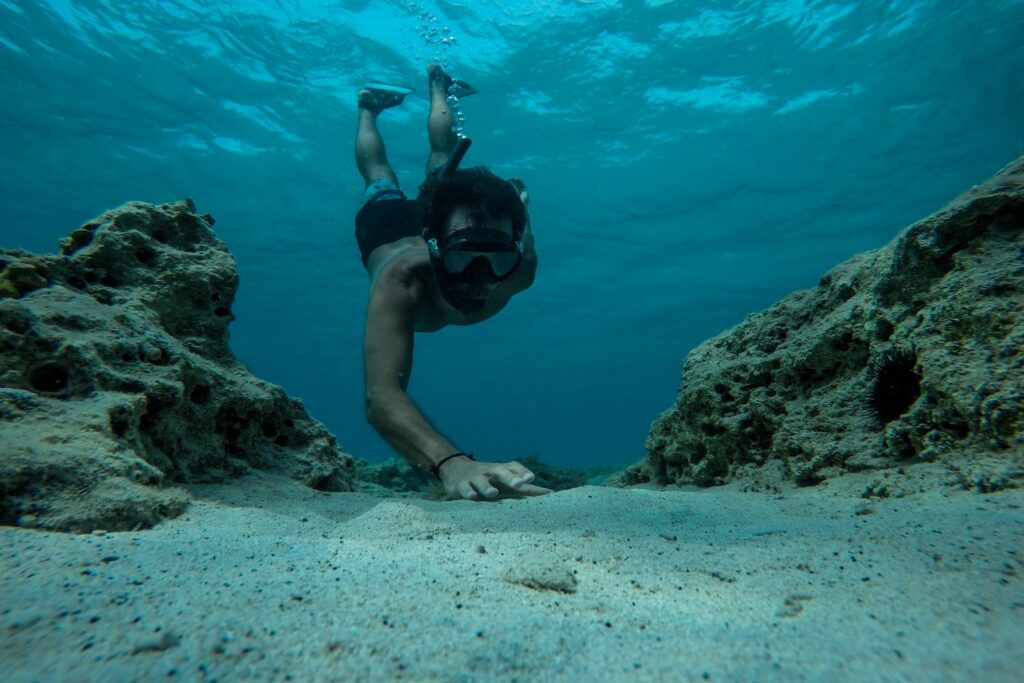
The report introduces an important distinction: there is “living” sand and there is “dead” sand. The first is that which remains in ecosystems, which filters water, protects coastlines from erosion, and is home to fish, turtles, birds and crabs. The second is what we extract and turn into concrete, asphalt and glass: inert materials, permanently removed from the natural cycle.
Live sand decreases, dead sand increases. With the consequences denounced by Pascal Peduzzi, director of the Unep Global Resource Information Database in Geneva: since sand is our first line of defense against sea level rise, storm surges and salinization of coastal water tables, phenomena exacerbated by climate change, having less sand in the right places means we are more exposed. We are dismantling our natural defenses brick by brick, skyscraper by skyscraper, artificial island by artificial island.
And herein lies the most disturbing short-circuit in the affair: coastal erosion, accelerated by sand mining, generates demand for new protective infrastructure-dams, retaining walls, beach nourishment projects-that in turn require huge amounts of sand. A self-destructive loop.
Dredging in protected areas: a normalized anomaly
One of the most puzzling figures in the Unep report concerns marine dredging operations. About half of all dredging companies operate within marine protected areas. Those same areas that governments have formally declared out of bounds for commercial exploitation. Marine protected areas risk becoming, in effect, mining concessions with a nice green logo.
To understand the geopolitical dimensions of the crisis, one need only look at Singapore. The city-state has imported more than 517 million tons of sand since 1990, literally expanding its territory by 25 percent through pond-filling projects to gain land. An urbanistic ambition paid for in large part by neighboring countries, whose rivers and coastlines have been progressively emptied to feed Singapore’s construction sites. So much so that Indonesia, Malaysia, Vietnam and Cambodia have, over time, banned sand exports to the city-state.
Singapore is the most emblematic case, but it is not the only one. The project for the new international airport in Manila, Philippines, has also accumulated delays because of difficulties in finding the quantities of sand needed to fill the shoreline areas. In the Middle East, Dubai’s artificial islands have turned the Persian Gulf seabed into a permanent construction site.
There is also another complicating factor: not all sand is the same. That from deserts, smoothed by the wind over millennia, has grains too smooth and rounded to be used in concrete. It does not bind. In fact, the United Arab Emirates, surrounded by dunes as far as the eye can see, imports sand from Australia for its construction sites. The sand the construction industry needs is the sand from rivers, coastlines and the seabed: granular, angular, capable of aggregation. And it is exactly that which is found in the most delicate and vulnerable ecosystems.
Nature takes hundreds of thousands of years to produce sand through geological erosion. The mining industry consumes it in quarters. It is this time lag that defines the structural nature of the crisis. We are talking about something that the Planet cannot reproduce at the rates that serve the current organization of our industries.
A crisis that does not appear on political agendas
Sand is the second most mined natural resource in the world after water. Yet it does not appear in major international climate agreements, does not figure in the priorities of environmental diplomacy, and is absent from electoral debates. It lacks an international convention to regulate its extraction, trade and use. As the Unep report notes, there are global agreements for biodiversity, for climate, for plastic waste, but nothing equivalent for what the program itself calls“one of the Planet’s most critical and least regulated resources.”
Why this blindness? Partly because sand is historically perceived as abundant and trivial. Partly because the damages of extraction are externalized: the poor coastal communities, the fishermen who lose their bottoms, and the species that inhabit river deltas pay for them, not the skyscraper builders or the governments that commission major works.
What can be done: from circularity to governance
The Unep report does not limit itself to diagnosis: it also outlines some proposals. The first is that of thecircular economy applied to construction: construction debris, hitherto treated as waste for disposal, can become recycled aggregates. The most recent research confirms that recycled concrete, properly processed, can replace between 20 and 30 percent of natural sand without compromising structural strength. The global construction industry generates about three billion tons of rubble each year: if even 30 percent were recovered as aggregate, it would offset 900 million tons of primary extraction.
The second direction is governance. Unep calls for governments to recognize sand as a strategic resource rather than a mere commodity, to price its value by including environmental and social costs, to develop international standards for marine dredging, and to explicitly ban extraction on beaches, which are critical for coastal resilience.
The third, perhaps the most difficult, is cultural: to stop viewing construction activities as resource-neutral. Every square meter of concrete, every kilometer of asphalt, every man-made island has an extractive cost that so far has not been accounted for. It is the same mistake made with CO₂, with plastics, with deforestation: treating the physical limits of the planet as irrelevant externalities, until they become manifest crises.
The speck we don’t see
There is something metaphorical about the fact that the sand crisis is so difficult to see. Sand is an invisible material: it hides in the concrete of buildings, in the asphalt of streets, in the glass of our screens. We carry it with us everywhere without knowing it. And that is perhaps why its disappearance from the seabed, from river deltas, from the coasts of Southeast Asia and West Africa, does not generate the same emotional response as a retreating glacier or a burning forest.
Yet the stakes are very high. Losing live sand means losing the natural defenses of thousands of miles of coastline. It means jeopardizing the food security of those who make their living from fishing in river deltas. It means accelerating erosion just as the sea is advancing. As the Unep report explains, it is a problem of today, not tomorrow.