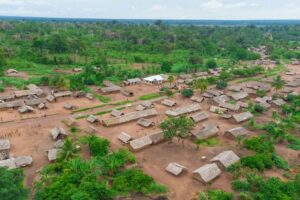
What are a biomaterials research center, a bioplastics factory—the only one of its kind in the world—and a land art installation by one of Italy’s leading artists doing in a small town in the Messina hinterland? In Roccavaldina, a village of just under a thousand residents located 30 kilometers from Messina, the answer is the “Polo Olivettiano”: a local development initiative launched on Friday, July 10, by the Messina Foundation in collaboration with the municipality and partners from the scientific and social economy sectors.
The underlying idea: a rural area can avoid depopulation and job scarcity not through welfare, but through a genuine manufacturing enterprise, linked to research and committed to goals of social and environmental justice. “An innovative experience with a holistic character,” is how Gaetano Giunta, president of the Messina Foundation, describes it. For him, the project demonstrates that the freedom of the most vulnerable, social capital, and sustainability can serve as constraints on the logic of profit maximization.
The factory that turns waste into bioplastic
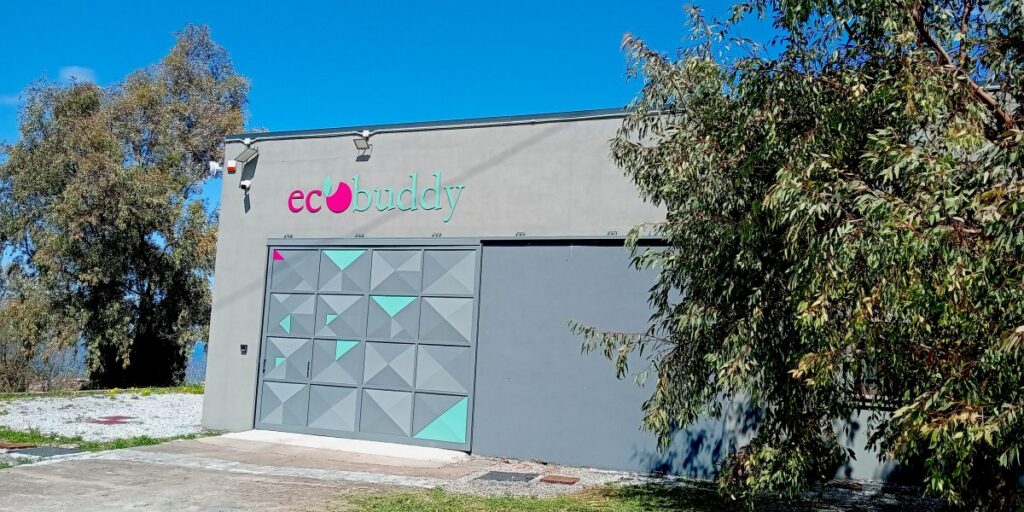
At the heart of it all is Ecobuddy, the facility that transforms local agri-food waste into bioplastic: spent grain from the Messina Brewery and residues from olive oil, citrus, and coffee processing. The production process, the first of its kind, stems from research conducted as part of the European LIFE RESTART project, coordinated by the Foundation in collaboration with the Universities of Messina and Ca’ Foscari in Venice, the Ecomed cooperative, and the Pistoia horticultural district, with the support of Heineken Italia, Clementoni, and Quercetti. EcosMed is responsible for managing the project: new jobs—some reserved for vulnerable individuals—and profits partially reinvested in research and efforts to combat educational poverty.
An ecosystem has grown up around the factory. The co-working space is home to the Terra di Sicilia pasta factory, which processes heirloom grains from Slow Food’s Slow Grains network, and a studio run by designer Francesco Belvisi, where large robots 3D-print macro-objects. In partnership with Enel Cuore and Fondazione Con il Sud, a permanent educational center has been established to promote STEAM knowledge related to the ecological transition.
Energy for Those Who Need It Most
The Hub is also the main renewable energy hub in the area and powers a solidarity-based energy community that distributes electricity according to social algorithms: more energy, at lower costs, to those who need it most. The system, developed in collaboration with the CNR’s ITAE institute and the University of Messina, is connected to Andròn, a digital platform for giving and exchange.
Beauty is also part of the project: the co-working space’s solar panels form “Maternità,” a mosaic of cells designed by Agostino Ferrari and curated by Martina Corgnati. And on Saturday, July 11, in Novara di Sicilia, “Segno forma” was unveiled—a white photovoltaic pyramid facing the Aeolian Islands—as part of the Horcynus Festival 2026 program.