Usually at the end of winter or in the spring, the sky over Italy, Spain, France, and Greece takes on an unnatural hue: a pale yellow, almost a diluted orange, that filters the sunlight and leaves a reddish dust film on cars and windowsills. Most people notice how unsightly it is, wonder when the right time will be to wash their car, and then forget about it. Yet that dust isn’t just dirt: it’s a message written in millions of particles, some of which are alive.
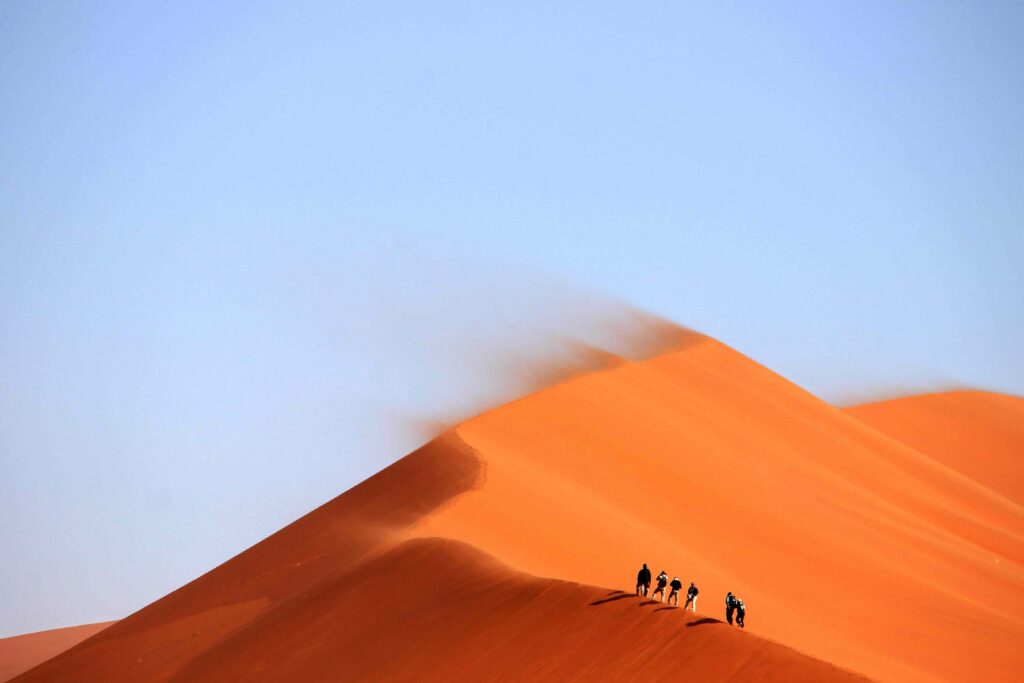
Saharan dust is a well-known phenomenon in meteorology and atmospheric sciences, but its biological impact is much less understood by the general public. The Sahara is the world’s largest hot desert and the primary source of mineral dust in the Northern Hemisphere: the Sahara-Sahel regions of North Africa account for between 50 and 75% of the global estimate of aerosol dust in the atmosphere, releasing up to one billion metric tons each year. These particles are carried by the wind, enter the troposphere, travel thousands of kilometers, and settle everywhere: over the Mediterranean, Central Europe, the Amazon rainforest, the Greater Antilles, and the Gulf of Mexico.
But the news is that these dust particles carry stowaways: bacteria, fungal spores, pollen grains, and fragments of biological material that have left the desert and are now settling on European soils, perhaps altering their microbial composition in ways that researchers are only beginning to understand.
To understand the scale of this phenomenon, imagine atmospheric currents as intercontinental highways connecting the heart of the African desert to every corner of the planet. Saharan sandstorms form when strong winds lift enormous quantities of particles from the desert floor. Depending on atmospheric circulation patterns, these particles can enter the upper troposphere and remain there for days, even weeks, traveling thousands of kilometers before settling.
The Invisible Passengers: Bacteria, Spores, and Fungi
What makes this phenomenon particularly fascinating—and in some ways unsettling—is its biological component. Saharan dust is not sterile: it acts as a vehicle for the global transport of microorganisms, including potential pathogens. Among the bacterial species identified in scientific studies conducted on these events are genera that are extremely diverse in origin and characteristics: Bacillus (widespread in deserts and a known pathogen for animals and plants), Escherichia (identified in African dust intrusions in southern Spain), Staphylococcus (a component of the desert soil microbiome and an antibiotic-resistant nosocomial pathogen), Sphingomonas (reported in North African desert dust and in the Middle East), Deinococcus and Pontibacter (previously identified in Saharan soils and dust).
In the so-called “red rains”—precipitation colored by Saharan dust that stains surfaces a brick-red hue—researchers have identified an even wider variety of biological material: in addition to bacteria, fungal spores, biofilms, pollen grains, and even nanoteres—nanometer-scale structures whose nature and effects on the ecosystem remain largely unexplored.
Surviving in Extreme Conditions: The Art of Saharan Extremophiles
How do these microorganisms survive such a long and hostile journey? The atmosphere is one of the most extreme environments on Earth: microorganisms inhabiting the troposphere are exposed to more intense ultraviolet radiation, drying conditions, freezing temperatures, and a much more severe lack of nutrients than in any other habitat. Yet some species have developed extraordinary survival strategies.
The ability to form endospores—dormant, nearly impermeable structures that protect genetic material and essential cellular components—is one of the keys to the success of genera such as Bacillus. These structures can remain viable even after weeks of exposure to atmospheric conditions and then “wake up” as soon as conditions become favorable, such as when the particles settle on moist, nutrient-rich soil.
European soil as the final destination
When the particles settle, they bring with them a twofold contribution: mineral and biological. The mineral aspect has been studied for much longer: Saharan dust enriches soils with iron, phosphorus, and other essential micronutrients. This mechanism contributes to the fertility of ecosystems far from Africa, including the Amazon rainforest, which regularly receives minerals from the Sahara across the Atlantic. But the biological contribution is much less studied and potentially just as significant.
Some of the microorganisms carried by dust particles can survive and remain viable in the local ecosystems where the aerosols settle. Highly resilient microbial communities may contain potentially harmful pathogens: this is the main concern of public health researchers. However, current research paints a more nuanced picture.
As part of its science outreach efforts, Copernicus clarifies that the transport of microorganisms by Saharan dust should not be a cause for immediate alarm, since airborne bacteria and viruses are a normal part of the atmosphere. The critical factor is not presence but concentration: for a pathogen to cause harm, it must reach sufficient levels in the air we breathe. However, there are documented exceptions: in particular, there is evidence that the transport of Saharan dust has contributed to diseases in Caribbean coral reefs, with fungal spores originating in Africa responsible for outbreaks affecting Gorgonia ventalina.
Climate Amplification: A Growing Trend
While the phenomenon has always existed, what concerns the scientific community is its intensification. The 2020–2024 seasons saw episodes of unprecedented intensity and duration. In March 2022, in particular, an exceptional event occurred that broke every record, affecting Western and Central Europe in an unprecedented way.
Desertification and droughts associated with global warming can increase the amount of dust available for atmospheric transport. Unsustainable use of water and soil also contributes to rising dust levels. The United Nations General Assembly has designated the decade 2025–2034 as the Decade for Combating Sand and Dust Storms, underscoring the urgency of global cooperation. July 12 has been designated as the International Day to Combat Sand and Dust Storms, with the aim of raising public awareness about the effects of these events on health, agriculture, transportation, and the environment.
Health, Ecosystems, and the Issue of Regulation
From a health perspective, particles with a diameter of less than 10 micrometers (PM10) can penetrate the lower respiratory tract, causing respiratory problems, while ultrafine particles with a diameter of less than 2.5 micrometers (PM2.5) can reach the bronchi and contribute to chronic bronchitis or asthma. The most vulnerable populations—the elderly, children, and people with pre-existing respiratory or cardiovascular conditions—are most at risk during episodes of high concentration.
In addition to direct risks to human health, Saharan dust affects aviation visibility, reduces the performance of solar panels by coating their surfaces, and alters the chemical and biological composition of bodies of water where it settles. In Italy, every year, the southern regions—and in particular Sicily, Sardinia, and Puglia—are among the areas most affected, with episodes occurring mainly between February and May, peaking during the period of peak Scirocco wind activity.
This phenomenon reminds us how little significance the borders we draw on a map have for natural processes. The atmosphere knows no borders: it connects the Sahel with Scandinavia, the dunes of Mauritania with the fields of Padania, and the heart of Africa with the depths of the Caribbean Sea. In a world where climate change is altering global atmospheric conditions, accelerating desertification, and intensifying dust transport events, this connection is bound to become more pronounced, not less so.