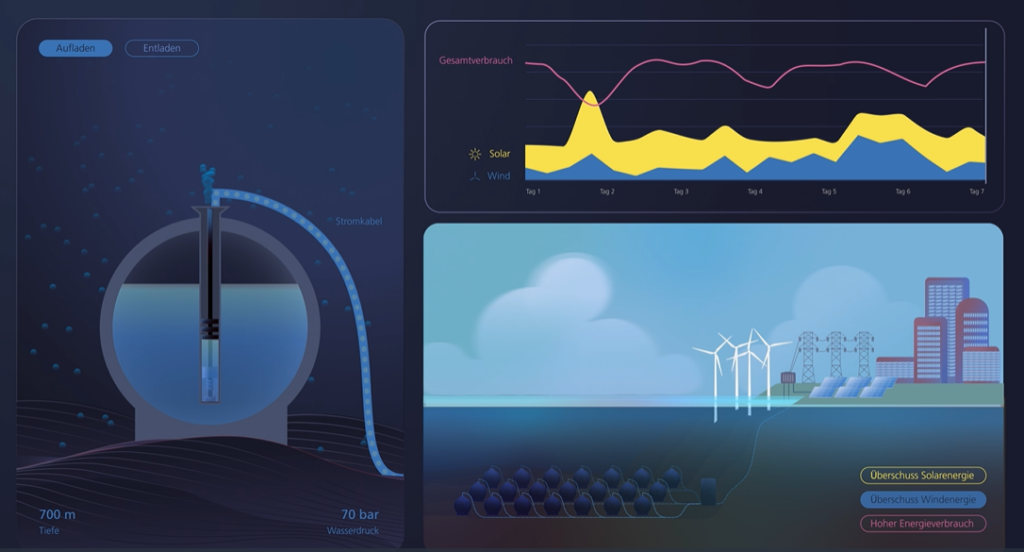
Generating electricity—plenty of it, and clean—is a wonderful thing. But then there’s the problem of storing it, because, as we’ve all learned by now, the power grid must receive exactly the same amount of energy that businesses and residents demand, second by second. When there’s plenty of sun and wind, solar panels and wind turbines generate a huge amount of clean, nearly free electricity—but in reality, at least some of it goes to waste. How can this be solved? With storage systems. One we’re very familiar with is batteries, but scientists and industries are constantly trying to find new solutions. One of the strangest ideas (perhaps) is “underwater pumped-storage,” which the Chinese are currently testing using underwater spheres.
“Gravity-fed” pumping is the traditional method. This method uses the difference in elevation to store electrical energy. When there is a surplus of energy, it is used to power pumps that carry water upward into a hydroelectric reservoir. Then, when we need electricity, we let the water from the reservoir flow down through the turbines, and we “recover” the energy.
How it works
Underwater pumped-storage replaces the difference in elevation with water pressure. Imagine a hollow sphere anchored to the bottom of the sea or a reservoir in a lake. Well, it is emptied using special pumps when the grid has excess energy and filled in a matter of seconds when electricity is needed. In China, at Minhu Lake in Fujian Province, Dongfang Electric has just completed a ten-day test on a kilowatt-scale demonstration unit, Dongchu 1, at a depth of 65 meters. Over one hundred charge and discharge cycles verified the unit’s integrity, stability, and energy conversion efficiency.
This principle is well known in hydraulics: the deeper the water, the greater the pressure—and thus the greater the amount of useful work that can be obtained by allowing it to flow back into a low-pressure chamber. In practice, the sphere acts as a self-contained lower reservoir, while the surrounding water serves as the natural upper reservoir. During periods of low electricity demand, surplus energy drives pumps that empty the sphere, creating a sealed volume with very low internal pressure. When demand rises, a valve opens and the pressure difference causes the water to rush back into the sphere, driving a turbine that generates electricity. For the Chinese, this is a way to circumvent the land and geographical constraints of traditional pumped-storage, with the potential to integrate with offshore wind power, which requires flexibility.
The First Prototypes
It’s not just a Chinese idea. In Europe, the most advanced project is StEnSea, developed by Germany’s Fraunhofer Institute: modular concrete spheres anchored at depths of between 600 and 800 meters that can be grouped into arrays. Following a 1:10 scale prototype in Lake Constance, the StEnSea 2.0 plan calls for a larger demonstrator off the coast of California by the end of this year to test logistics, installation, and the wear and tear of the spheres and turbomachinery.
It seems like a nice, elegant solution, but there’s still a lot of work to be done. We need to see how well these systems will hold up in the extremely challenging marine environment, how much long-term maintenance will cost to prevent erosion and problems caused by mussels and barnacles, and how much it will cost to install the hollow spheres and everything else needed. It’s certainly worth a try, given that dams and hydroelectric reservoirs have a major impact on nature and the landscape.
Fraunhofer estimates investments in the range of hundreds of euros per kWh for pilot plants, with operating costs to be verified in the field. An academic study based on StEnSea projected 2.2 GWh of capacity at 750 meters for 120 modules, with installation costs of around 940 million euros. These figures are (for now) economically unrealistic for envisioning an industrial supply chain.