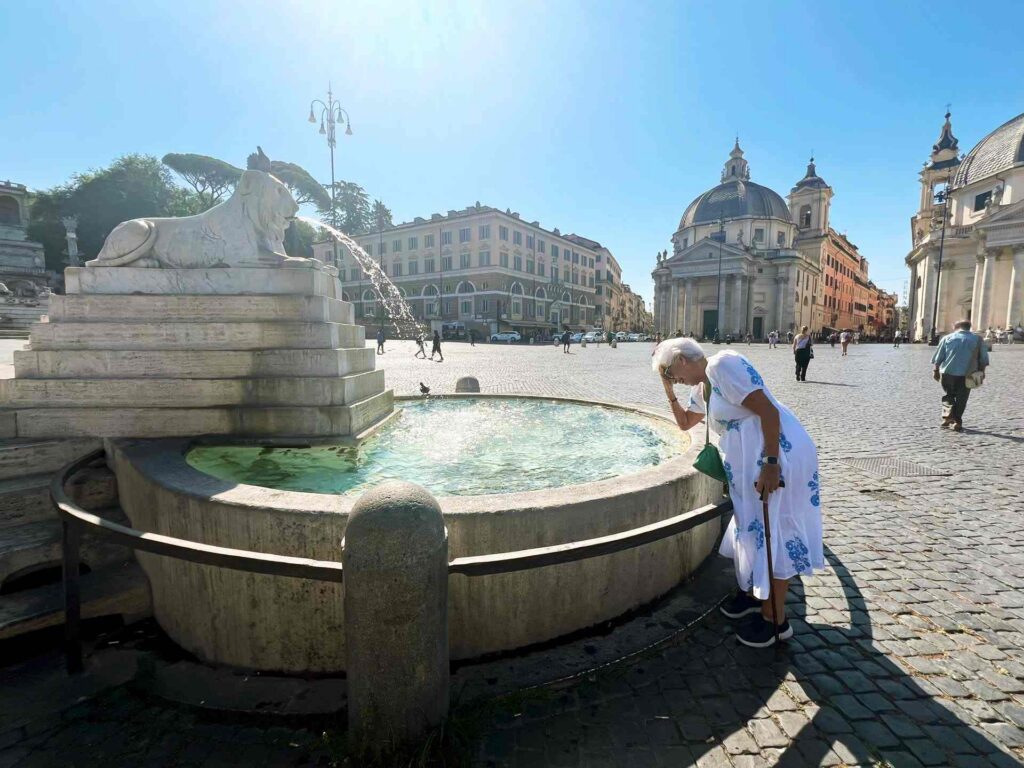
In the countries of what used to be called the West, we have a strange notion of security. We claim it as an innate right, and we struggle to accept the idea that a certain degree of risk is inherent in human existence. And so we transform the concept of security from a philosophical and scientific calculation into a dogma of civic faith. Yet we remain blind to the greatest threat of all: that of a radical transformation that would make survival on this planet—home to 8 billion human beings—extremely difficult due to the increase in droughts, floods, disruptions to production systems, and tensions that tend to escalate into wars.
In no other field of scientific analysis is there a similar suppression of research as that affecting the work of climatologists. Through half a century of patient effort, the scientific community has come to analyze and understand the dynamics of a complex system—the atmosphere—which is under stress from the forced and increasing (and still rising) release of greenhouse gases. Over this long period, it has produced tens of thousands of pages of reports predicting the consequences of rising concentrations of these gases, starting with CO2 and methane.
What we are seeing these days is nothing more than a glimpse of the future that climatologists had predicted. Not the worst-case scenario. It corresponds to a global temperature increase of about one and a half degrees compared to the start of the Industrial Revolution (roughly half of the warming projected based on current trends).
Trump and his many Italian imitators would say that a rise of one and a half degrees saves on home heating costs and that a few extra days at the beach are good for tourism. The reality is a bit different. The WHO (World Health Organization) has conservatively estimated that since June 21, there have been more than 1,300 excess deaths linked to high temperatures in Europe. But according to a study publishedby *The Economist* based on the London School of Hygiene’s “Masselot model,” between June 24 and 26 alone, the extreme heat may have caused approximately 12,000 excess deaths across Europe.
Europe is the fastest-warming continent on Earth, heating at twice the global average. Right now 150 million people are living under extreme heat, hundreds have died, schools are shut, grids are buckling.
— Tedros Adhanom Ghebreyesus (@DrTedros) June 28, 2026
Driven by climate change and global warming, the phenomenon of the…
Italy is among the countries most vulnerable to climate-related risks. On June 28, none of the 27 Italian cities monitored by the Ministry of Health as part of the National Plan for the Prevention of Heat-Related Health Effects were in good condition: 18 were at red alert (level 3, emergency) and 6 were at orange alert. At the pediatric emergency room at the Bambino Gesù Hospital in Rome, one in four visits was attributed to high temperatures.
Obviously, this situation is having a severe impact on the economy. According to an analysis by Italy for Climate, climate-related damage in Europe between 1980 and 2025 amounts to 812 billion euros. But the most concerning aspect is that, of these 812 billion, over 200 billion—more than a quarter of the total—have occurred in the last four years. The escalation is clear.
The scale of the climate risk is clear. Yet almost all the commentary on these events avoids naming the root cause of the problem: the reckless use of fossil fuels and deforestation. This attitude is consistent with Trump’s denial of the problem and with the effort—in which Italy is at the forefront—to slow down the ecological transition that is the solution to the problem.
We have increasingly strict rules regarding minor risks, yet we still fail to take action when faced with the greatest risk. As Trump would say: Is it hot? Buy a fan.