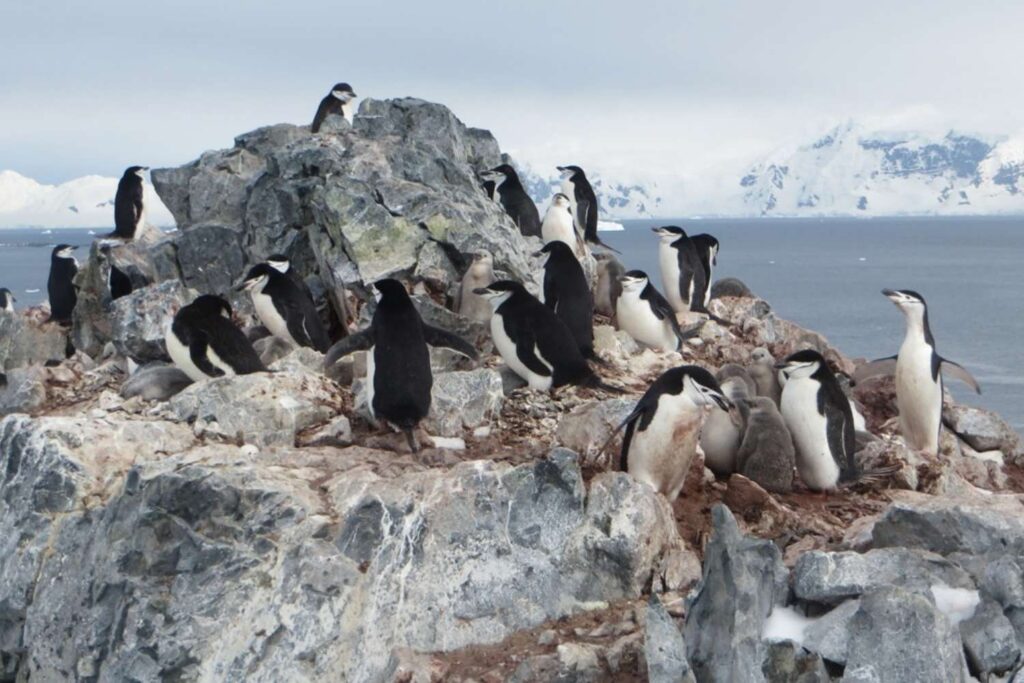
In 2011, Zavodovski—a deserted volcanic island in the South Atlantic and the northernmost of the South Sandwich Islands— was home to the largest penguin colony on the planet: 600,000 chinstrap penguins (Pygoscelis antarcticus) and 90,000 macaroni penguins (Eudyptes chrysolophus). Fourteen years later, that record has been surpassed elsewhere. A study by the British Antarctic Survey and other institutions, published in *Current Biology*, estimates that the number of chinstrap penguin breeding pairs has fallen from 542,675 to 201,182 between 2011 and 2025: a 62.93% decline. “A massive population collapse,” as Norman Ratcliffe, who led the research, described it to The Guardian.
A Count from Above
The researchers counted the pairs: each nest occupied by a bird or a brooding pair counts as one. In December 2023, six of them landed on the island and flew over the colonies with a drone. A computer program counted the nests in the images, and the results were verified across 114 sample areas. A comparison with satellite images taken between 2011 and 2025 showed that the area occupied by chinstrap penguins is shrinking by 9.46% each year at a steady rate. For the population, this means a decline of about 7% per year.
The steady rhythm is also one of the clues that rule out other explanations. Mount Curry, the island’s volcano, erupted in March 2016, but the decline had already begun and there were no tremors following the eruption; a catastrophe caused by ash and gas would have left a sudden spike in the data. Furthermore, the penguins avoid the plain at the foot of the crater. Industrial fishing for
Krill, the small crustacean on which they feed, has always been scarce in the area and disappeared entirely in the early 1990s. Humpback whales, whose numbers have returned to pre-whaling levels, consume between 19% and 29% of the krill in the management area, but they frequent waters farther offshore than those where penguins forage during the breeding season. As for the macaroni penguins, the other species on the island, there are large abandoned nesting areas around the colonies: there is no shortage of space, so competition is minimal.
Krill are moving south
The authors believe the most likely cause is global warming. The krill have shifted southward, and chinstrap penguins—which feed almost exclusively on krill—are finding less of it. Satellite trackers attached to twelve penguins show that they are hunting in cold waters northwest of the island. The region is warming rapidly: according to The Guardian, winter temperatures on the Antarctic Peninsula have risen by 5 degrees compared to pre-industrial levels, and on June 6, the Argentine Esperanza Station recorded 15.4 degrees—about 20 degrees above the seasonal average—a figure scientists have called “crazy”.
Macaroni, on the other hand, have a more varied diet, which includes fish and other crustaceans, and they hunt in the warmer waters to the northeast. Their numbers rose from 168,936 pairs in 2011 to 216,606 in 2025, with a 28.22% increase concentrated through 2016.
A species to be reclassified
The Australian Sandwich Islands are home to about 38% of the world’s chinstrap penguins, and until now, the species was believed to be safe there. If the decline observed by Zavodovski were true for the entire archipelago, 95.8% of projections over three generations (28 years) would fall into the “Endangered” category of the International Union for Conservation of Nature (IUCN). Today, the species is classified as “least concern,” the lowest risk level.
The picture remains incomplete. The islands of Candlemas, Visokoi, and Saunders—which each hosted more than 150,000 breeding pairs in 2011—have not been re-surveyed, and the authors are calling for new censuses.