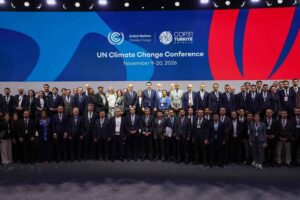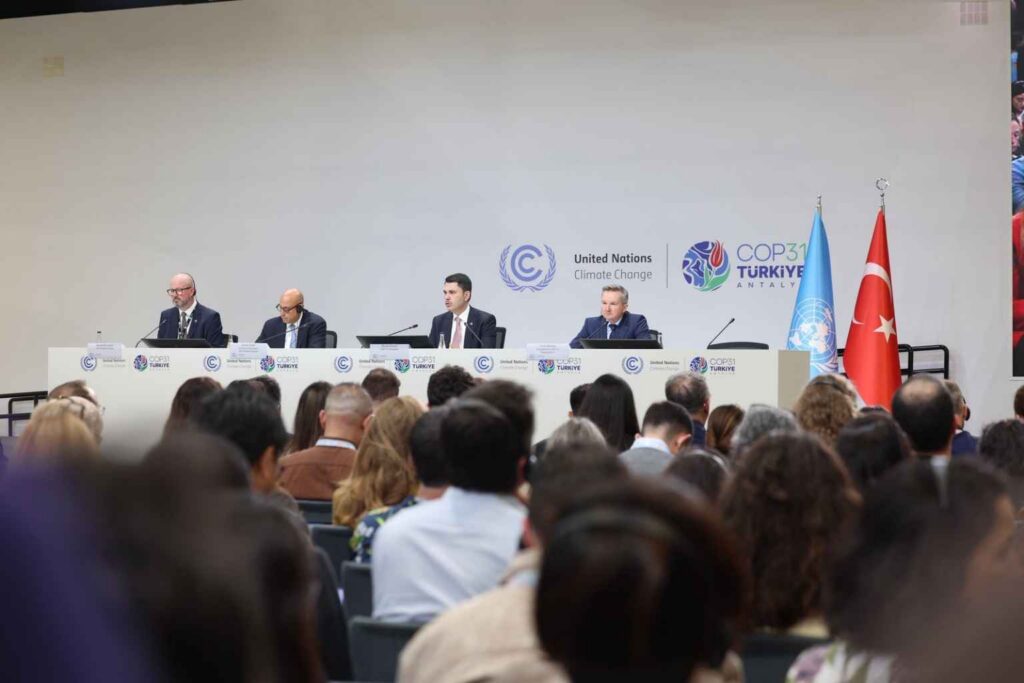
Stopping the clock is the last resort for a COP that has reached the final day of its two-week session and has failed to reach a conclusion acceptable as a lowest common denominator among the parties. And so, with some texts approved around 8:00 p.m., the conclusion has been postponed until Saturday—if not Sunday. That is, if there is a conclusion at all, of course, because there is also the possibility—slim, but not entirely out of the question—that no agreement will be reached at all. And for the great enemy of multilateralism, Donald Trump, who withdrew from the UNFCCC after pulling out (for the second time) of the Paris Agreement, that would be a great gift. But such is life. Mala tempora currunt.
Yet, at a COP dominated by the obstructionism of oil-producing countries—Saudi Arabia and its ally Russia, first and foremost—and by the European Union’s coolness toward requests for additional funds for adaptation and loss and damage coming from countries in the Global South, there are some positive developments. Some refuse to accept inaction and negotiation texts that do not even dare to mention fossil fuels, and are pursuing a parallel path that is more active and concrete. While the majority refuses to move forward, there are pioneers exploring a bolder approach to the energy transition. This is the reality for those who refuse to give up.
The “Spirit of Santa Marta”
The “Spirit of Santa Marta” has arrived at COP31. The Colombian city, which in April hosted the first conference dedicated to phasing out fossil fuels, has found concrete support: 25 countries have announced that they have already approved—or are in the process of approving—a national plan for the so-called TAFF (Transition Away from Fossil Fuels).
Stientje van Veldhoven, who chaired the Santa Marta Conference in April and serves as the Dutch Minister of Climate, took credit for the outcome. “The time for waiting is over; now is the time to act,” she said. “What’s happening in the real world goes far beyond what can be written in COP documents. If some want to slow down, we want to speed up—and not just with words. We need this transition to reduce our environmental impact and lower energy prices in our countries.”
Progress outside the COP
According to van Veldhoven, the numbers speak for themselves: at last year’s COP, there were zero national plans, while at the Santa Marta launch six months ago, there was only one—France’s. “This is enormous progress.” The minister then emphasized that simply adding a few renewable energy plants is not enough: “We must break free from our dependence on oil, coal, and gas.” Among the participating countries are Germany, France, Great Britain, the Netherlands, Denmark, Panama, Brazil, Indonesia, Ireland, Sweden, Spain, Portugal, Iceland, Switzerland, Finland, Norway, the Marshall Islands, Tuvalu, Vanuatu, and Fiji.
“There are so many of us,” she added. “We are proof that, despite those who are holding us back, there is genuine ambition and tremendous momentum toward the transition—one that extends beyond our group.” This is demonstrated, she concluded, by what is happening at COP31, where nearly one hundred events dedicated specifically to phasing out fossil fuels have been organized. And unfortunately, at least for now, Italy is not among the 25 countries, even though Environment Minister Gilberto Pichetto Fratin has said that our country will request that the TAFF pathway be included in the cover decision and has not ruled out the possibility that we, like many other European countries, might decide to join the effort.
“The government will decide,” was his assessment. In other words, if anything, the next government will handle it. And many observers are closely watching these developments, which seem to be solidifying the Santa Marta initiative that brings together the pioneers of the energy transition. “This is a clear demonstration by many countries, including the Netherlands, Germany, France, Brazil, Panama, and Guatemala,” notes Matt Webb, Associate Director of Global Clean Power Diplomacy at the E3G think tank, “that it is essential to take action to accelerate the transition away from fossil fuels by continuing the roadmap process, and that this must be reflected in the overall outcomes of COP31 in Antalya. Approving the TAFF plans is a sign that there are those who refuse to accept the extremely slow pace of the process and want to push it forward. This can only be a good thing, especially if many other countries join in.” Italy, are you in? Not really, at the moment.